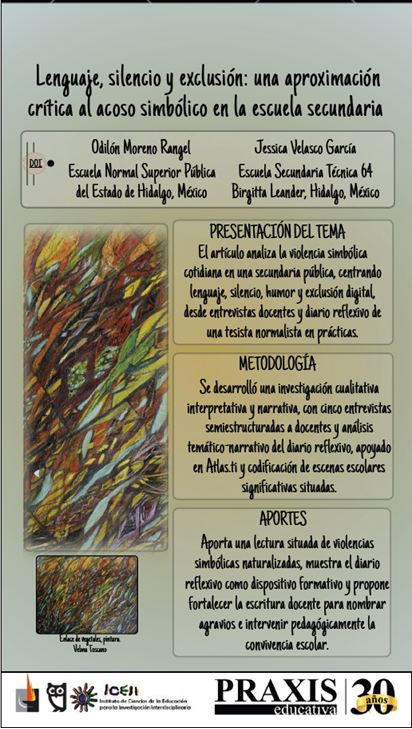
Lenguage, silence, and exclusion: a critical approach to symbolic bullyng in secondary school
DOI:
https://doi.org/10.19137/praxiseducativa-2026-300223Abstract
The article presents a critical approach to symbolic violence in secondary schools, based on a situated qualitative research project co-authored by a teacher education student and her thesis advisor during the professional practicum process. Through the use of a reflective journal and interviews with teachers, the study identified everyday forms of exclusion that operate through language, silence, humor, and digital technologies. The findings reveal that these symbolic violences are normalized and rarely questioned, both by students and by teachers, whose interventions often focus more on control than on reflection. The article argues that these forms of violence are linked to modern school structures that hierarchize knowledge and silence subjectivities. From a decolonial, feminist, and critical pedagogical perspective, the article defends reflective writing as a tool for epistemic interruption and symbolic resistance. It concludes that schools must be reconfigured as spaces of situated truth, where subaltern voices are heard and embodied knowledge is legitimized. The research proposes the integration of the reflective journal as a pedagogical device in teacher education, to enable the narration of what hurts, discomforts, or remains silenced, thus advancing toward a pedagogy of difference and symbolic restitution.
Downloads
References
Belausteguigoitia, M. (2018). Theory as interruption: what inter(re)feres = La teoría como interrupción: lo que se atraviesa. Camino Real, 10(13), 105–116.
Braun, V., & Clarke, V. (2006). Using thematic analysis in psychology. Qualitative Research in Psychology, 3(2), 77–101. https://doi.org/10.1191/1478088706qp063oa
Freire, P. (1970). Pedagogía del oprimido. Siglo XXI Editores.
García-Piña, C. A., & Posadas-Pedraza, S. (2018). Acoso escolar: De lo tradicional a un enfoque integral. Acta Pediátrica de México, 39(2), 190–201. https://doi.org/10.18233/apm39no2pp190-2011579
Gentili, P. (2011). Pedagogía de la igualdad: Ensayos contra la educación excluyente. CLACSO.
Gómez-Gloria, J., & Chaparro, A. (2021). La convivencia en el contexto de pandemia: Experiencia de docentes de secundaria. Sinéctica, Revista Electrónica de Educación, (57), e1276. https://doi.org/10.31391/S2007-7033(2021)0057-016
Litichever, L., & Fridman, D. L. (2021). Convivencia escolar antes y durante la pandemia. Análisis de la experiencia escolar y las prácticas de participación desde las voces del estudiantado. Sinéctica, Revista Electrónica de Educación, (57), e1248. https://doi.org/10.31391/S2007-7033(2021)0057-010
Livingstone, S., & Sefton-Green, J. (2016). The class: Living and learning in the digital age. New York University Press.
Mendoza, B., Pérez-Maldonado, H., Domínguez Medina, J. M., & Román de la Vega, M. (2022). Roles de participación en el bullying y episodios violentos en la interacción profesor-alumno. Revista Electrónica de Investigación Educativa, 24, e25, 1–16. https://doi.org/10.24320/redie.2022.24.e25.4240
Mendoza González, B., & Barrera Baca, A. (2018). Gestión de la convivencia escolar en educación básica: Percepción de los padres. Revista Electrónica de Investigación Educativa, 20(2), 93–102. https://doi.org/10.24320/redie.2018.20.2.1729
Muñoz-Matías, J. M., Vergara-Lope, S., & Hevia-de-la-Jara, F. J. (2024). Impacto de los aprendizajes básicos de ciudadanía en la manifestación de violencia escolar en contextos de violencia. Evidencias de una ciudad mexicana. Sinéctica, Revista Electrónica de Educación, (63), e1630. https://doi.org/10.31391/S2007-7033(2024)0063-008
Paredes, J. (2010). Hilando fino desde el feminismo comunitario. Mujeres Creando Comunidad.
Patierno, N. (2020). Violencia y autoridad en la escuela secundaria: ¿Jóvenes “violentos” o adultos ausentes? Perfiles Educativos, 42(168), 10–27. https://doi.org/10.22201/iisue.24486167e.2020.168.59221
Pacheco-Salazar, B. (2018). Violencia escolar: La perspectiva de estudiantes y docentes. Revista Electrónica de Investigación Educativa, 20(1), 112–121. https://doi.org/10.24320/redie.2018.20.1.1523
Pavez, I., & García-Béjar, L. (2020). Ciberacoso desde la perspectiva docente: Discursos, percepciones y estrategias de profesores en dos ciudades de Chile y México. Perfiles Educativos, 42(168), 28–41. https://doi.org/10.22201/iisue.24486167e.2020.168.58850
Pineau, P., Dussel, I., & Caruso, M. (2001). La escuela como máquina de educar: Tres escritos sobre un proyecto de la modernidad. Paidós.
Reyes-Angona, S., Gudiño Paredes, S., & Fernández-Cárdenas, J. M. (2018). Violencia escolar en Michoacán y Nuevo León, un diagnóstico situado para promover escuelas seguras en educación básica. Revista Electrónica de Investigación Educativa, 20(2), 46–58. https://doi.org/10.24320/redie.2018.20.2.1548
Santos, B. de S. (2009). Una epistemología del Sur: La reinvención del conocimiento y la emancipación social. Siglo XXI Editores.
Segato, R. L. (2018). Contra-pedagogías de la crueldad. Prometeo Libros.
Skliar, C. (2017). Pedagogías de las diferencias. Noveduc.
Walsh, C. (Ed.). (2013). Pedagogías decoloniales: Prácticas insurgentes de resistir, (re)existir y (re)vivir (Tomo I). Abya-Yala.
Published
Issue
Section
License
Copyright (c) 2026 Odilón Moreno Rangel, Jessica Velasco García

This work is licensed under a Creative Commons Attribution-NonCommercial-ShareAlike 4.0 International License.
Copyright Notice
Editorial Committee Educational Praxis Magazine:
I hereby declare that I am the author of the article titled (article name), that it is original and my own and that it was not previously published in any other format or medium. I declare to know that the magazine will not charge me any type of fee under any circumstances, nor will I receive any type of monetary compensation If it were accepted for publication in Educational Praxis, I authorize the aforementioned magazine to publish it digitally and to advertise it on its social networks.
If the work is published, I adhere to the Creative Commons license called "Attribution - Non-Commercial Share Alike CC BY-NC-SA", through which it is allowed to copy, reproduce, distribute, publicly communicate the work and generate derivative works, as long as when the original author is cited and acknowledged. This license has been used since September 2018. In 2016 CC BY NC ND 4.0 was adhered to; and in the years 2017 and 2018 (January-August) CC BY NC 4.0.
This CC BY-NC-SA Share Alike license does not, however, permit commercial use of the work. As an author, the journal may establish additional agreements for the non-exclusive distribution of the version of the work published in the journal, it allows me to self-archive the published articles, in their post-print version, in institutional, thematic repositories, personal web pages or any other relevant use. with the recognition of having been first published in this journal.
Educational Praxis adheres to DORA (Declaration on Research Assessment) signed in San Francisco, California, on December 16, 2012, and to the Declaration of Mexico (Joint Declaration LATINDEX - REDALYC - CLACSO - IBICT).









_(1)2.png)


3.png)








_(2).png)






2.jpg)