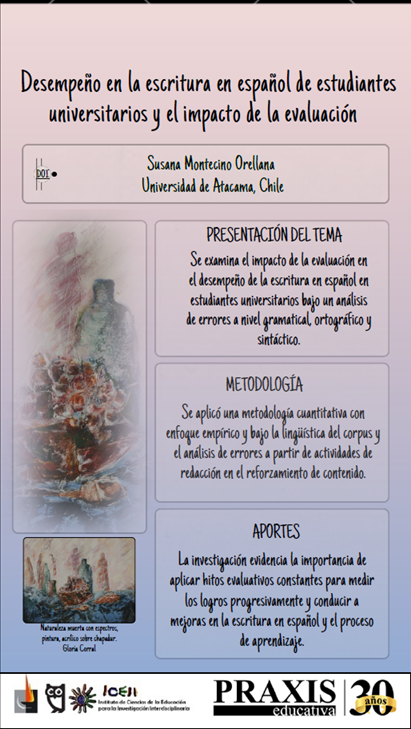
PERFORMANCE IN SPANISH WRITING OF UNDERGRADUATE STUDENTS AND THE IMPACT OF EVALUATION
DOI:
https://doi.org/10.19137/praxiseducativa-2026-300215Keywords:
Writing; evaluation; higher education; error analysis; corpus linguistics.Abstract
Spanish writing represents a complex process since linguistic norms are contemplated and which are adapted to grammatical, syntactic, semantic aspects, etc. One way of assessing the performance of this competence is by evaluating under the error analysis method. This investigation is framed in a quantitative methodology with a descriptive approach under corpus linguistics and error analysis to identify which are the most frequent errors in Spanish writing by undergraduate students and to verify whether evaluation really impacts the performance of such skill. Findings note that the most frequent errors are those with a spelling and punctuation nature and that the evaluation component does have an influence on Spanish writing performance. Thus, the evaluation enjoys a prominent position since it places the student in a conscious and responsible role before the challenges proposed in the classroom.
Downloads
References
Anaya-Figueroa, T. M., Brito-Garcías, J. G. y Montalvo-Castro, J. (2023). Retos de la Escritura Académica en estudiantes universitarios: una revisión de la literatura. Revista Conrado, 19(91), 86-94.
Chimenti, M. de los Ángeles, y Tonani, J. (2024). Escribir en la escuela: una revisión sistemática de propuestas de enseñanza implementadas en el nivel secundario. REXE- Revista De Estudios Y Experiencias En Educación, 23(51), 12–31. https://doi.org/10.21703/rexe.v23i51.1722
Colantonio, C. (2023). El uso de corpus lingüísticos con fines pedagógicos: el caso de SEAH PROJECT. Revista de lingüística teórica y aplicada, 61(1), 75-92. https://dx.doi.org/10.29393/rla61-3uccc10003
Contreras-Wise, A. (2020). Análisis de los errores ortográficos en la escritura de los estudiantes de herencia. Cuadernos de Lingüística Hispánica, (36), 59-78.
Espinoza Freire, E. E. (2022). La evaluación de los aprendizajes. Revista Conrado, 18(85), 120-127.
Fernández, S. (1997): Interlengua y análisis de errores en el aprendizaje del español como lengua extranjera. Madrid: Edelsa.
Ferreira Cabrera, A., Blanco San Martín, L., y Elejalde, J. (2023). Dificultades en la precisión ortográfica de palabras agudas en la escritura académica de estudiantes del sistema educacional chileno. Revista Sophia Austral, 29, 4. https://doi.org/10.22352/SAUSTRAL20232904
Gómez Camacho, A., y Gómez del Castillo, M. T. (2015). Escritura ortográfica y mensajes de texto en estudiantes universitarios. Perfiles Educativos, XXXVII (150), 91-104.
Granados Ramos, D. E., y Torres Morales, P. (2016). Errores de escritura en español en niños de tercer grado de educación primaria. Pensamiento Psicológico, 14(2), 12. https://doi.org/10.11144/Javerianacali.PPSI14-2.eeen
Hidalgo, N., y Murillo, F. J. (2017). Las Concepciones sobre el Proceso de Evaluación del Aprendizaje de los Estudiantes. REICE. Revista Iberoamericana Sobre Calidad, Eficacia Y Cambio En Educación, 15(1). https://doi.org/10.15366/reice2017.15.1.007
Leal, F., Matute, E., y Zarabozo, D. (2005). La transparencia del sistema ortográfico del español de México y su efecto en el aprendizaje de la escritura. Estudios de lingüística aplicada, 23(42), 127-145.
Maury-Sintjago, E., y Rodríguez-Fernández, A. (2020). Problemas ortográficos en estudiantes chilenos de ciclo inicial pertenecientes a carreras de la salud. EDUMECENTRO, 12(1), 4-14.
Perea Siller, F. J. (2012). Errores lingüísticos y secuencias textuales: un estudio sobre la escritura en el último curso preuniversitario. Rilce. Revista De Filología Hispánica, 28(2), 534-57. https://doi.org/10.15581/008.28.2928
Pérez Pino, M., Enrique Clavero, J. O., Carbó Ayala, J. E., & González Falcón, M. (2017). La evaluación formativa en el proceso enseñanza aprendizaje. EDUMECENTRO, 9(3), 263-283.
Real Academia Española. (2010). Manual de la Nueva Gramática de la Lengua Española. Espasa.
Ríos González, G., (2011). ¿Por qué escribimos como hablamos? Una experiencia con estudiantes de secundaria. Revista Electrónica "Actualidades Investigativas en Educación", 11(1), 1-14.
Rojas, M. (2018). La influencia del chat en la escritura de los estudiantes. Desde el Sur, 9(2), pp. 433-445.
Rosales Pérez, F. de M. (2023). Percepción de la evaluación educativa en la voz de estudiantes de educación superior. Revista Guatemalteca De Educación Superior, 6(1), 108-122. https://doi.org/10.46954/revistages.v6i1.113
Sánchez, R. (2019). Modelo de las etapas de escritura para la producción de textos. Revista Científica Institucional TZHOECOEN. 11(1). 1-10. Recuperado de http://revistas.uss.edu.pe/index.php/tzh/article/view/1027/886
Sandoval Rubilar, P., Maldonado-Fuentes, A. C., y Tapia-Ladino, M. (2022). Evaluación educativa de los aprendizajes: Conceptualizaciones básicas de un lenguaje profesional para su comprensión. Páginas De Educación, 15(1), 49–75. https://doi.org/10.22235/pe.v15i1.2638
Santos Gargallo, I. (2004) El análisis de errores en la interlengua del hablante no nativo. En
J. Sánchez Lobato (2004) Vademécum para la formación de profesores. Enseñar español como segunda lengua (L2) / lengua extranjera (LE) (pp. 391-410). Madrid: S.A. Sociedad General Española de Librería.
Sotomayor, C., Ávila, N., Bedwell, P., Domínguez, A., Gómez, G., y Jéldrez, E. (2017). Desempeño ortográfico de estudiantes chilenos: claves para la enseñanza de la ortografía. Estudios pedagógicos (Valdivia), 43(2), 315-332. https://dx.doi.org/10.4067/S0718-07052017000200017
Suárez Ramírez S., Suárez Muñoz Á., Guisado Sánchez I. y Suárez Ramírez M. (2019). La ortografía en el ámbito universitario: una realidad que exige la reflexión del alumnado y la implicación del profesorado. Didáctica. Lengua y Literatura, 31, 135-145. https://doi.org/10.5209/dida.65945
Valencia, C. Errores de ortografía acentual y literal frecuentes en textos informativos producidos por estudiantes de educación superior técnico profesional en Santiago de Chile [tesis]. Chile: Universidad de Chile. 2014. Disponible en: http://repositorio.uchile.cl/bitstream/handle/2250/137440/Errores-de-ortografia-acentual-y-literal-frecuentes-en-textos-informativos-producidos-por-estudiantes-de-educacion-superior-tecnico-profesional-en-Santiago-de-Chile.pdf?sequence=1
Vázquez, G. (1999): ¿Errores? ¡Sin falta!, Madrid: Edelsa.
Published
Issue
Section
License
Copyright (c) 2026 Susana Montecino Orellana

This work is licensed under a Creative Commons Attribution-NonCommercial-ShareAlike 4.0 International License.
Copyright Notice
Editorial Committee Educational Praxis Magazine:
I hereby declare that I am the author of the article titled (article name), that it is original and my own and that it was not previously published in any other format or medium. I declare to know that the magazine will not charge me any type of fee under any circumstances, nor will I receive any type of monetary compensation If it were accepted for publication in Educational Praxis, I authorize the aforementioned magazine to publish it digitally and to advertise it on its social networks.
If the work is published, I adhere to the Creative Commons license called "Attribution - Non-Commercial Share Alike CC BY-NC-SA", through which it is allowed to copy, reproduce, distribute, publicly communicate the work and generate derivative works, as long as when the original author is cited and acknowledged. This license has been used since September 2018. In 2016 CC BY NC ND 4.0 was adhered to; and in the years 2017 and 2018 (January-August) CC BY NC 4.0.
This CC BY-NC-SA Share Alike license does not, however, permit commercial use of the work. As an author, the journal may establish additional agreements for the non-exclusive distribution of the version of the work published in the journal, it allows me to self-archive the published articles, in their post-print version, in institutional, thematic repositories, personal web pages or any other relevant use. with the recognition of having been first published in this journal.
Educational Praxis adheres to DORA (Declaration on Research Assessment) signed in San Francisco, California, on December 16, 2012, and to the Declaration of Mexico (Joint Declaration LATINDEX - REDALYC - CLACSO - IBICT).









_(1)2.png)


3.png)







_(2).png)






2.jpg)