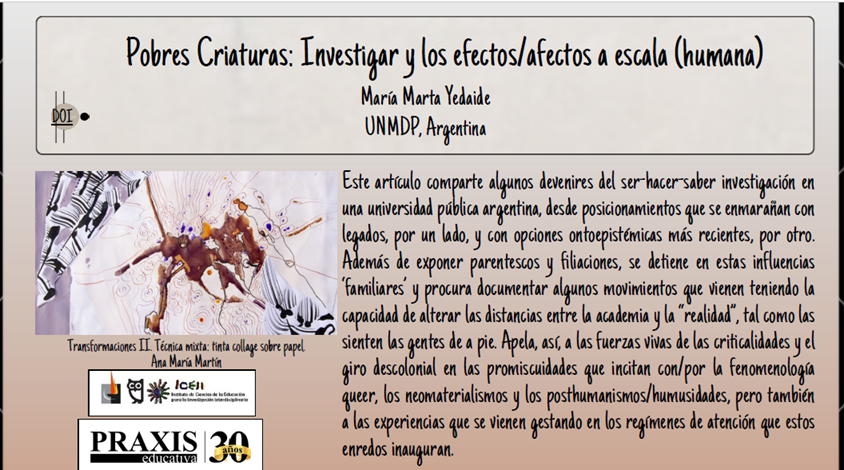
Poor Things: Researching and the effects/affects on a (human) scale
DOI:
https://doi.org/10.19137/praxiseducativa-2026-300205Keywords:
research; ontoepistemis; kinship; affects/effects; becomingsAbstract
This article presents a number of becomings in being-knowing-doing research at an Argentinian state university, in the event of their entanglement with certain heritage and recent onto epistemological options. Besides describing kinship and other family relationships, the text delves into their influence and has the intention of documenting some contemporary movements with the capacity to narrow the distances between the academia and “reality”, as ordinary people feel it. It focuses, thus, on the intercourse between criticalities and the decolonial turn with queer phenomenology, neomaterialismos and the posthumanisms/humusities, on the one hand, but also on some ordinary experiences that are defining new attention regimes. Instead of proving recipes or standardized solutions, the article seeks to leave open the question about the social value of research and universities, as well as their capacities to affect the presents. It is grounded on the belief that pedagogies may be lived as technologies to further de/re-educations that matter.
Downloads
References
AHMED, S. (2019). Fenomenología queer: orientaciones, objetos, otros. Trad. Javier Sáez del Álamo. Ediciones Bellaterra
AHMED, S. (2020). La promesa de la felicidad. Una crítica cultural al imperativo de la alegría. Caja Negra.
ANGENOT, M. (2010). La era de las hegemonías dinámicas. Entrevista de Facundo García en Diario Página 12. Edición impresa 12/10/2010.
ANGENOT, M. (2012). El discurso social. Los límites históricos de lo pensable y lo decible. Siglo veintiuno.
BARAD, K. (2007). Meeting the universe halfway: Quantum physics and the entanglement of matter and meaning. Duke University Press
BARAD, K. (2023). Cuestión de Materia. Barcelona: Holobionte Ediciones.
BARAD, K. (2024). La performatividad queer de la naturaleza. CABA: hekht
BÉNARD CALVA, S. (2019). Autoetnografía. Una metodología cualitativa. Universidad Autónoma de Aguascalientes & El Colegio de San Luis, A.C.
BENNET, J. (2010). Vibrant Matter. A Political Ecology of Things. Duke University Press
BERLANT, L. (2020). El optimismo cruel. Trad. Hugo Salas. Caja Negra Editora.
BRAIDOTTI, R. (2015). Lo posthumano. Gedisa
CASTRO-GÓMEZ, S. (2001). Ciencias sociales, violencia epistémica y el problema de la “invención del otro”. En E. LANDER (comp.). La colonialidad del saber: eurocentrismo y ciencias sociales: perspectivas latinoamericanas. Ciccus Ediciones
COOLE, D. & FROST, S. (2010). New Materialisms. Ontology, Agency, and Politics. Duke University Press
DELEUZE, G. & GUATTARI, F. (2020[1988]. Mil mesetas. Capitalismo y esquizofrenia. Pre-Textos
DELIGNY, F. (2015). Los vagabundos eficaces. Editorial UOC.
DENZIN, N. & GIARDINA, M. (2024). Qualitative Inquiry in Transition—Past, Presents, & Futures. A Critical Reader. Routledge.
DENZIN, N. (2017). Critical Qualitative Inquiry. Qualitative Inquiry, Vol. 23 (1) 8-16.
DENZIN, N. (2018). Performance, Hermeneutics, Interpretation. The SAGE Handbook of Qualitative Data Collection, SAGE Publications Ltd. 200-216.
DESPRET, V. (2022). Habitar como un pájaro: modos de hacer y de pensar los territorios. Cactus.
ESCOBAR, A., OSTERWEIL, M. Y SHARMA, K. (2024). Relacionalidad. Una política emergente de la vida más allá de lo humano. Tinta Limón.
FOUCAULT, M. (2013 [1969]). La arqueología del saber. Siglo Veintiuno Editores.
FREIRE, P. (1975 [1969]). Pedagogía del oprimido. Siglo XXI.
GALCERÁN HUGUET, M. (2010). Límites y paradojas de los universales eurocéntricos. Cairo, H. & R. Grosfoguel (et al.) Descolonizar la modernidad, descolonizar Europa: un diálogo Europa-América Latina. IEPALA.
GIRALDO, O. F. & TORO, I. (2020). Sensibilidad ambiental. Sensibilidad, empatía, estéticas del habitar. Universidad Veracruzana.
GROSFOGUEL, R. & CAIRO, H. (2010). Descolonizar los sueños de la Razón para dejar de producir monstruos. Cairo, H. & R. Grosfoguel (et al.) Descolonizar la modernidad, descolonizar Europa: un diálogo Europa-América Latina. Madrid: IEPALA.
HARAWAY, D. (2004). Testigo_Modesto@ Segundo_Milenio. HombreHembra©_ Conoce_Oncorratón®: Feminismo y tecnociencia. UOC. Colección Nuevas Tecnologías y Sociedad.
HARAWAY, D. (2019). Seguir con el problema. Generar parentesco en el Chthuluceno. Consonni.
LYOTARD, J. F. (1979). The Postmoden Condition. A report on knowledge. University of Minnesota Press.
MIGNOLO, W. (1999). Colonialidad del poder y diferencia colonial, Anuario Mariateguiano, IX/10.
MIGNOLO, W. (2007). El pensamiento decolonial: desprendimiento y apertura. El giro decolonial. Reflexiones para una diversidad epistémica más allá del capitalismo global. Instituto Pensar/IESCO.
NOGUERA, P., RAMÍREZ, L. Y ECHEVERRY, S. (2004). Metodoestesis: los caminos del sentir en los saberes de la tierra. Una aventura geo-epistémica en clave sur. Revista de investigación agraria y ambiental (Número especial), 73-90.
NORDSTROM, S. (2018). Antimethodology: Postqualitative Generative Conventions. Qualitative Inquiry Vol. 24 (3) 215-226.
NORDSTROM, S. N. (2024). Inquiry as Resonance: Wiry Workings of Failure and Patience. Qualitative Inquiry, 31(10), 936-945. https://doi.org/10.1177/10778004241288599 (Original work published 2025)
Porta, L. (org) (2020). La expansión biográfica en educación. Colección: Narrativas, Autobiografías y Educación. Universidad de Buenos Aires.
RIVERA CUSICANQUI, S. (2018). Un mundo ch’ixi es posible. Ensayos desde un presente en crisis. Tinta Limón.
ROLNIK, S. (2019). Esferas de la insurrección: Apuntes para descolonizar el inconsciente. Tinta Limón.
SPIVAK, G. (1985). ¿Puede el subalterno hablar? Revista Orbis Tertius, Año 6, No. 6. Trad. José Amícola.
ST. PIERRE, E. (2017). Haecceity: Laying Out a Plane for Post Qualitative Inquiry. Qualitative Inquiry, 23 (9), 686-698.
ST. PIERRE, E. (2024). Practices for the “New” in the New Empiricisms, the New Materialisms, and Postqualitative Inquiry. Denzin, N. y Giardina, M. (Eds.) Qualitative Inquiry in Transition—Pasts, Presents, & Futures. Routeledge.
YEDAIDE, M. (2026). Autoetnografiar: ensayos científicos en/de/para un sur global. 1a ed. Universidad Nacional de Mar del Plata.
Published
Issue
Section
License
Copyright (c) 2026 María Marta Yedaide

This work is licensed under a Creative Commons Attribution-NonCommercial-ShareAlike 4.0 International License.
Copyright Notice
Editorial Committee Educational Praxis Magazine:
I hereby declare that I am the author of the article titled (article name), that it is original and my own and that it was not previously published in any other format or medium. I declare to know that the magazine will not charge me any type of fee under any circumstances, nor will I receive any type of monetary compensation If it were accepted for publication in Educational Praxis, I authorize the aforementioned magazine to publish it digitally and to advertise it on its social networks.
If the work is published, I adhere to the Creative Commons license called "Attribution - Non-Commercial Share Alike CC BY-NC-SA", through which it is allowed to copy, reproduce, distribute, publicly communicate the work and generate derivative works, as long as when the original author is cited and acknowledged. This license has been used since September 2018. In 2016 CC BY NC ND 4.0 was adhered to; and in the years 2017 and 2018 (January-August) CC BY NC 4.0.
This CC BY-NC-SA Share Alike license does not, however, permit commercial use of the work. As an author, the journal may establish additional agreements for the non-exclusive distribution of the version of the work published in the journal, it allows me to self-archive the published articles, in their post-print version, in institutional, thematic repositories, personal web pages or any other relevant use. with the recognition of having been first published in this journal.
Educational Praxis adheres to DORA (Declaration on Research Assessment) signed in San Francisco, California, on December 16, 2012, and to the Declaration of Mexico (Joint Declaration LATINDEX - REDALYC - CLACSO - IBICT).









_(1)2.png)


3.png)








_(2).png)






2.jpg)