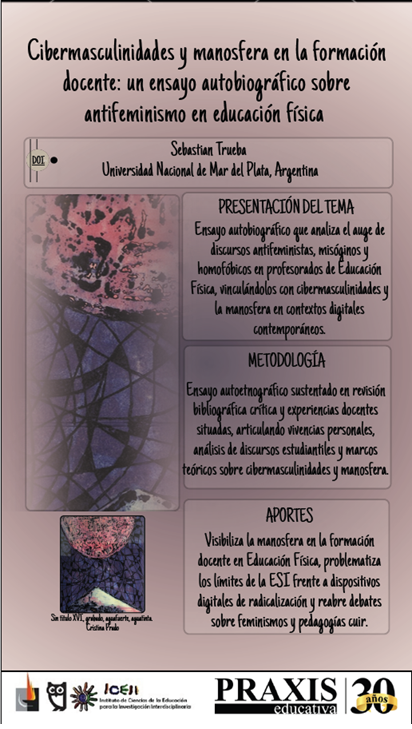
Cybermasculinities and the Manosphere in Teacher Training: An Autobiographical Essay on Antifeminism in Physical Education
DOI:
https://doi.org/10.19137/praxiseducativa-2026-300221Keywords:
educação física; antifeminismo; cibermasculinidades; manosfera; formação de professoresAbstract
This essay analyzes the emergence of antifeminist, misogynistic, and homophobic discourses among students entering physical education teacher training programs, relating them to digital phenomena such as cybermasculinities and the manosphere. Based on a bibliographic review and situated teaching experiences, the text problematizes how digital platforms commodify masculinities in crisis, offering reactionary narratives that become naturalized in academic spaces historically permeable to masculinism. The work shows that Comprehensive Sexuality Education, while present throughout the educational trajectory of these populations, seems insufficient in the face of the reach of digital radicalization devices. The necessity to reopen the debate on feminisms, queer pedagogies, and disputes of meaning in teacher training careers is proposed, particularly in physical education.
Downloads
References
AA. VV (2016). Encuesta del clima escolar dirigida a jóvenes LGBT. 100% Diversidad y derechos / CTERA / Facebook Argentina. https://100porciento.wordpress.com/wp-content/uploads/2016/12/informe-final-encuesta-de-clima-escolar-lgbt.pdf
Aisenstein, Á. y Scharagrodsky, P. (2006). Tras las huellas de la Educación Física escolar argentina. Cuerpo, género y pedagogía: 1880 /1950. Prometeo Libros.
Bonavitta, P., Norval, V., & Fioretti, L. (2025). “Ahora todo es violencia”: percepciones de docentes sobre las violencias de género en educación superior. En Páginas De Educación, 18(1), e4276. https://doi.org/10.22235/pe.v18i1.4276
Cavaller Pedrosa, P. (2023), Homofobia en el aula: el Profesor de Educación Física gay, una autoetnografía una autoetnografía [Tesis de Maestría] Máster Universitario en Formación del Profesorado de Secundaria, Bachillerato, ciclos, escuelas de idiomas y enseñanzas deportivas. Universidad Europea de Valencia.
Colectivo Genera (2024). Genera(r) otra Educación Física con perspectiva de género. Espíritu Guerrero Editor.
Copolechio Morand, M. (2024). Mi historia con la sexualidad: relatos de estudiantes de Educación Física. En Contextos de educación,36. DOI: https://doi.org/10.5281/zenodo.13108536
Deluca, M. y Ríos, M. (2025). Juguemos en el bosque mientras las autoras no están: Techo de cristal en la formación en Educación Física - UNLP. Ponencia presentada en el 16º Argentino, 11º Latinoamericano y 3º Internacional Congreso de Educación Física y Ciencias. Educación Física por venir (Saberes, prácticas y territorios en disputa). https://sedici.unlp.edu.ar/handle/10915/187463?show=full
Flood, M. (2021). Backlash: los movimientos de los varones enojados. En L. Fabbri (comp.): La masculinidad incomodada. Homo Sapiens. (pp. 213-240)
Lorente Acosta, M. (2021). El posmachismo: trampas y resistencia contra la igualdad. En L. Fabbri (comp.): La masculinidad incomodada. Homo Sapiens. (pp.179-194)
Marquez de la Orden, R. (2025). “¿De qué color es tu Bugatti?”: Los gym bros y la narrativa neoliberal de la manosfera. En Comunicación y género. Madrid. DOI: https://doi.org/10.5209/cgen.99671
Maureira Cid, F., Flores Ferro, E., Serey Araneda, D., Maureira Roldán, G., Lagos Urzúa, B., Solari Cerda, C., Gárate Lagos, T., & Espinoza Neira, C. (2024). Relación entre homofobia, transfobia, sexismo y conocimientos biológicos sobre la homosexualidad y transexualidad en estudiantes de 1º año de Educación Física de Chile. En Retos, 51, 559-565. https://revistaretos.org/index.php/retos/article/view/100561
Mujica Johnson, F., & Guerrero Lacoste, S. (2025). Currículum vivido, emociones y homosexualidad masculina en la formación docente de Educación Física en Chile. En Sportis. Scientific Journal of School Sport, Physical Education and Psychomotricity, 11(4), 1-22. https://doi.org/10.17979/sportis.2025.11.4.12048
Muñoz-Saavedra, J. y Bär Kwast, B. (2025). Masculinidades hegemónicas, antifeminismo y capitalismo de plataformas. Análisis y acción en una experiencia de alfabetización digital crítica en educación superior. En Revista Izquierdas. Una mirada histórica desde América Latina. 54, agosto 2025: 1-37. https://www.izquierdas.cl/images/pdf/2025/54/Mono10.pdf
Petrocelli, S. (2021). La andrósfera. En L. Fabbri (comp.): La masculinidad incomodada. Homo Sapiens. (pp.195-212)
Ramallo, F. y Gómez, J. (2019). “Deslices kuir: una presentación para no leer tan recto”, en Revista de Educación, Año X, Nº18, pp. 13-18. https://fh.mdp.edu.ar/revistas/index.php/r_educ/article/view/3746/3687
Scharagrodsky, P. (2000). Cuerpo, género y poder en la escuela: La construcción de las masculinidades en las clases de educación física [Tesis de Maestría] Director Mariano Narodowski, Maestría en Educación, FLACSO.
Scharagrodsky, P. (2001). Juntos pero no revueltos: la educación física mixta en clave de género. En Revista Nómadas, Nº4 (142-154). Universidad Central. Bogotá. Disponible en: https://www.redalyc.org/pdf/1051/105115268012.pdf
Scharagrodsky, P. (2002). En la educación física queda mucho “género” por cortar. En Revista Educación Física & Ciencia, Nº6. Disponible en: https://sedici.unlp.edu.ar/handle/10915/11770
Trueba, S. (2019). Educación física cuir: ¿un largo camino por recorrer?. En Revista de Educación, 0(18), 261-273. Recuperado de https://fh.mdp.edu.ar/revistas/index.php/r_educ/article/view/3760
Trueba, S. A. y Ramallo, F. (2021). Estertores en la clase de educación (física): Desmarcaciones con una pedagorgía. En Educación Física & Ciencia, 23(1), e160. https://doi.org/10.24215/23142561e160
Published
Issue
Section
License
Copyright (c) 2026 Sebastián Trueba

This work is licensed under a Creative Commons Attribution-NonCommercial-ShareAlike 4.0 International License.
Copyright Notice
Editorial Committee Educational Praxis Magazine:
I hereby declare that I am the author of the article titled (article name), that it is original and my own and that it was not previously published in any other format or medium. I declare to know that the magazine will not charge me any type of fee under any circumstances, nor will I receive any type of monetary compensation If it were accepted for publication in Educational Praxis, I authorize the aforementioned magazine to publish it digitally and to advertise it on its social networks.
If the work is published, I adhere to the Creative Commons license called "Attribution - Non-Commercial Share Alike CC BY-NC-SA", through which it is allowed to copy, reproduce, distribute, publicly communicate the work and generate derivative works, as long as when the original author is cited and acknowledged. This license has been used since September 2018. In 2016 CC BY NC ND 4.0 was adhered to; and in the years 2017 and 2018 (January-August) CC BY NC 4.0.
This CC BY-NC-SA Share Alike license does not, however, permit commercial use of the work. As an author, the journal may establish additional agreements for the non-exclusive distribution of the version of the work published in the journal, it allows me to self-archive the published articles, in their post-print version, in institutional, thematic repositories, personal web pages or any other relevant use. with the recognition of having been first published in this journal.
Educational Praxis adheres to DORA (Declaration on Research Assessment) signed in San Francisco, California, on December 16, 2012, and to the Declaration of Mexico (Joint Declaration LATINDEX - REDALYC - CLACSO - IBICT).









_(1)2.png)


3.png)








_(2).png)






2.jpg)