Las giras educativas como estrategia didáctica en el Colegio Científico de Puntarenas, Costa Rica
DOI:
https://doi.org/10.19137/praxiseducativa-2026-300214Resumo
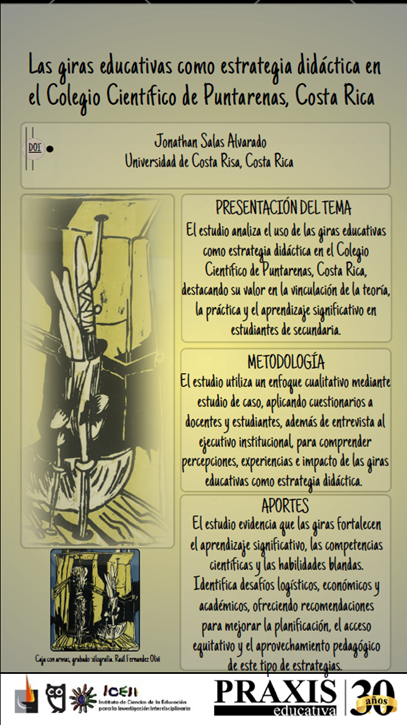
Este artigo é um estudo de caso que analisa o papel das visitas de campo como estratégia de ensino no Colégio Científico da Costa Rica, Campus de Puntarenas. O estudo coleta dados por meio da aplicação de questionários a 5 professores e 37 alunos, além de uma entrevista semiestruturada com a diretoria da escola. Os resultados demonstram que as visitas de campo são uma ferramenta pedagógica valiosa que permite estabelecer vínculos entre a teoria e a prática dos conteúdos em sala de aula, promovendo uma aprendizagem significativa e fortalecendo as competências científicas e as habilidades interpessoais dos alunos. Além disso, o artigo analisa os desafios que as visitas de campo podem gerar e seu impacto negativo sobre alunos e professores. O objetivo é obter uma visão geral da implementação dessa estratégia de ensino com base na experiência dessa instituição de ensino, que possa oferecer recomendações baseadas em sua experiência e que possam ser úteis a outros centros educacionais.
Downloads
Referências
Blanco, E. (2018). La gira educativa como apoyo a la enseñanza de lenguas extranjeras: experiencias de los cursos de Catalán Básico en la Universidad de Costa Rica. Revista de Lenguas Modernas, 28, 209-215. https://doi.org/10.15517/rlm.v0i28.34774
Chaverra, B., Gaviria, D. y González, E. (2019). El estudio de caso como alternativa metodológica en la investigación en educación física, deporte y actividad física. Conceptualización y aplicación. Retos, 35, 422-427. https://doi.org/10.47197/retos.v0i35.60168
Gómez, J. (2024). Transformaciones pedagógicas esperanzadoras desde la interculturalidad y la decolonialidad: giras educativas interculturales. Siwo, Revista de Teología/Estudios Socio religiosos, 17(1), 1-18. https://doi.org/10.15359/siwo.17-1.2
Jiménez, V. (2022). El estudio de casos y sus etapas en las investigaciones. Revista sobre estudios e investigaciones del saber académico, 16(16), 1-7. http://publicaciones.uni.edu.py/index.php/rseisa
López, M. (2020). Visitas técnicas guiadas como recurso didáctico: Diseño de una visita al Centro I+D+i de Renault [trabajo fin de Máster]. Universidad de Valladolid.
Menkshi, E. y Braholli, E. (2020). Field trips as a valuable learning experience for students. Vjetari Shkencor, 4, 221-227. https://www.researchgate.net/publication/370400427
Myers, B. y Jones, L. (2015). Effective Use of Field Trips in Educational Programming: A Three Stage Approach. Agricultural Education and Communication Department. University of Florida.
Nawi, N. y Azmi, A. (2016). An assessment of the effectiveness of field trips as a teaching and learning strategy: A case study of field trip to the Parliament. Journal of Academia UiTM Negeri Sembilan, 4, 1-11. https://www.researchgate.net/publication/323904483_An_Assessment_of_the_Effectiveness_of_Field_Trips_as_a_Teaching_and_Learning_Strategy_A_Case_Study_of_Field_Trip_to_the_Parliament
Núñez, V. (2017). Las salidas escolares como recurso motivador para los niños (trabajo de fin de grado]. Universidad de Valladolid, Facultad de Educación de Soria. https://uvadoc.uva.es/bitstream/handle/10324/28923/TFG-O-1170.pdf?sequence=1&isAllowed=y
Oranga, J. y Matere, A. (2023). Qualitative Research: Essence, Types and Advantages. Open Access Library Journal, 10. Https://doi.org/10.4236/oalib.1111001
Pedreschi, R. y Nieto, O. (2023). Importancia de las giras académicas como estrategia en los cursos del área de Mercadotecnia que se imparten en la Licenciatura en Mercadeo de la Extensión Universitaria de Aguadulce. Revista Saberes APUDEP, 6(2), 180-197. https://doi.org/10.48204/j.saberes.v6n2.a4089
Short, F. y Lloyd, T. (2017). Taking the student to the world: Teaching sensitive issues using field trips. Psychology Teaching Review, 23(1), 49-55. https://files.eric.ed.gov/fulltext/EJ1146413.pdf
Sistema Nacional de los Colegios Científicos de Costa Rica. (2025). Historia de los Colegios Científicos. https://sncccr.ed.cr/acerca-del-sncccr/historia-de-los-ccc
Zavala, D., Ramírez, N. y Godoy, C. (2023). Desempeño académico de estudiantes que realizaron giras presenciales y virtuales en la asignatura Laboratorio de Biodiversidad e Inventario de la Naturaleza. Repertorio Científico, 26(1), 16-26. Https://doi.org/10.22458/rc.v26i1.4839
Publicado
Edição
Seção
Licença
Copyright (c) 2026 Jonnathan Salas Alvarado

Este trabalho está licenciado sob uma licença Creative Commons Attribution-NonCommercial-ShareAlike 4.0 International License.
Aviso de direitos autorais
Comitê Editorial Revista Práxis Educativa:
Declaro que sou o autor do artigo intitulado (nome do artigo), que o mesmo é original e de minha autoria e que não foi publicado anteriormente em qualquer outro formato ou meio. Declaro saber que a revista não me cobrará nenhum tipo de taxa em hipótese alguma, nem receberei qualquer tipo de remuneração monetária.
Caso seja aceito para publicação na Práxis Educacional, autorizo a referida revista a publicá-lo digitalmente e a divulgá-lo em suas redes sociais.
Se o trabalho for publicado, aderi à licença Creative Commons denominada "Atribuição - Compartilhamento Não Comercial pela mesma Licença CC BY-NC-SA", por meio da qual é permitido copiar, reproduzir, distribuir, comunicar publicamente o trabalho e gerar trabalhos derivados , desde que o autor original seja citado e reconhecido. Esta licença está em uso desde setembro de 2018. Em 2016 foi aderido ao CC BY NC ND 4.0; e nos anos de 2017 e 2018 (janeiro-agosto) CC BY NC 4.0.
Esta licença CC BY-NC-SA Share Alike não permite, entretanto, o uso comercial da obra. Como autor, a revista poderá estabelecer acordos adicionais para a distribuição não exclusiva da versão do trabalho publicado na revista, permite-me autoarquivar os artigos publicados, na sua versão post-print, em repositórios institucionais, temáticos , páginas web pessoais ou qualquer outro uso relevante. com o reconhecimento de ter sido publicado pela primeira vez nesta revista.
SA Práxis Educacional adere à DORA (Declaração sobre Avaliação de Pesquisa) assinada em São Francisco, Califórnia, em 16 de dezembro de 2012, e à Declaração do México (Declaração Conjunta LATINDEX - REDALYC - CLACSO - IBICT).








_(1)2.png)

3.png)







_(2).png)






2.jpg)