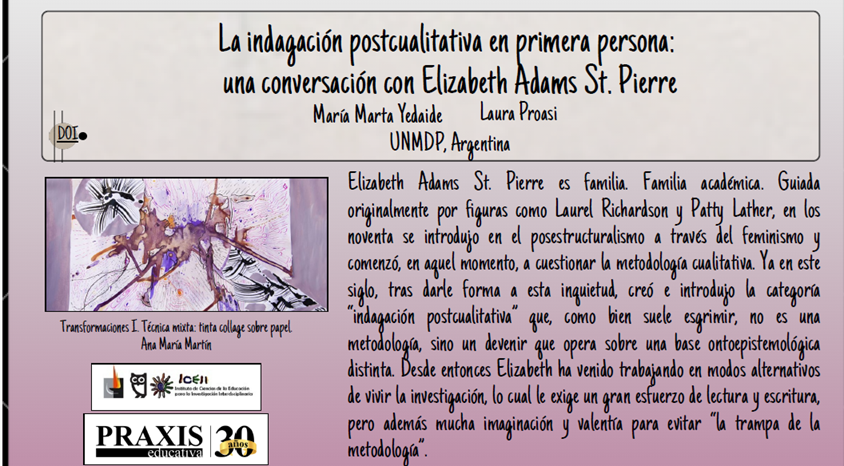
Post-qualitative inquiry in the first person
A conversation with Elizabeth Adams St. Pierre
DOI:
https://doi.org/10.19137/praxiseducativa-2026-300203Keywords:
Post-Qualitative Inquiry; Poststructuralism; Ontoepistemological; AntimethodologyAbstract
Elizabeth Adams St. Pierre is family. Academic family. Originally mentored by figures like Laurel Richardson and Patty Lather, she became acquainted with poststructuralism through feminism in the nineties and paid enough heed to the cognitive dissonance she experienced in her dissertation process to start challenging qualitative methodology at that time. In this century, after maturing this uneasiness, she created, and coined, Post-Qualitative Inquiry which, as she often says, is not a methodology but rather a becoming which operates on a different ontoepistemological basis. She has ever since worked on experimenting research that demands a lot of hard work in reading and writing, but also a great deal of imagination and courage, to avoid ‘the trap of methodology’. Her work has been unparalleled and so is her kindness and candor. In this conversation we delved into her beginnings, what matters the most to her, and her investment in doing academic work that really counts.
Downloads
Published
Issue
Section
License
Copyright (c) 2026 María Marta Yedaide, Laura Proasi

This work is licensed under a Creative Commons Attribution-NonCommercial-ShareAlike 4.0 International License.
Copyright Notice
Editorial Committee Educational Praxis Magazine:
I hereby declare that I am the author of the article titled (article name), that it is original and my own and that it was not previously published in any other format or medium. I declare to know that the magazine will not charge me any type of fee under any circumstances, nor will I receive any type of monetary compensation If it were accepted for publication in Educational Praxis, I authorize the aforementioned magazine to publish it digitally and to advertise it on its social networks.
If the work is published, I adhere to the Creative Commons license called "Attribution - Non-Commercial Share Alike CC BY-NC-SA", through which it is allowed to copy, reproduce, distribute, publicly communicate the work and generate derivative works, as long as when the original author is cited and acknowledged. This license has been used since September 2018. In 2016 CC BY NC ND 4.0 was adhered to; and in the years 2017 and 2018 (January-August) CC BY NC 4.0.
This CC BY-NC-SA Share Alike license does not, however, permit commercial use of the work. As an author, the journal may establish additional agreements for the non-exclusive distribution of the version of the work published in the journal, it allows me to self-archive the published articles, in their post-print version, in institutional, thematic repositories, personal web pages or any other relevant use. with the recognition of having been first published in this journal.
Educational Praxis adheres to DORA (Declaration on Research Assessment) signed in San Francisco, California, on December 16, 2012, and to the Declaration of Mexico (Joint Declaration LATINDEX - REDALYC - CLACSO - IBICT).









_(1)2.png)


3.png)







_(2).png)






2.jpg)