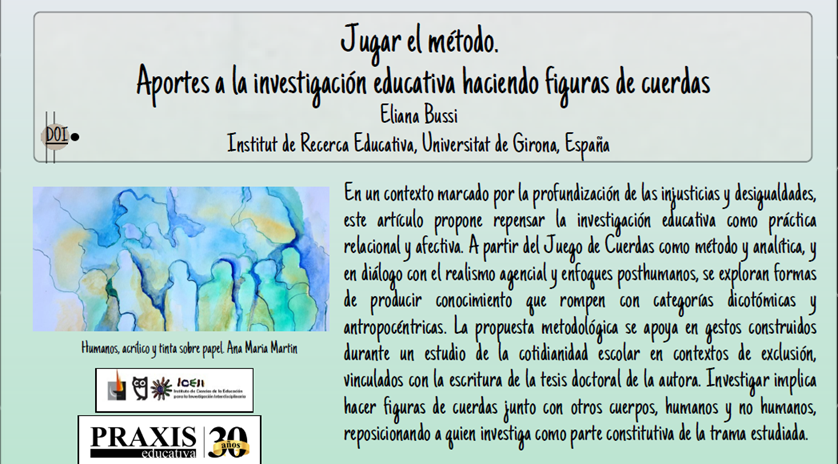
Playing the method. Contributions to educational research making string figures
DOI:
https://doi.org/10.19137/praxiseducativa-2026-300207Keywords:
Educational research, Relationalities, Posthumanism, Agencial Realism, ExclusionAbstract
In a context characterised by deepening injustices and inequalities, this article puts forward the idea of rethinking educational research as a relational and affective practice. Using String Play as both a methodological approach and an analytical framework, and engaging with agentic realism and posthumanist perspectives, the article explores alternative modes of knowledge production that transcend dichotomous and anthropocentric categories. This methodological approach is based on gestures created during an investigation into everyday school life in exclusionary contexts, which is linked to the author's doctoral dissertation. The research involves creating string figures with other bodies — both human and non-human — thereby repositioning the researcher as a constitutive part of the narrative being studied. The result is an affective narrative that recounts the tensions, intensities and movements involved in holding the strings, revealing a way of conducting research as an embodied practice in a constant process of becoming with others.
Downloads
References
Barad, K. (2003). Posthuman Performativity – Toward an Understanding of How Matter Comes to Matter. Signs Journal of Women in Culture and Society, 28(3), 801-831. https://doi.org/10.1086/345321
Barad, K. (2007). Meeting the Universe Halfway. Quantum Physics and the Entanglement of Matter and Meaning. Duke University Press.
Bennet, J. (2010). Materia vibrante. Una ecología política de las cosas. Duke University Press.
Blom, S., Lasczik, A. & Cutter-Mackenzie-Knowles, A. (2025). Diffractive ethnography: a divergent methodology in educational research. The Australian Educational Researcher, 52, 2751–2777. https://doi.org/10.1007/s13384-025-00835-3
Braidotti, R. (2013). The posthuman. Polity Press.
Braidotti, R. (2018) Por una política afirmativa. Itinerarios éticos. Gedisa.
Braidotti, R. (2020a). El conocimiento posthumano. Gedisa.
Braidotti, R. (2020b). “We” are in this together, but we are not one and the same. Journal of Bioethical Inquiry, 17(4), 465–469. https://doi.org/10.1007/s11673-020-10017-8
Bussi, E. & Jornet, A. (2025). Teachers Fighting for Dignified Homes for their Students: A Case for a Politi-cized Sustainability Education. En: Romero, M. (Ed.). (2025). Towards equity, peace and sustainability in times of crisis: Proceedings of the ISCAR Southern Europe and West Asia Conference 2025, Barcelona. DOI: 10.5281/zenodo.18080161). Pp. 121-125
Bussi, E. (2023). Vida escolar y degradación ambiental en tiempos gerenciales. Un estudio en escuelas secundarias ubicadas en el Área Metropolitana de Buenos Aires, en contextos de extrema pobreza urbana [Tesis de doctorado UBA-UMA]. https://riuma.uma.es/entities/publication/c7cb8dc2-d5b4-42a0-9e6e-02a2fbf660c4
Bussi, E., Schwamberger, C., y Grinberg, S. (2023). Entre la quema y te re-quema. Un estudio sobre el devenir docente en contextos de pobreza urbana y degradación ambiental. Praxis educativa, 27(1), 139-156. https://doi.org/https://doi.org/10.19137/praxiseducativa-2023-270111
Butler, J. (2010). Marcos de guerra. Las vidas lloradas. Paidós.
Butler, J. (2017). Vulnerabilidad corporal, coalición y la política de la calle. Nómadas, núm. 46, abril, 2017, pp. 13-30 Universidad Central Bogotá, Colombia. http://www.redalyc.org/articulo.oa?id=105152132003
Castro Varela, A., y Onsès Segarra, J. (2019). La investigación sobre educación como desplazamiento: no saber, abrirse, devenir. Educatio Siglo XXI, 37(2 Jul-Oct), 141–158. https://doi.org/10.6018/educatio.387051
Curutchet, G., Grinberg, S. y Gutiérrez, R. (2012). Degradación ambiental y periferia urbana: Un estudio transdiciplinario sobre la contaminación en la región metropolitana de Buenos Aires. Ambiente & Sociedade, 15(2), 173–194. https://doi.org/10.1590/S1414 753X2012000200010
Deleuze, G. y Guattari, F. (2004). Mil Mesetas. Capitalismo y esquizofrenia. Pre-Textos.
Escobar, A., Osterweil, M. y Sharma, K. (2024). Relacionalidad. Una política emergente de la vida más allá de lo humano. Ed. Tinta Limón.
Esteban Guitart, M., Searle, D., Jornet, A., y Lamas, M. (2025). Investigación participativa para la transformación escolar desde la perspectiva de los Fondos Comunitarios de Conocimiento e Identidad: Un estudio de caso en Punucapa, Chile. Perspectiva Educacional, 64(2), 178–205. https://doi.org/10.4151/07189729 Vol.64 Iss.2 Art.1670
Grinberg, S. (2013a). Researching the pedagogical apparatus (dispositf): An ethnography of the molar, molecular and desire in contexts of extreme urban poverty. R. Coleman & J. Ringrose (Eds.), Deleuze and research methodologies (pp. 201–218). Edinburgh University Press.
Grinberg, S. (2013b). Me voy a caer mil veces, pero me voy a levantar: Cartografías urbanas de la desigualdad escolar. Revista Latinoamericana de Ciencias Sociales, Niñez y Juventud, 11(2), 1049–1062.
Grinberg, S. (2020). Cartografías de la escolaridad contemporánea: entre la vida cotidiana y la gubernamentalidad. Psicoperspectivas, 19(3), 1–12. https://doi.org/10.5027/psicoperspectivas-vol19-issue3-fulltext-2079
Grinberg, S. (2022). Introducción. En: Grinberg, S.,Langer, E., Armella, J., Orlando, G., Schwamberger, C., Dafunchio, S., Bonilla, A., Carpentieri, Y., Mantiñán, M., Bussi, E., Peuchot, P., Rodriguez, G., Machado, M, Ojeda, M, Muñoz Cabrera, A., Abálsamo, M. (2022). Silencios que gritan en la escuela. Dispositivos, espacio urbano y desigualdades. CLACSO. https://biblioteca-repositorio.clacso.edu.ar/handle/CLACSO/169354
Gutiérrez, K. D., Engeström, Y., & Sannino, A. (2016). Expanding educational research and interventionist methodologies. Cognition and Instruction, 34(3), 275–284. https://doi.org/10.1080/07370008.2016.1183347
Haraway, D. (1988). Situated knowledges: The science question in feminism and the privilege of partial perspective. Feminist Studies, 14(3), 575–599. https://doi.org/10.2307/3178066
Haraway, D. (2020). Seguir con el problema: Generar parentesco en el Chthuluceno. Consonni.
Haraway, D. J. (1994). A game of cat’s cradle: Science studies, feminist theory, cultural studies. Configurations, 2(1), 59–71.
Hoenigman, D. (2020). Talking about strings: The language of string figure-making in a Sepik society in Papua New Guinea. Language Documentation & Conservation, 14, 598–641. https://hdl.handle.net/10125/24964
Ingold, T. (2015). Líneas. Una breve historia. Gedisa.
Jayne, C. (1906). String figures. A study of cat’s-cradle in many lands. Charles Scribner’s Sons. https://archive.org/details/stringfiguresstu00jaynuoft
Lather, P., & St. Pierre, E. A. (2013). Post-qualitative research. International Journal of Qualitative Studies in Education, 26(6), 629–633. https://doi.org/10.1080/09518398.2013.788752
Latour, B. (1993). We have never been modern. Harvard University Press.
Latour, B. (2005). Reassembling the social: An introduction to actor network theory. Oxford University Press. https://doi.org/10.1093/oso/9780199256044.001.0001
Porta, L., y Yedaide, M. M. (2014). La investigación narrativa en educación: Perspectivas, tensiones y desafíos. SophiA: Revista de Filosofía de la Educación, 17, 201–222. https://doi.org/10.17163/soph.n17.2014.22
Ramallo, F. (2013). La educación en clave de-colonial: apuestas pedagógicas, saberes y experiencias desde las historias propias. Revista de Educación, 0(6), 249-265. https://fh.mdp.edu.ar/revistas/index.php/r_educ/article/view/763
Ringrose, J., Warfield, K. & Zarabadi, S. (2019). Feminist Posthumanisms, New Materialisms and Education. Routledge.
Schwamberger, C., Armella, J., Carpentieri, Y., y Dafunchio, S. (2022). Maneras del decir: producción audiovisual y escuela secundaria. Un estudio sociopedagógico en la Región Metropolitana de Buenos Aires. Revista de Estudios Sociales, 79, 94–107. https://doi.org/10.7440/res79.2022.06
St. Pierre, E. A. (2011). Post qualitative research: The critique and the coming after. In N. K. Denzin & Y. S. Lincoln (Eds.), The SAGE handbook of qualitative research (5th ed., pp. 611–626). SAGE.
St. Pierre, E. A., Jackson, A.Y., y Mazzei, L. A. (2016). New Empiricisms and New Mate¬rialisms: Conditions for New Inquiry. Cultural Studies-Critical Methodologies 16(2), 99–110.
Yedaide, M. M., Porta, L., y Ramallo, F. (2021). Alter(n)ando las condiciones de autoridad de la investigación narrativa contemporánea: amarres, enredos y desgarros. Espacios en Blanco. Revista de Educación, 31(2), 381–396. https://doi.org/10.37177/UNICEN/EB31-309
Published
Issue
Section
License
Copyright (c) 2026 Eliana Bussi

This work is licensed under a Creative Commons Attribution-NonCommercial-ShareAlike 4.0 International License.
Copyright Notice
Editorial Committee Educational Praxis Magazine:
I hereby declare that I am the author of the article titled (article name), that it is original and my own and that it was not previously published in any other format or medium. I declare to know that the magazine will not charge me any type of fee under any circumstances, nor will I receive any type of monetary compensation If it were accepted for publication in Educational Praxis, I authorize the aforementioned magazine to publish it digitally and to advertise it on its social networks.
If the work is published, I adhere to the Creative Commons license called "Attribution - Non-Commercial Share Alike CC BY-NC-SA", through which it is allowed to copy, reproduce, distribute, publicly communicate the work and generate derivative works, as long as when the original author is cited and acknowledged. This license has been used since September 2018. In 2016 CC BY NC ND 4.0 was adhered to; and in the years 2017 and 2018 (January-August) CC BY NC 4.0.
This CC BY-NC-SA Share Alike license does not, however, permit commercial use of the work. As an author, the journal may establish additional agreements for the non-exclusive distribution of the version of the work published in the journal, it allows me to self-archive the published articles, in their post-print version, in institutional, thematic repositories, personal web pages or any other relevant use. with the recognition of having been first published in this journal.
Educational Praxis adheres to DORA (Declaration on Research Assessment) signed in San Francisco, California, on December 16, 2012, and to the Declaration of Mexico (Joint Declaration LATINDEX - REDALYC - CLACSO - IBICT).










_(1)2.png)


3.png)








_(2).png)






2.jpg)