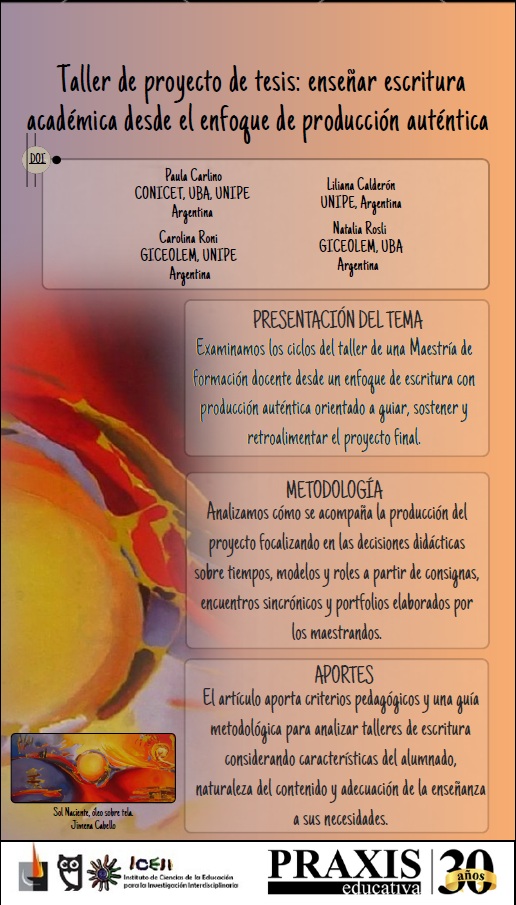
Thesis proposal seminar: teaching academic writing through an authentic production approach
DOI:
https://doi.org/10.19137/praxiseducativa-2026-300105Keywords:
escritura, enseñanza, alfabetización academica, proyecto de tesis, investigaciónAbstract
We developed an 18-month master's thesis proposal seminar with an “authentic production-based teaching approach” to shorten the distance between teaching and learning academic writing. Over the course of 10 years, the seminar has been redefined to preserve the nature of the literacy practices it seeks to teach, while considering the educational needs of its students. Our analysis details the seminar design to help participants effectively produce their thesis proposals and construct the knowledge required to elaborate it, driven by the need to solve the problems their production entails. This paper examines the instructional decisions regarding time frames, work cycles, tasks, guidelines, assignments, use of written models and bibliographic material, and student and teacher roles.
Downloads
References
Alvarez, G. y Difabio de Anglat, H. (2023). Fundamentos de una iniciativa pedagógica en línea orientada a la revisión y reescritura de capítulos de tesis de posgrado. En G. Alvarez (Coord.), Enseñanza de la escritura de la tesis de posgrado en entornos presenciales y virtuales (pp. 47-86). Universidad Nacional de General Sarmiento.
Bazerman, C. y Russell, D. (Eds.). (2003). Writing Selves/Writing Societies: Research from Activity Perspectives. The WAC Clearinghouse; Mind, Culture, and Activity. https://doi.org/10.37514/PER-B.2003.2317
Carlino, P. (2009). Exploración de géneros, diario de tesis y revisión entre pares: Análisis de un ciclo de investigación-acción en talleres de tesis de posgrado. En E. Arnoux de Narvaja (Ed.), Escritura y producción de conocimiento en carreras de posgrado. Santiago Arcos. https://www.aacademica.org/paula.carlino/182
Calderón, L. (2018). Escribir libros de ciencias: los profesores como autores. Eje Desarrollo profesional docente: modalidades y experiencias exitosas. VIII encuentro internacional de la Red Kipus. Profesión docente: Valoración, formación inicial y permanente. San José, Costa Rica https://redkipuscr.ucr.ac.cr/memoria/
Calderón, L. (2024). Escritura en Ciencias: lecciones aprendidas para la enseñanza de las ciencias y la escritura en la formación de docentes. Séminaire adressé aux étudiants de Master et doctorat des universités partenaires. Prefalc: Programme regional france, Amérique latine, Caräibe. https://www.fmsh.fr/appels/programme-prefalc
Carlino, P. (2012). Helping Doctoral Students of Education to Face Writing and Emotional Challenges in Identity Transition. En M. Castello y C. Donahue, University writing: Selves and Texts in Academic Societies. Emerald Group Publishing. https://www.aacademica.org/paula.carlino/99
Carlino, P. (2013). Alfabetización académica diez años después. Revista Mexicana de Investigación Educativa, XVII (57), 355-381. https://www.aacademica.org/paula.carlino/103
Carlino, P. (2015). Revisión entre pares: una práctica social que los posgrados deberían enseñar. Espaço Pedagógico, 22(1), 9-29. https://www.aacademica.org/paula.carlino/219
Carlino, P. (2023). New Cognitive Practices in a Master's Thesis Proposal Writing Seminar. En P. Rogers, D. Russell, Pa. Carlino y J. Marine (Eds.), Writing as a human activity: Implications and applications of the work of Charles Bazerman. Fort Collins: Colorado State University Open Press y The WAC Clearinghouse. https://www.aacademica.org/paula.carlino/304
Carlino, P. y Cordero, G. (2023). Enseñar con escritura y enseñar a escribir: enfoque entrelazado mediante colaboración interdisciplinar. Lengua y Sociedad. Revista de Lingüística Teórica y Aplicada, 22(2), 35-64. https://www.aacademica.org/paula.carlino/306
Cassany, D. (1988). Describir el escribir. En Cómo se aprende a escribir. Paidós.
Cavallini, A. y Alvarez, G. (2024). Panorama de estudios latinoamericanos sobre retroalimentación escrita en formación de posgrado. Praxis educativa, 28(2), 1-18. https://dx.doi.org/10.19137/praxiseducativa-2024-280217
Chevallard, I. (1998). La transposición didáctica. Del saber sabio al saber enseñado. Aique Grupo editor.
Chois Lenis, P. M., Guerrero Jiménez, H. I. y Brambila Limón, R. (2020). Una mirada analítica a la enseñanza de la escritura en posgrado: revisión de prácticas documentadas en Latinoamérica. Íkala, Revista de Lenguaje y Cultura, 25(2), 535-556. https://doi.org/10.17533/udea.ikala.v25n02a09
Chois. P. y Jaramilllo, L. (2016). La investigación sobre la escritura en posgrado: estado del arte. Lenguaje, 44(2), 227-259.
Espino Datsira, S. (2015). La enseñanza de estrategias de escritura y comunicación de textos científicos y académicos a estudiantes de posgrado. Revista mexicana de investigación educativa, 20(66), 959-976.
Fernández Fastuca, L. y Guevara, J. (2017). Los talleres de tesis como aproximación a una comunidad de práctica. Cuadernos de Investigación Educativa, 8(1). https://repositorio.uca.edu.ar/handle/123456789/8742
Giraldo-Giraldo, C. (2020). Dificultades de la escritura y desaprovechamiento de su potencial epistémico en estudiantes de posgrado. Revista Colombiana de Educación, (80), 173-192. https://doi.org/10.17227/rce.num80-9633
Guerrero, H. I. y Chois Lenis, P. M. (2019). Prácticas de escritura en posgrado: el caso de una maestría en educación. Lenguaje, 47(1), 120-146. https://doi.org/10.25100/lenguaje.v47i1.6094
Guerrero, R. y Mostacero, R. (2014). Logros y alcances de escribir el trabajo de grado en un grupo de escritura. EDUCERE, 18(61), 527-534.
Hernández Morales, J., Morales, P. A., Pérez Arenas, D. y Condés Infante, J. F. (2022). Procesos y momentos de la investigación en los posgrados en educación. Praxis educativa, 26(2), 254-276. https://dx.doi.org/https://doi.org/10.19137/praxiseducativa-2022-260213
Lerner, D. (2001). Leer y escribir en la escuela: Lo real, lo posible y lo necesario. Fondo de Cultura Económica.
Martín Torres, G. G. (2012). La escritura de tesis de posgrado en el área de investigación educativa. El acompañamiento, una pieza clave. CPU-e, Revista de Investigación Educativa, (15), 69-86.
Pastré, P. (2008). Aprendizaje y actividad. En A. Pereyra y L. Calderón, Didáctica profesional y trabajo docente. Aportes teóricos para su análisis en la formación (pp. 205-237). UNIPE Editorial Universitaria.
Pozzo, M. I., Camargo Angelucci, T. y Cardoso, A. L. (2021). Formación de profesores universitarios en posgrados interdisciplinarios. Dificultades en la escritura del plan de tesis. Revista Digital de Investigación en Docencia Universitaria, 15(2), e1238. https://doi.org/10.19083/10.19083/ridu.2021.1238
Pozzo, M. I. y Rosso, F. (2023). Enseñanza de la escritura académica en entornos virtuales: desafíos de la pandemia en el posgrado. Folios, (58), 56-74. https://doi.org/10.17227/folios.58-16014.
Rossi Peralta, M. (2023). Dificultades sociodiscursivas para la escritura académica en estudiantes universitarios de pregrado y posgrado. Lengua y Sociedad, 22(2), 335-356. https://dx.doi.org/10.15381/lengsoc.v22i2.23883
Russell, D. R. (1995). Activity theory and its implications for writing instruction. En J. Petraglia (Ed.), Reconceiving writing, rethinking writing instruction (pp. 51-77). Laurence Erlbaum.
Smith, F. (1983). Reading like a writer. Language Arts, 60(5), 558-567.
Villabona Osorio, L. (2018). Situaciones que facilitan o dificultan la escritura de tesis de posgrado. Perspectivas Metodológicas, 22(2), 49-74.
Published
Issue
Section
License
Copyright (c) 2026 Natalia Rosli

This work is licensed under a Creative Commons Attribution-NonCommercial-ShareAlike 4.0 International License.
Copyright Notice
Editorial Committee Educational Praxis Magazine:
I hereby declare that I am the author of the article titled (article name), that it is original and my own and that it was not previously published in any other format or medium. I declare to know that the magazine will not charge me any type of fee under any circumstances, nor will I receive any type of monetary compensation If it were accepted for publication in Educational Praxis, I authorize the aforementioned magazine to publish it digitally and to advertise it on its social networks.
If the work is published, I adhere to the Creative Commons license called "Attribution - Non-Commercial Share Alike CC BY-NC-SA", through which it is allowed to copy, reproduce, distribute, publicly communicate the work and generate derivative works, as long as when the original author is cited and acknowledged. This license has been used since September 2018. In 2016 CC BY NC ND 4.0 was adhered to; and in the years 2017 and 2018 (January-August) CC BY NC 4.0.
This CC BY-NC-SA Share Alike license does not, however, permit commercial use of the work. As an author, the journal may establish additional agreements for the non-exclusive distribution of the version of the work published in the journal, it allows me to self-archive the published articles, in their post-print version, in institutional, thematic repositories, personal web pages or any other relevant use. with the recognition of having been first published in this journal.
Educational Praxis adheres to DORA (Declaration on Research Assessment) signed in San Francisco, California, on December 16, 2012, and to the Declaration of Mexico (Joint Declaration LATINDEX - REDALYC - CLACSO - IBICT).









_(1)2.png)


3.png)








_(2).png)






2.jpg)