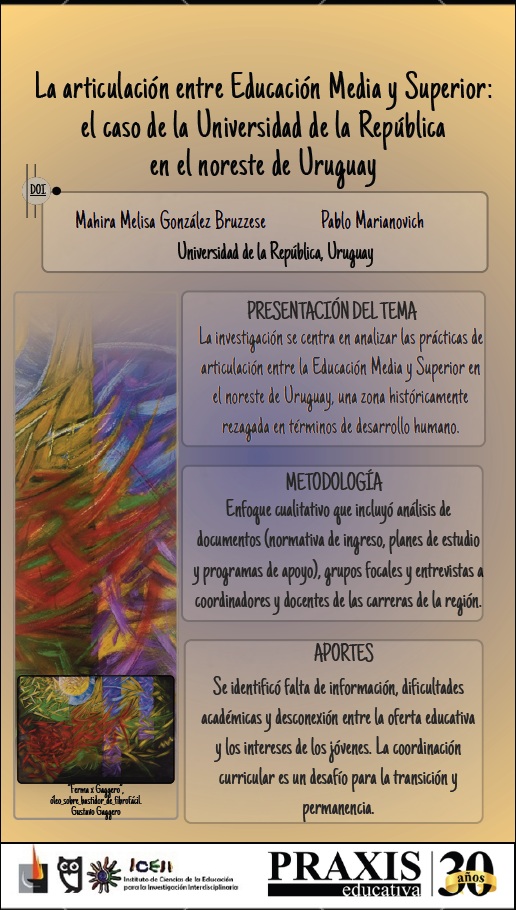
The articulation between upper secondary and higher education: the case of the University of the Republic in northeastern Uruguay
DOI:
https://doi.org/10.19137/praxiseducativa-2026-300117Keywords:
higher education, democratization of education, articulation, Education policyAbstract
In recent decades, Latin America has seen strong growth in higher education, promoting its democratization. In this context, the University of the Republic of Uruguay included the goal of generalized university access in its 2020-2024 Strategic Plan. This research focuses on analyzing the coordination policies between secondary and higher education in Northeast Uruguay, an area historically lagging in terms of human development. Coordination practices such as guidance, academic preparation courses, and mentoring are explored. Through a qualitative approach, problems such as a lack of information about majors, academic difficulties, and a disconnect between educational offerings and young people's interests were identified. Although some support practices have been implemented, the lack of curricular coordination between secondary and higher education remains a central challenge for students' transition to and retention in university.
Downloads
References
Aveleyra, R. (2023). Informe regional: educación superior en América Latina. CLACSO.
Benítez González, M. C., Speratti Mendoza, H. M. y Rolón, V. (2023). Articulación curricular entre la educación media y la educación superior a partir de publicaciones realizadas en la REDALYC. Revista Científica de Estudios e Investigaciones, 12(1), 38-55. https://doi.org/10.26885/rcei.12.1.3
Camargo Casallas, E., Garzón, G. E. Y. y Urrego, L. S. (2012). Articulación de la educación media y superior para Bogotá. Visión electrónica, 6(2), 160-171. https://revistas.udistrital.edu.co/index.php/visele/article/view/388
Comisión Sectorial de Enseñanza. (s.f.). Programa de Respaldo al Aprendizaje. https://www.cse.UDELAR.edu.uy/PROGRESA-old/
Comisión Sectorial de Enseñanza. Unidades de Apoyo a la Enseñanza. https://www.cse.UDELAR.edu.uy/recursos/uaes/
Comisión Sectorial de Enseñanza-Centro Universitario de Tacuarembó. (s.f.). Unidad de Apoyo a la Enseñanza - Centro Universitario Regional Noreste Tacuarembó. https://www.cse.UDELAR.edu.uy/recursos/uaes/centro-universitario-regional-noreste-tacuarembo/
Comisión Sectorial de Enseñanza-Sede Rivera. (s.f.). Unidad de Apoyo a la Enseñanza - Centro Universitario Regional Noreste Rivera. https://www.cse.UDELAR.edu.uy/recursos/uaes/centro-universitario-regional-norte-rivera/
Diaz Rios, C. M. (2012). La política de articulación entre la educación media y la superior. El caso de los programas de la Secretaría de Educación de Bogotá. Investigación & Desarrollo, 20(2), 230-253. https://rcientificas.uninorte.edu.co/index.php/investigacion/article/view/4470
Fernández, T. (2024). El creciente (¿y necesario?) divorcio entre la Educación Media y la Educación Superior de Uruguay de los últimos 30 años. VIII Congreso Internacional de investigación Educativa. Facultad de Ciencias de la Educación, Universidad Nacional de Comahue.
Fernández, T. y Ríos, A. (2014). El tránsito entre ciclos en la Educación Media y Superior de Uruguay. CSIC-UDELAR.
Fernández, T., Gonzalez, M., Sommer, M., Buschiazzo, V. y Calixto, P. (2020). Largos Caminos. La descentralización de la enseñanza de grado y la inclusión educativa en las sedes de Maldonado, Rivera y Tacuarembó de la Universidad de la República (2007-2018). Facultad de Ciencias Sociales-CSIC.
Fernández, T., Trevignani, V., Cardozo, S., Pacífico, A., Marques, A., Kunrath, R. y Da Cunha, P. (2022). Perfil de ingreso, puntos de bifurcación en la trayectoria y desafiliación en el ingreso a la universidad: un estudio de caso comparado en tres universidades de Argentina, Brasil y Uruguay. Universidad Nacional del Litoral.
Figueroa, V. (2018). Claves para comprender el acceso de los estudiantes del interior del país a la Universidad de la República. Una investigación realizada en Salto, Tacuarembó y Cerro Largo [Tesis de maestría en Sociología]. Montevideo, Facultad de Ciencias Sociales.
Guerrero-Mosquera, A., Martínez-Benavides, J. A. y Guazmayán-Ruiz, C. A. (2012). Articulación entre la educación media y superior: Universidad de Nariño. Magis. Revista Internacional de Investigación en Educación, 4(9), 741-753.
Naciones Unidas. (2015). Transformar nuestro mundo: la Agenda 2030 para el Desarrollo Sostenible. https://sdgs.un.org/es/2030agenda
Observatorio Territorio Uruguay. (2018). Índice de Desarrollo Humano por departamento. https://otu.opp.gub.uy/?q=listados/listados_datos_formato&id=2679&cant=19&deptos=1,2,3,4,5,6,7,8, 9,10,11,12,13,14,15,16,17,18,19&fecha=2018-01-0
Pacífico, A., Mántaras, B., Trevignani, V., Beltramino, V. y Sejas, N. (2019). Instituciones, sujetos y trayectorias. Universidad Nacional del Litoral.
Rossano, A. (2006). El pasaje de la primaria a la secundaria como transición educativa. En F. Terigi (Comp.), Diez miradas sobre la escuela primaria. Siglo XXI Editores.
Rubio, R. G., Mejía, H. E. y Huertas, V. M. (2015). Articulación de la educación media con la educación superior: instrumento administrativo para el sector educativo de la ciudad de Ibagué. Praxis Educativa, 11, 76-88.
Sánchez Echeverri, D. M. (2024). La articulación en la transición de la educación media a la educación superior, el caso colombiano: Universidad en Tu Colegio. Praxis Educativa, 28(1), 1-18. https://doi.org/10.19137/praxiseducativa-2024-280108
Santiviago, C. (2018). Las tutorías entre pares como estrategia de apoyo y herramienta de transformación de la educación superior. Comisión Sectorial de Enseñanza, Universidad de la República.
UNESCO. (2020). Las mujeres en ciencias, tecnología, ingeniería y matemáticas en América Latina y el Caribe. https://www.unesco.org/es/gender-equality/education/stem
UNESCO. (2020). Hacia el acceso universal a la educación superior: tendencias internacionales. https://unesdoc.unesco.org/ark:/48223/pf0000375683
Universidad de la República. (2011). Ordenanza de estudios de grado y otros programas de formación terciaria.
Universidad de la República. (2020). Propuesta al país 2020-2024. Plan estratégico de desarrollo de la Universidad de la República. https://UDELAR.edu.uy/portal/presupuesto-2020/documentos/
Uzuriaga López, V. L., Posso Agudelo, A. E. y Martínez Acosta, A. (2013). Algunas estrategias para mejorar la articulación de la educación media con la superior. Scientia Et Technica, 18(4), 732-736. https://doi.org/10.22517/23447214.8859
Vergara Hernández, C. I. y Arévalo Tovar, L. (2019). Reflexión teórica sobre la transición académica en educación superior. Panorama Económico, 27(1), 194-207. https://doi.org/10.32997/2463-0470-vol.27-num.1-2019-2623
Published
Issue
Section
License
Copyright (c) 2026 MAHIRA MELISA GONZALEZ BRUZZESE, Pablo Marianovich

This work is licensed under a Creative Commons Attribution-NonCommercial-ShareAlike 4.0 International License.
Copyright Notice
Editorial Committee Educational Praxis Magazine:
I hereby declare that I am the author of the article titled (article name), that it is original and my own and that it was not previously published in any other format or medium. I declare to know that the magazine will not charge me any type of fee under any circumstances, nor will I receive any type of monetary compensation If it were accepted for publication in Educational Praxis, I authorize the aforementioned magazine to publish it digitally and to advertise it on its social networks.
If the work is published, I adhere to the Creative Commons license called "Attribution - Non-Commercial Share Alike CC BY-NC-SA", through which it is allowed to copy, reproduce, distribute, publicly communicate the work and generate derivative works, as long as when the original author is cited and acknowledged. This license has been used since September 2018. In 2016 CC BY NC ND 4.0 was adhered to; and in the years 2017 and 2018 (January-August) CC BY NC 4.0.
This CC BY-NC-SA Share Alike license does not, however, permit commercial use of the work. As an author, the journal may establish additional agreements for the non-exclusive distribution of the version of the work published in the journal, it allows me to self-archive the published articles, in their post-print version, in institutional, thematic repositories, personal web pages or any other relevant use. with the recognition of having been first published in this journal.
Educational Praxis adheres to DORA (Declaration on Research Assessment) signed in San Francisco, California, on December 16, 2012, and to the Declaration of Mexico (Joint Declaration LATINDEX - REDALYC - CLACSO - IBICT).









_(1)2.png)


3.png)








_(2).png)






2.jpg)