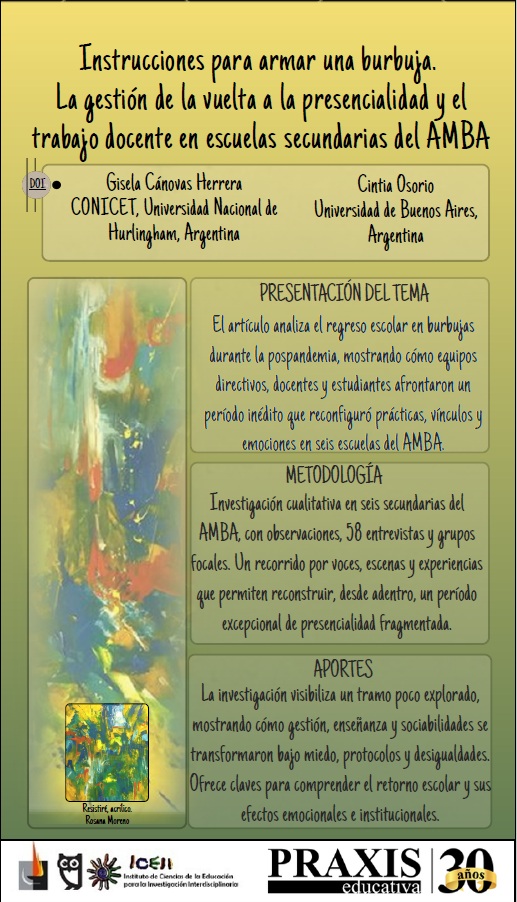
Instructions for Building a Bubble
Managing the return to in-person learning and teaching work in secondary schools in the AMBA region
DOI:
https://doi.org/10.19137/praxiseducativa-2026-300107Keywords:
secondary school, high school, health bubble, teaching work, management team, emotionsAbstract
This article analyzes the return to in-person classes in the Buenos Aires Metropolitan Area after the COVID-19 lockdown, focusing on the impact of the bubble model on school organization and teachers’ work. Based on a sociological approach and fieldwork in six secondary schools, the study reveals how the simultaneity of in-person and virtual classes blurred the boundaries of work time and space, leading to an unsustainable workload. From a socio-anthropological perspective, it also explores the role of emotions, especially fear, in the reconfiguration of school spaces. The study highlights the tensions faced by teachers and school leaders and evidences teachers' skepticism about the effectiveness of educational policies, often perceived as a "simulation" in response to urgent demands. The findings underscore the importance of educational policies having clear objectives and shared meanings to achieve sustainable transformations in the education system.
Downloads
References
Ahmed, S. (2015). La política cultural de las emociones. UNAM-PUEG.
Alucin, S. (2023). Políticas educativas durante la pandemia en el nivel medio. Una mirada sobre el malestar docente. Praxis Educativa, 27(3), 1-19. https://doi.org/10.19137/praxiseducativa-2023-270310
Anderete Schwal, M. (2022). El confinamiento y la vuelta a clases en Argentina: Relatos de docentes sobre la desigualdad en pandemia. Texto Livre, 15.
Arroyo, M., Felicioni, S. y Merodo, A. (2022). Alteraciones del trabajo docente en escuelas secundarias del conurbano. Reconfiguración e incertidumbre. En Educación secundaria, desigualdad, pandemia y horizontes pospandemia. Puntoaparte.
Ball, S. (2002). Textos, discursos y trayectorias de la política: La teoría estratégica. Páginas, 2, 19-33.
Consejo Federal de Educación. (2020). Resolución CFE n.o 370/2020: Marco de análisis y evaluación de riesgo epidemiológico. https://www.argentina.gob.ar/sites/default/files/anexo_res_cfe_370_marco_y_eval_if-2020-68356394-a pn-sgcfeme.pdf
Elias, N. (1990). Cambios en el equilibrio entre el yo y el nosotros. En La sociedad de los individuos (pp. 177-270). Península.
ENCRESPA. (2022). Datos destacados de la encuesta a docentes de nivel secundario—Argentina 2021 (5). Subred Educación. http://encrespa.web.unq.edu.ar/2022/06/25/informe-n5/
Goffman, E. (2001). Internados. Ensayos sobre la situación social de los enfermos mentales. Amorrortu.
Iglesias, A., Alterman, D. y Giovanardi, A. (2022). Experiencias docentes en pandemia. Las escuelas secundarias argentinas entre la virtualidad y el desafío del regreso a la presencialidad. Voces de la educación, 217-256.
Le Breton, D. (2010). Ocultando el rostro. En Rostros. Ensayo antropológico (pp. 183-220). Letra Viva.
Matovich, I. y Bucciarelli, M. E. (2021). El regreso a clases 2021: Un análisis de los protocolos provinciales.CIPPEC. https://www.cippec.org/textual/el-regreso-a-clases-2021-un-analisis-de-los-protocolos-provinciales/
Meo, A. I. y Dabenigno, V. (2021). Teletrabajo docente durante el confinamiento por COVID19 en Argentina. Condiciones materiales y perspectivas sobre la carga de trabajo, la responsabilidad social y la toma de decisiones. Revista de Sociología de la Educación-RASE, 14(1), 103. https://doi.org/10.7203/RASE.14.1.18221
Morgade, G. (2020). La pandemia y el trabajo de las mujeres en foco: Acerca del «cuidado» como categoría y eje de las políticas. En Pensar la educación en tiempos de pandemia: Entre la emergencia, el compromiso y la espera. UNIPE.
Natanson, J. (enero de 2021). Qué hacer con los “jóvenes irresponsables”. Le Monde Diplomatique.
Niedzwiecki, D. (2010). Preceptores, de la reproducción normativa a la construcción artesanal de vínculos [Tesis de maestría]. FLACSO Argentina.
Nobile, M. y Tobeña, V. (2023). Los desafíos de la gestión directiva en pandemia como claves para pensar la configuración desigual del sistema educativo del nivel secundario en CABA. Cuadernos de Educación, 21, 62-74.
Vázquez, M. (2023). “Ahora es nuestro tiempo”. Activismos juveniles en las nuevas derechas durante la pandemia (Argentina, 2020-2022). IBEROAMERICANA. América Latina - España - Portugal, 117-137. https://doi.org/10.18441/IBAM.23.2023.82.117-137
Vommaro, P. (enero de 2021). La juventud como chivo expiatorio. Le Monde Diplomatique.
Published
Issue
Section
License
Copyright (c) 2026 Gisela Canovas Herrera, Cintia Osorio

This work is licensed under a Creative Commons Attribution-NonCommercial-ShareAlike 4.0 International License.
Copyright Notice
Editorial Committee Educational Praxis Magazine:
I hereby declare that I am the author of the article titled (article name), that it is original and my own and that it was not previously published in any other format or medium. I declare to know that the magazine will not charge me any type of fee under any circumstances, nor will I receive any type of monetary compensation If it were accepted for publication in Educational Praxis, I authorize the aforementioned magazine to publish it digitally and to advertise it on its social networks.
If the work is published, I adhere to the Creative Commons license called "Attribution - Non-Commercial Share Alike CC BY-NC-SA", through which it is allowed to copy, reproduce, distribute, publicly communicate the work and generate derivative works, as long as when the original author is cited and acknowledged. This license has been used since September 2018. In 2016 CC BY NC ND 4.0 was adhered to; and in the years 2017 and 2018 (January-August) CC BY NC 4.0.
This CC BY-NC-SA Share Alike license does not, however, permit commercial use of the work. As an author, the journal may establish additional agreements for the non-exclusive distribution of the version of the work published in the journal, it allows me to self-archive the published articles, in their post-print version, in institutional, thematic repositories, personal web pages or any other relevant use. with the recognition of having been first published in this journal.
Educational Praxis adheres to DORA (Declaration on Research Assessment) signed in San Francisco, California, on December 16, 2012, and to the Declaration of Mexico (Joint Declaration LATINDEX - REDALYC - CLACSO - IBICT).









_(1)2.png)


3.png)








_(2).png)






2.jpg)