Democratic transitions and episcopates in Colombia and Venezuela (1957-1959)
DOI:
https://doi.org/10.19137/qs.v30i1.8995Keywords:
Dictatorship, Democracy, Episcopate, Political crisisAbstract
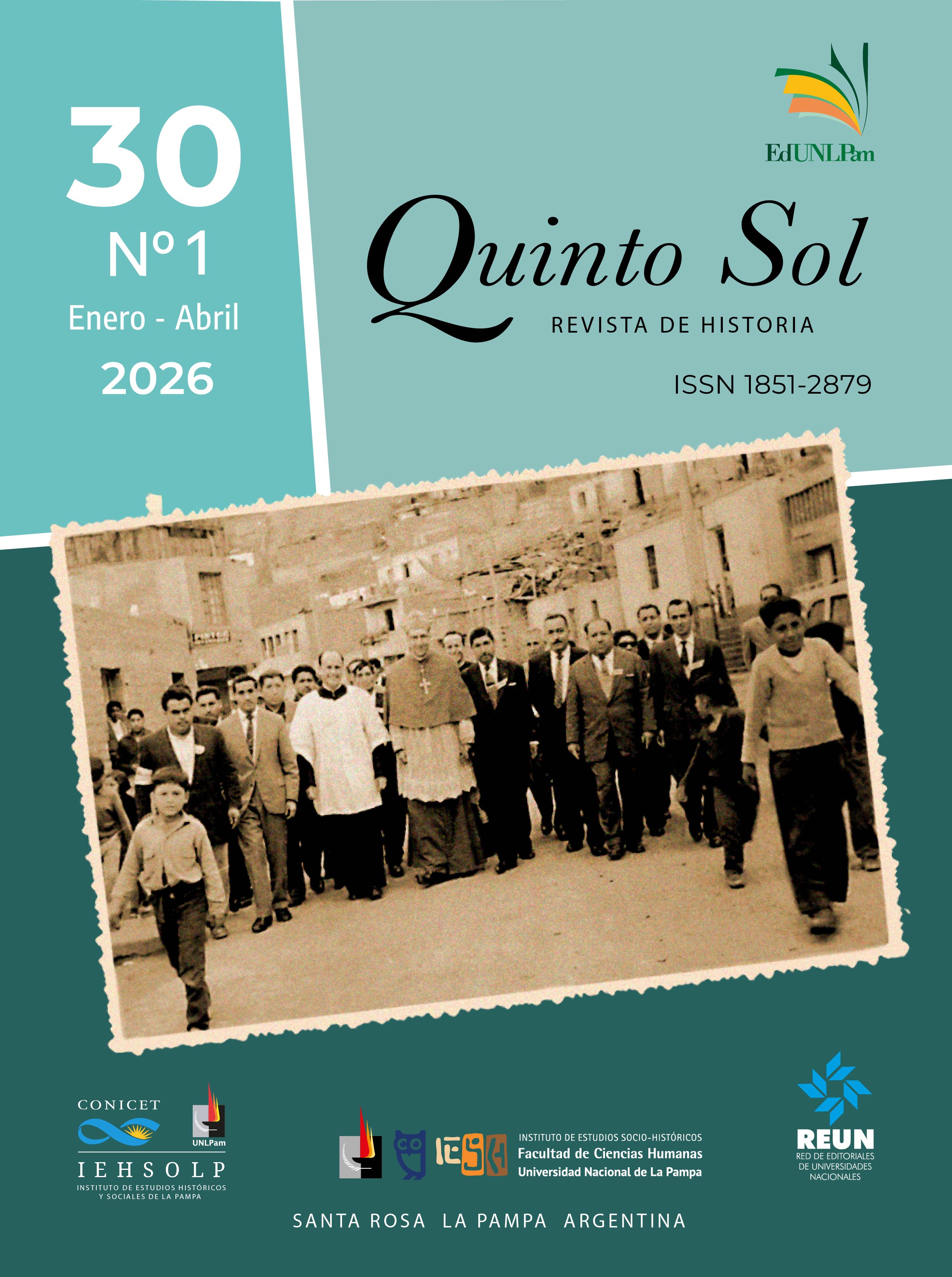
Between 1957 and 1959, a critical juncture developed in Colombia and Venezuela, beginning with the collapse of dictatorships and culminating in the establishment of restricted democratic systems. This article compares the trajectories of the episcopates of both countries, arguing that the Catholic hierarchies coincided in taking distance from the governments of Rojas Pinilla in Colombia and Pérez Jiménez in Venezuela, incorporating pro-democratic civil coalitions for the overthrow of authoritarian regimes and supporting the partisan pacts that created a new political system. In the years leading up to the Second Vatican Council, the bishops of two neighboring but different churches established a new interaction with the state, which led to a reassessment of the political influence of the religious institution. This analysis draws on concepts from historical institutionalism, such as antecedents and critical junctures, change, agency, and trajectories of dependency.
Downloads
References
Abel, C. (1987). Política, Iglesia y Partidos en Colombia. Universidad Nacional de Colombia.
Andersen, J. (2009). Christianity and democratisation: From pious subjects to critical participants. Manchester University Press.
Archila, M. (1995). Protestas sociales en Colombia 1946-1958. Historia Crítica, 1(11), 63-78. https://doi.org/10.7440/histcrit11.1995.03
Arias, R. (2003). El episcopado colombiano. Intransigencia y laicidad (1850-2000). Universidad de los Andes-Instituto Colombiano de Antropología e Historia. https://doi.org/10.57784/1992/56001
Arráiz, R. (2016). El “trienio Adeco” (1945-1948) y las conquistas de la ciudadanía. Editorial Alfa.
Arráiz, R. (2020). La democracia en Venezuela: un proyecto inconcluso. Alfa.
Atehortúa, A. L. (2010). El golpe de Rojas y el poder de los militares. Folios, (31), 33-48. https://doi.org/10.17227/01234870.31folios33.48
Atehortúa, A. y Rojas, D. (2005). Venezuela antes de Chávez: auge y derrumbe del sistema de "punto fijo". Anuario Colombiano de Historia Social y de la Cultura, (32),255-274. https://dialnet.unirioja.es/servlet/articulo?codigo=9007391
Ayala, C. A. (1991). El discurso de la conciliación: análisis cuantitativo de las intervenciones de Gustavo Rojas Pinilla entre 1952 y 1959. Anuario Colombiano de Historia Social y de la Cultura, (18-19), 205-243. https://revistas.unal.edu.co/index.php/achsc/article/view/35911
Betancourt, R. (1968). La revolución democrática en Venezuela. Tomo I. Imprenta Nacional.
Braun, H. (2013). Mataron a Gaitán. Vida pública y violencia urbana en Colombia. Punto de Lectura.
Caballero, M. (1998). Las crisis de la Venezuela contemporánea. Monte Ávila.
Capoccia, G. (2015). Critical junctures and institutional change. En J. Mahoney y K. Thelen (Eds.), Advances in Comparative-Historical Analysis (pp. 147-179). Cambridge University Press. https://doi.org/10.1017/CBO9781316273104
Capoccia, G. (2016). Critical Juntures. En O. Fioretos, T. Falleti y A. Sheingate (Eds.), The Oxford Handbook of Historical Institutionalism (pp. 89-106). Oxford University Press. https://doi.org/10.1093/oxfordhb/9780199662814.013.5
Cifuentes, M. y Florián, A. (2004). El catolicismo social: entre el integralismo y la Teología de la Liberación. En A. Bidegain (Dir.), Historia del cristianismo en Colombia: corrientes y diversidad (pp. 321-372). Taurus.
Crisp, B., Levine, D. y Molina, J. (2000). El ascenso y la decadencia del COPEI en Venezuela. En S. Mainwaring y T. Scully (Eds.), La democracia cristiana en América Latina. Conflictos y competencia electoral (pp. 365-397). Fondo de Cultura Económica.
Di Tella, T. (2013). Historia de los partidos políticos en América Latina. Fondo de Cultura Económica.
Duque Daza, J. (2022). El plebiscito de 1957 en Colombia. El pacto de élites y su refrendación popular. Criterio Libre, 19(35), 252-268. https://doi.org/10.18041/1900-0642/criteriolibre.2021v19n35.8375
Galvis, S. y Donadio, A. (1988). El jefe supremo. Rojas Pinilla en La Violencia y el poder. Planeta.
Garzón, I. (2020). Rebeldes, románticos y profetas. La responsabilidad de sacerdotes, políticos e intelectuales en el conflicto armado colombiano. Ariel/ Universidad de La Sabana.
Giraldo, J. (2018). Populistas a la colombiana. Debate.
González, F. (1997). Poderes enfrentados. Iglesia y Estado en Colombia. Centro de Investigación y Educación Popular.
GrzyMala-Busse, A. (2016). Weapons of the Meek: How Churches Influence Public Policy. World Politics, 68(1), 1-36. https://doi.org/10.1017/S0043887115000301
Gutiérrez, F. (2014). El orangután con sacoleva. Cien años de democracia y represión en Colombia (1910-2010). Debate/Universidad Nacional de Colombia.
Gutiérrez, F. (2017). La destrucción de una república. Taurus/Universidad Externado de Colombia.
Gutiérrez Ardila, D. (2024). La Regeneración. Nueva historia de un proceso político y constituyente que transformó a Colombia (1875-1886). Taurus.
Hall, P. (2012). Historical Institutionalism in Rationalist and Sociological Perspective. En J. Mahoney y K. Thelen (Eds.), Advances in Comparative-Historical Analysis (pp. 204–224). Cambridge University Press. https://doi.org/10.1017/CBO9780511806414
Henderson, J. (2006). La modernización en Colombia. Los años de Laureano Gómez 1889-1965. Editorial Universidad de Antioquia.
Huntington, S. (2002). La tercera ola: la democratización a finales del siglo XX. Paidós.
Klaiber, J. (1997). Iglesia, dictaduras y democracia en América Latina. Pontificia Universidad Católica del Perú.
Krzywicka, K. (2014). Las relaciones entre el Estado y la Iglesia en Venezuela: desarrollo histórico, normas jurídicas y bases institucionales. Revista del CESLA, (17), 15-42. https://www.revistadelcesla.com/index.php/revistadelcesla/article/view/41
Levine, D. (1974). Venezuela después de 1958: restauración y consolidación de la política democrática. Desarrollo Económico, 14(55), 441-480. https://doi.org/10.2307/3466156
Levine, D. (1978). Models, Authority in Church and Society: Latin American Models. Comparative Studies in Society and History, 20(4), 517-544. https://doi.org/10.1017/S0010417500012548
Levine, D. (1981). Religion and Politics in Latin America The Catholic Church in Venezuela & Colombia. Princeton University Press.
Mahoney, J. (2001). The Legacies of Liberalism Path Dependence and Political Regimes in Central America. The Johns Hopkins University Press.
Mahoney, J., Mohamedali, K. y Nguyen, C. (2016). Causality and Time in Historical Institutionalism. En O. Fioretos, T. Falleti y A. Sheingate (Eds.), The Oxford Handbook of Historical Institutionalism (pp. 71-88). Oxford University Press. https://doi.org/10.1093/oxfordhb/9780199662814.013.4
Mantilla, L. F. (2011). Scripture, structure and the formation of Catholic parties: The case of Venezuela. Party Politics, 18(3), 369-390. https://doi.org/10.1177/1354068810382938
March, J. y Olsen, J. (2006). Elaborating the "New Institutionalism". En R. Rhodes, S. Binder y B. Rockman (Eds.), The Oxford Handbook of Political Institutions (pp. 3-20). Oxford University Press. https://doi.org/10.1093/oxfordhb/9780199548460.003.0001
Murgueitio, C. A. (2005). Los gobiernos militares de Marcos Pérez Jiménez y Gustavo Rojas Pinilla: nacionalismo, anticomunismo y sus relaciones con los Estados Unidos (1953-1957). Historia y Espacio, 1(25), 39-97. https://doi.org/10.25100/hye.v1i25.1642
Palacios, M. (2001). De populistas, mandarines y violencias. Luchas por el poder. Planeta.
Palacios, M. (2008). Entre la legitimidad y la violencia. Colombia 1875-1994. Norma.
Palacios, M. (2012). Violencia pública en Colombia, 1958-2010. Fondo de Cultura Económica.
Pécaut, D. (2012). Orden y violencia: Colombia 1930-1953. Fondo Editorial Universidad Eafit.
Pécaut, D. (2008). Crónica de cuatro décadas de política colombiana. Norma.
Quintero, I. (2018). El siglo XX: conquista, construcción y defensa de la democracia. En E. Pino Iturrieta (Coord.), Historia mínima de Venezuela (pp. 141-232). El Colegio de México/Turner.
Ramírez Bonilla, L. (2015). Entre altares y mesas de diálogo. El episcopado colombiano en acercamientos de paz con grupos armados ilegales (1994-2006). Debate/Instituto de Estudios Políticos y Relaciones Internacionales-Universidad Nacional de Colombia.
Reid, M. (2018). El continente olvidado. Una historia de la nueva América Latina. Crítica.
Rodríguez Cuadros, J. (2020). Iglesias locales y construcción de paz. Los casos de Barrancabermeja, Quibdó, San Vicente del Caguán y Tumaco. Centro de Investigación y Educación Popular.
Rodríguez Iturbe, J. (1968). Iglesia y Estado en Venezuela (1824-1964). Universidad Central de Venezuela.
Rodríguez Iturbe, J. (1984). Crónica de la década militar. Ediciones Nueva Política.
Rodríguez Iturbe, J. (2024). Venezuela: la persecución de la sombra. De la Cosiata al octubrismo. Alfa.
Rouquié, A. (1984). El Estado militar en América Latina. Siglo XXI.
Slater, D. y Simmons, E. (2009). Informative Regress: Critical Antecedents in Comparative Politics. Comparative Political Studies, 43(7), 886-917. https://doi.org/10.1177/0010414010361343
Soifer, D. (2012). The Causal Logic of Critical Junctures. Comparative Political Studies, 45(12), 1572-1597. https://doi.org/10.1177/0010414012463902
Streeck, W. y Thelen, K. (2005). Introduction: Institutional Change in Advanced Political Economies. En W. Streeck y K. Thelen (Eds.), Beyond Continuity Institutional Change in Advanced Political Economies (pp. 1-39). Oxford University Press.
Thelen, K. y Mahoney, J. (2015). Comparative-historical analysis in contemporary political science. En J. Mahoney y K. Thelen (Eds.), Advances in Comparative-Historical Analysis (pp. 3-36). Cambridge University Press. https://doi.org/10.1017/CBO9781316273104
Thelen, K. y Steinmo, S. (1992). Historical institutionalism in comparative politics. En S. Steinmo, K. Thelen y F. Longstreth (Eds.), Structuring Politics. Historical Institutionalism in Comparative Analysis (pp. 1-32). Cambridge University Press. https://doi.org/10.1017/CBO9780511528125
Tirado Mejía, A. (2019). La Revolución en marcha. El primer gobierno de Alfonso López Pumarejo 1934-1938. Debate/Universidad Nacional de Colombia.
Tirado Mejía, A. (2022). Una historia política de Colombia. Del siglo XIX al Frente Nacional. Debate.
Wilde, A. (1984). Redemocratization, the Church and Democracy in Colombia (Working paper n.° 22). Universidad de Notre Dame. https://doi.org/10.7274/26127115.v1
Downloads
Published
Issue
Section
License
Copyright (c) 2025 Quinto Sol

This work is licensed under a Creative Commons Attribution-NonCommercial-ShareAlike 4.0 International License.
When submitting their contributions, authors must declare that they have the permission of the file or repository where the documents that are attached to the work were obtained, whatever their format (unpublished manuscripts, images, audiovisual files, etc.). Such permission authorizes their publication and reproduction, releasing the journal and its editors from any liability or claim from third parties.
Likewise, authors must adhere to the Creative Commons license called "Attribution - Non-Commercial CC BY-NC-SA", through which the author allows copying, reproducing, distributing, publicly communicating the work and generating derivative works, as long as the original author is properly quoted and acknowledged. It is not allowed, however, to use the work for commercial purposes. Authors may establish additional agreements for the non-exclusive distribution of the version of the paper published in the journal (for example, placing it in an institutional repository or publishing it in a book), with the acknowledgment of having been published first in this journal.
The publication of content in this journal does not imply any royalty or charge for taxpayers.
Quinto Sol adheres to the DORA (Declaration on Research Assessment) signed in San Francisco, California, on December 16, 2012, and to the Declaration of Mexico (Joint Declaration LATINDEX - REDALYC - CLACSO - IBICT).






4.png)
2.png)









_(2).png)


1.jpg)



1.jpg)