Dialogues with IA·MAE: Art Education and Emerging Postdigital Challenges for (Future)Teachers
DOI:
https://doi.org/10.19137/praxiseducativa-2026-300308Keywords:
postdigitality, art education, artificial intelligence, teacher education, Ana Mae BarbosaAbstract
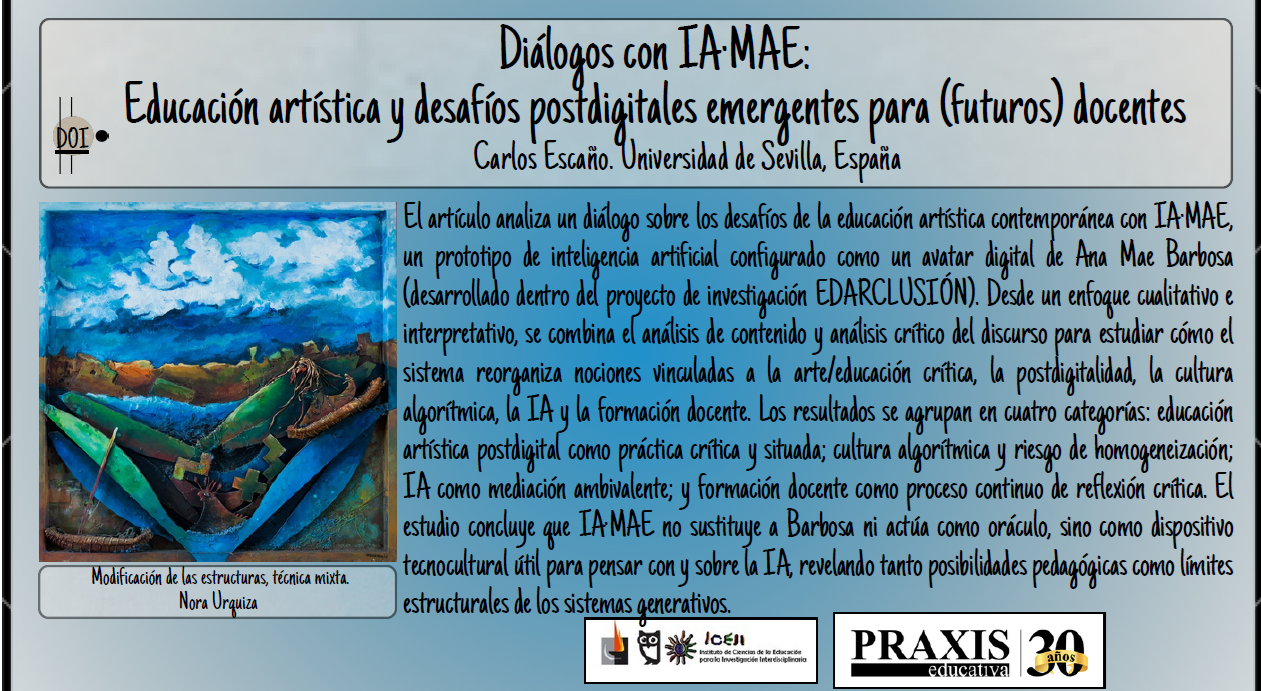
The article analyses a dialogue on the challenges of contemporary art education with IA·MAE, an artificial intelligence prototype configured as a digital avatar of Ana Mae Barbosa and developed within the EDARCLUSIÓN research project. From a qualitative and interpretive approach, the study combines content analysis and critical discourse analysis to examine how the system reorganises notions linked to critical art/education, postdigitality, algorithmic culture, artificial intelligence and teacher education. The results are grouped into four categories: postdigital art education as a critical and situated practice; algorithmic culture and the risk of homogenisation; AI as an ambivalent mediation; and teacher education as a continuous process of critical reflection. The study concludes that IA·MAE neither replaces Barbosa nor acts as an oracle, but rather operates as a technocultural device useful for thinking with and about AI, revealing both pedagogical possibilities and structural limits of generative systems.
References
Barbosa, A. M. (2019). A imagem no ensino da arte: Anos 1980 e novos tempos. Perspectiva.
Barbosa, A. M. (2022). Arte/Educación. Textos seleccionados. CLACSO.
Beer, D. (2017). The social power of algorithms. Information, Communication & Society, 20(1), 1–13. https://doi.org/10.1080/1369118X.2016.1216147
Braun, V., & Clarke, V. (2021). Thematic analysis: A practical guide. SAGE.
Bucher, T. (2018). If... then: Algorithmic power and politics. Oxford University Press.
Crawford, K. (2021). Atlas of AI: Power, politics, and the planetary costs of artificial intelligence. Yale University Press.
Escaño, C. (2023). Educación postdigital: Un enfoque desde la pedagogía crítica y mediática para un contexto post-COVID19. Revista Mediterránea de Comunicación, 14(2), 243–257. https://doi.org/10.14198/MEDCOM.23899
Escaño, C., Ferreira de Lima, S. P., & Feltrero, R. (2026). Educación artística inclusiva e inteligencia artificial: Análisis discursivo comparativo entre Ana Mae Barbosa y su avatar digital. Arte, Individuo y Sociedad, 38(2), 433–445. https://dx.doi.org/10.5209/aris.105507
Fairclough, N. (2003). Analysing discourse: Textual analysis for social research. Routledge.
Feltrero, R., García-Cuadrado, C., & Escaño, C. (2026). Modelos de lenguaje personalizados e innovación abierta para la educación artística con LLMeducakit, en C. Escaño & J. Mañero. Educación Artística Inclusiva. Fundamentos y praxis para tiempos postdigitales. (pp. 273-300). Dykinson.
Freire, P. (1997). Pedagogía de la autonomía: Saberes necesarios para la práctica educativa. Siglo XXI.
Giroux, H. A. (1990). Los profesores como intelectuales. Hacia una pedagogía crítica del aprendizaje. Paidós.
Jandrić, P., Escaño, C., & Mañero, J. (2023). Pedagogía crítica postdigital y justicia social bioinformacional. Profesorado. Revista de Currículum y Formación del Profesorado, 27(1), 61–80. https://doi.org/10.30827/profesorado.v27i1.24645
Jandrić, P., Knox, J., Besley, T., Ryberg, T., Suoranta, J., & Hayes, S. (2018). Postdigital science and education. Educational Philosophy and Theory, 50(10), 893–899. https://doi.org/10.1080/00131857.2018.1454000
Knox, J. (2019). What does the postdigital mean for education? Three critical perspectives on the digital, with implications for educational research and practice. Postdigital Science and Education, 1, 357–370. https://doi.org/10.1007/s42438-019-00045-y
Kuckartz, U. (2014). Qualitative text analysis: A guide to methods, practice and using software. SAGE.
Larson, E. J. (2021). The myth of artificial intelligence: Why computers can’t think the way we do. Harvard University Press.
Mañero, J. (2023). La no revolución digital o cómo la postdigitalidad cuestiona nuestro presente cultural. ASRI. Arte y Sociedad. Revista de Investigación en Artes y Humanidades Digitales, 23, 1–12. https://doi.org/10.5281/zenodo.8182808
Misselhorn, C. (2025). La inteligencia artificial y el fin del arte. Herder.
Paglen, T. (2016). Invisible images: Your pictures are looking at you. The New Inquiry.
Scott, R. (Director). (1982). Blade Runner [Película]. The Ladd Company; Shaw Brothers; Warner Bros.
Striphas, T. (2015). Algorithmic culture. European Journal of Cultural Studies, 18(4–5), 395–412. https://doi.org/10.1177/1367549415577392
Terranova, T. (2022). After the Internet: Digital networks between capital and the common. Semiotext(e).
UNESCO. (2021). AI and education: Guidance for policy-makers. UNESCO. https://doi.org/10.54675/PCSP7350
UNESCO. (2023). Foundation models such as ChatGPT through the prism of the UNESCO Recommendation on the Ethics of Artificial Intelligence. UNESCO. https://doi.org/10.54678/BGIV6160
van Dijk, T. A. (2008). Discourse and power. Palgrave Macmillan.
Zafra, R. (2015). Ojos y capital. Cosinni.
Zuboff, S. (2019). The age of surveillance capitalism: The fight for a human future at the new frontier of power. Public Affairs.
Downloads
Published
Issue
Section
License
Copyright (c) 2026 Carlos Escaño

This work is licensed under a Creative Commons Attribution-NonCommercial-ShareAlike 4.0 International License.
Copyright Notice
Editorial Committee Educational Praxis Magazine:
I hereby declare that I am the author of the article titled (article name), that it is original and my own and that it was not previously published in any other format or medium. I declare to know that the magazine will not charge me any type of fee under any circumstances, nor will I receive any type of monetary compensation If it were accepted for publication in Educational Praxis, I authorize the aforementioned magazine to publish it digitally and to advertise it on its social networks.
If the work is published, I adhere to the Creative Commons license called "Attribution - Non-Commercial Share Alike CC BY-NC-SA", through which it is allowed to copy, reproduce, distribute, publicly communicate the work and generate derivative works, as long as when the original author is cited and acknowledged. This license has been used since September 2018. In 2016 CC BY NC ND 4.0 was adhered to; and in the years 2017 and 2018 (January-August) CC BY NC 4.0.
This CC BY-NC-SA Share Alike license does not, however, permit commercial use of the work. As an author, the journal may establish additional agreements for the non-exclusive distribution of the version of the work published in the journal, it allows me to self-archive the published articles, in their post-print version, in institutional, thematic repositories, personal web pages or any other relevant use. with the recognition of having been first published in this journal.
Educational Praxis adheres to DORA (Declaration on Research Assessment) signed in San Francisco, California, on December 16, 2012, and to the Declaration of Mexico (Joint Declaration LATINDEX - REDALYC - CLACSO - IBICT).
How to Cite









_(1)2.png)