Project-Based Learning: a response to the COVID-19 crisis.
DOI:
https://doi.org/10.19137/praxiseducativa-2026-300317Keywords:
Project-Based Learning, Active Learning, Educational Innovation, Educational Crisis, PandemicAbstract
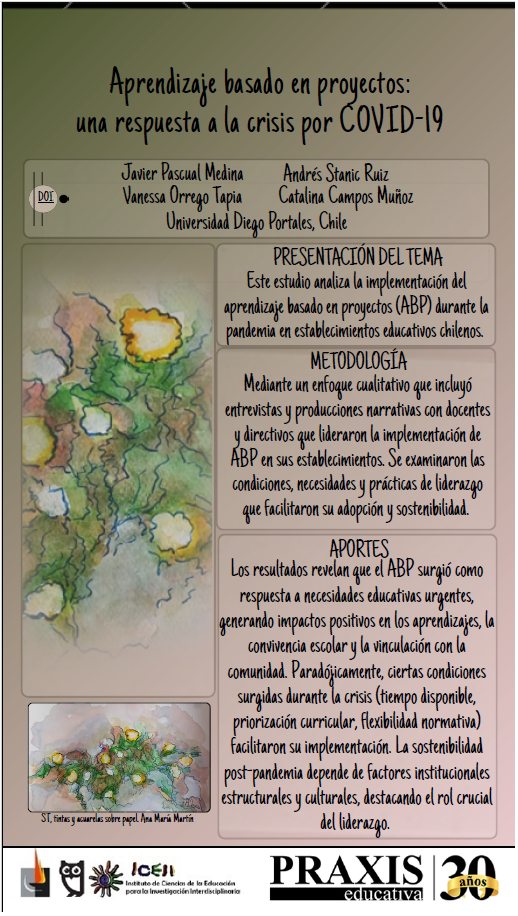
This study analyses the implementation of Project-Based Learning (PBL) during the pandemic in Chilean educational establishments. Using a qualitative approach that included interviews and narrative productions with teachers and administrators who led the implementation of PBL in their establishments, the conditions, needs and leadership practices that facilitated its adoption and sustainability were examined. The results reveal that PBL emerged in response to urgent educational needs, generating positive impacts on learning, school coexistence, and community engagement. Paradoxically, certain conditions that arose during the crisis (available time, curriculum prioritisation, regulatory flexibility) facilitated its implementation. Post-pandemic sustainability depends on structural and cultural institutional factors, highlighting the crucial role of leadership. It is concluded that PBL proved to be a resilient methodology in adverse contexts, suggesting the need to institutionalise flexible pedagogical practices that strengthen the education system's responsiveness to future crises.
References
Alomá, M., Crespo, L. M., González, K., & Estévez, N. (2022). Fundamentos cognitivos y pedagógicos del aprendizaje activo. Mendive. Revista de Educación, 20(4), 1353-1368.
Álvarez, F., Birgin, A., Herrera, J.I., Prats, J., Restrepo, R. y Stefos, E. (2018). Aprendizaje activo para el aula: Una síntesis de fundamentos y técnicas. Cuadernos de Política Educativa, 2. Observatorio de la Educación-UNAE
Asmi, A. W., Rahmat, F., & Adnan, M. (2022). The effect of project-based learning on students' mathematics learning in Indonesia: a systematic literature review. International Journal of Education, Information Technology, and Others, 5(4), 311-333.
Bani-Hamad, A. M. H., & Abdullah, A. H. (2019). The effect of project-based learning to improve the 21st century skills among Emirati secondary students. International Journal of Academic Research in Business and Social Sciences, 9(12), 560-573.
Benavides, F. & Pedró, F. (2007). Políticas educativas sobre nuevas tecnologías en los países iberoamericanos. Revista Iberoamericana de Educación, 45,19-69.
Boss, S., & Larmer, J. (2018). Project based teaching: How to create rigorous and engaging learning experiences. ASCD.
Bradley-Levine, J., & Mosier, G. (2014). Literature review on project-based learning. University of Indianapolis Center of Excellence in Leadership of Learning.
CEPAL & UNESCO (2020). La educación en tiempos de pandemia de COVID-19. UNESCO.
Condliffe, B. (2017). Project-Based Learning: A Literature Review. Working Paper. MDRC.
Díaz, A., & Arana, C. (2024). Impacto del Aprendizaje Basado en Proyectos en el Rendimiento Académico de Estudiantes Ecuatorianos en Instituciones de Básica Superior. MQRInvestigar, 8(2), 680-695.
Duke, N. K., Halvorsen, A. L., Strachan, S. L., Kim, J., & Konstantopoulos, S. (2021). Putting PjBL to the test: The impact of project-based learning on second graders’ social studies and literacy learning and motivation in low-SES school settings. American Educational Research Journal, 58(1), 160-200.
Educación 2020 (2021). Quiénes Somos. https://www.educacion2020.cl/quienes-somos/
Educación 2020 (2023). Aprendizaje Basado en Proyectos: Recomendaciones para quienes acompañan su implementación. Santiago de Chile
educarchile (2020). Encuesta. #Vinculando Aprendizajes. Indagación sobre estrategias de los docentes y apoyos requeridos para la educación a distancia en contexto de crisis sanitaria. educarchile.
Elige Educar, Centro de Estudios de Políticas y Prácticas en Educación [CEPPE], Centro de Investigación Avanzada en Educación [CIAE] & Fundación Reimagina (2021). Situación de docentes y educadores en contexto de pandemia. Elige Educar.
Enríquez, R. (2021). La Efectividad del Aprendizaje Activo en la Práctica Docente. EduSol, 21(74)
Foldnes, N. (2016). The flipped classroom and cooperative learning: Evidence from a randomised experiment. Active Learning in Higher Education, 17(1), 39-49.
Indrawan, E., & Jalinus, N. (2019). Review project based learning. International Journal of Science and Research (IJSR), 8(4), 1014-1018.
Irure, A., & Belletich, O. (2015). El método de aprendizaje basado en proyectos (ABP) en contextos educativos rurales y socialmente desfavorecidos de la educación infantil. Perspectiva Educacional, Formación de Profesores, 54(1), 90-109.
Kokotsaki, D., Menzies, V., & Wiggins, A. (2016). Project-based learning: A review of the literature. Improving schools, 19(3), 267-277.
Lantis, J. S., Kille, K. J., & Krain, M. (2010). Active teaching and learning: The state of the literature. Oxford research encyclopedia of international studies.
Larmer, J., Mergendoller, J. R., & Boss, S. (2015). Setting the standard for project based learning: A proven approach to rigorous classroom instruction. Alexandria, VA: ACSD.
Lugo, M. T. & Brito, A. (2015). Las políticas TIC en la educación de América Latina. Una oportunidad para saldar deudas pendientes. Archivos de Ciencias de la Educación, 9(9),1-16.
Lustosa R., A.C., Yaacov, B.B., Franco Segura, C., Arias Ortiz, E., Heredero, E., Botero, J., Brothers, P., Payva, T. & Spies, M. (2021). Education Technology in Latin America and the Caribbean. Inter-American Development Bank.
Maros, M., Korenkova, M., Fila, M., Levicky, M., & Schoberova, M. (2023). Project-based learning and its effectiveness: evidence from Slovakia. Interactive Learning Environments, 31(7), 4147-4155.
Montenegro, M., Balasch, M., & Pujol, J. (2022). A methodological proposal from situated knowledge epistemology: Narrative Productions. Qualitative Research in Psychology, 20(4), 542–551. https://doi.org/10.1080/14780887.2022.2135278
Mutch, C. (2015). Leadership in times of crisis: Dispositional, relational and contextual factors influencing school principals’ actions. International Journal of Disaster Risk Reduction, 14, 186–194. http://dx.doi.org/10.1016/j.ijdrr.2015.06.005
Restrepo, R., & Waks, L. (2018). Aprendizaje activo para el aula: una síntesis de fundamentos y técnicas.
Tutal, Ö., & Yazar, T. (2023). Active Learning Improves Academic Achievement and Learning Retention in K-12 Settings: A Meta-Analysis. Journal on School Educational Technology (JSCH), 18(3).
UNESCO (2013). Enfoques estratégicos sobre las TICS en educación en América Latina y el Caribe. UNESCO.
UNESCO (2022). The impact of the COVID-19 International evidence from the Responses to Educational Disruption Survey (REDS). UNESCO.
Villanueva, C., Ortega, G., & Díaz, L. (2022). Aprendizaje Basado en Proyectos: metodología para fortalecer tres habilidades transversales. Revista de estudios y experiencias en educación, 21(45), 433-445.
Zepeda, M., Cortés, J. & Cardoso, E. (2022). Estrategias para el desarrollo de habilidades blandas a partir del aprendizaje basado en proyectos y gamificación. RIDE. Revista Iberoamericana para la Investigación y el Desarrollo Educativo, 13(25).
Zhang, L., & Ma, Y. (2023). A study of the impact of project-based learning on student learning effects: A meta-analysis study. Frontiers in psychology, 14, 1202728.
Downloads
Published
Issue
Section
License
Copyright (c) 2026 Javier Pascual Medina, Andrés Stanic Ruiz, Catalina Campos Muñoz, Vanessa Orrego Tapia

This work is licensed under a Creative Commons Attribution-NonCommercial-ShareAlike 4.0 International License.
Copyright Notice
Editorial Committee Educational Praxis Magazine:
I hereby declare that I am the author of the article titled (article name), that it is original and my own and that it was not previously published in any other format or medium. I declare to know that the magazine will not charge me any type of fee under any circumstances, nor will I receive any type of monetary compensation If it were accepted for publication in Educational Praxis, I authorize the aforementioned magazine to publish it digitally and to advertise it on its social networks.
If the work is published, I adhere to the Creative Commons license called "Attribution - Non-Commercial Share Alike CC BY-NC-SA", through which it is allowed to copy, reproduce, distribute, publicly communicate the work and generate derivative works, as long as when the original author is cited and acknowledged. This license has been used since September 2018. In 2016 CC BY NC ND 4.0 was adhered to; and in the years 2017 and 2018 (January-August) CC BY NC 4.0.
This CC BY-NC-SA Share Alike license does not, however, permit commercial use of the work. As an author, the journal may establish additional agreements for the non-exclusive distribution of the version of the work published in the journal, it allows me to self-archive the published articles, in their post-print version, in institutional, thematic repositories, personal web pages or any other relevant use. with the recognition of having been first published in this journal.
Educational Praxis adheres to DORA (Declaration on Research Assessment) signed in San Francisco, California, on December 16, 2012, and to the Declaration of Mexico (Joint Declaration LATINDEX - REDALYC - CLACSO - IBICT).
How to Cite










_(1)2.png)