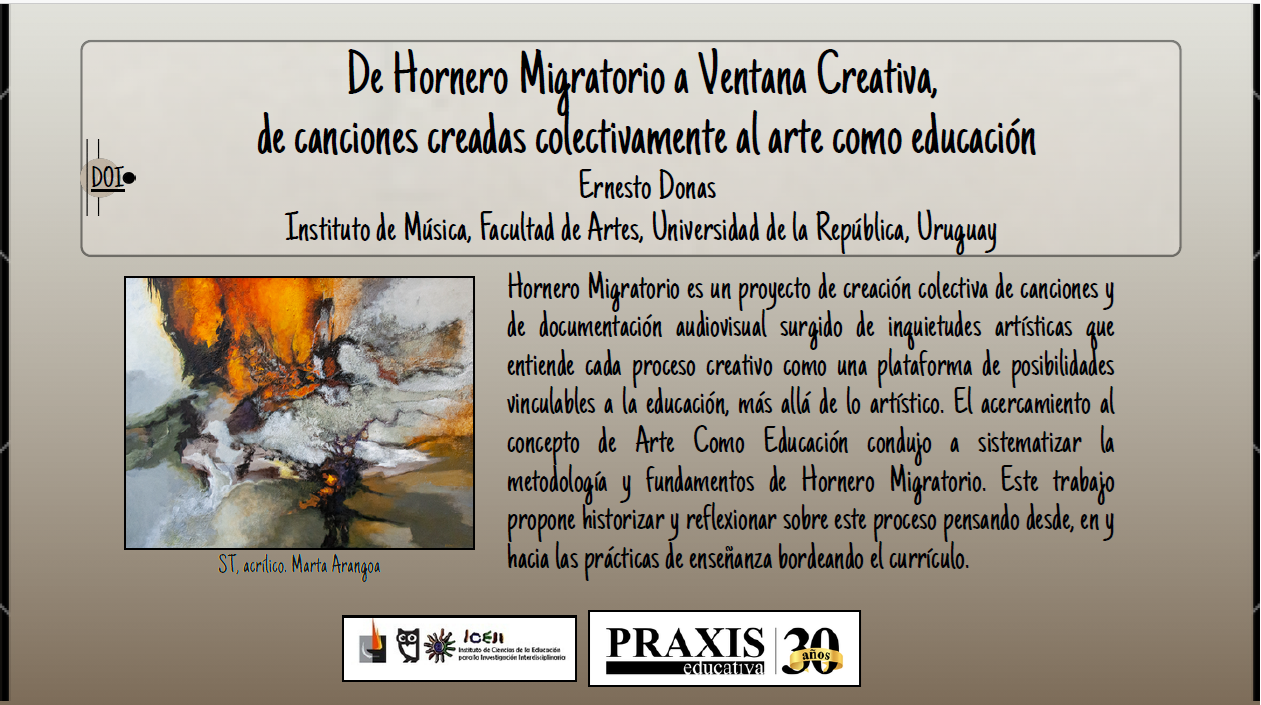
From Migratory Ovenbird to Creative Window, from collectively created songs to art as education
DOI:
https://doi.org/10.19137/praxiseducativa-2026-300304Keywords:
creativity, collective songwriting, art and education,, collaborative work, human developmentAbstract
Hornero Migratorio is a collective songwriting project with audiovisual documentation, exploring and discovering insights beyond mere experiences and outcomes. Conceived from artistic concerns, it evolved into understanding each creative process as a platform of possibilities linked to education beyond the purely artistic realm. The ongoing pursuit of collective learning and its transfer to the communities involved in each process has been the source of numerous practices and dialogues. Engagement with the concept of Art as Education led to the systematization of Hornero Migratorio's methodology and foundations. Ventana Creativa (Creative Window) is the resulting project, employing two action tools: the Crisálida Creative Education Seminar and the Resortes de Educación Creativa (Creative Education Springs). The latter comprises pedagogical processes, collective creative experiences, and the subjectification of learning within specific contexts. This work aims to historicize and reflect upon this process, considering it from, within, and towards teaching practices that border on the curriculum.
References
Cantera Silvera, F. (1968). Hacia los otros: historia y conclusiones de un ensayo de trabajo social con comunidades rurales. Corporación Gráfica.
Camnitzer, L. (2018). Hacia un socialismo de la creatividad. Esfera Pública. https://esferapublica.org/hacia-un-socialismo-de-la-creatividad/
Despret, V. (2022). Habitar como un pájaro: Modos de hacer y de pensar los territorios. Cactus.
Feld, S. (2015). Acoustemology. En D. Novak & M. Sakakeeny (Eds.), Keywords in sound (pp. 12–21). Duke University Press. https://static1.squarespace.com/static/545aad98e4b0f1f9150ad5c3/t/55b b05f3e4b0e9d0944e1b08/1438320115089/2015+Acoustemology.pdf
Hornero Migratorio. Rincón de los Francos. (2015). https://horneromigratorio.uy/6-RINCON-DE-LOS-FRANCOS
Hornero Migratorio. Balneario Iporá. (2016). https://horneromigratorio.uy/45-BALNEARIO-IPORA_TACUAREBO
Hornero Migratorio. La Lata. (2015). https://horneromigratorio.uy/4-LA-LATA
Hornero Migratorio. Rincón de Todos. (2012) https://horneromigratorio.uy/1-RINCON-DE-TODOS_MONTEVIDEO
Hornero Migratorio. Santa Clara. (2016). https://horneromigratorio.uy/30- SANTA-CLARA_-TREINTA-Y-TRES
Ingold, T. (2016). La creatividad que se experiencia. Innovación e Investigación en Arquitectura y Territorio, 4(2), 1–11. https://doi.org/10.14198/i2.2016.5.13
Lapetina, F. (2012). Hornero. Álbum. Perro Andaluz.
Martel, L. (2025). Un destino común: Intervenciones públicas y conversaciones. Caja Negra.
Martínez Jareño, O. (2025). Educación artística y sonidos del entorno: integrando el arte sonoro en el aula de primaria. Tercio Creciente, extra10, (pp. 83-96), https://dx.doi.org/10.17561/rtc.extra10.9965
Maturana, H. R., & Varela, F. J. (1998). De máquinas y seres vivos: Autopoiesis: La organización de lo vivo (6.ª ed.). Editorial Universitaria.
Morin, E. 2015. Enseñar a vivir. Manifiesto para cambiar la educación. Nueva visión.
Porta, L., & Molinas, I. (2024). Gestos botánicos y experiencias estéticas en la investigación educativa: laboratorio de indagación disruptiva. Praxis educativa, 28(2), pp. 1–17. https://www.redalyc.org/journal/1531/153177973003/html/
Solá Pizarro, B. M. 2019. Prácticas Artísticas Colaborativas: nuevos formatos entre el arte y la educación. De arte 18, pp. 261-66.
https://revpubli.unileon.es/ojs/index.php/dearte/article/view/5885/4543
Sommer, D. (2020). El arte obra en el mundo: Cultura ciudadana y humanidades públicas. Ediciones Metales Pesados.
Viglietti. D. (1971). Canciones chuecas. Álbum. Sello Orfeo.
Wajnerman, C. (2018). Presuponer el arte. Periódico de Artes Escénicas, (57), pp. 18–20. http://www.artesescenicas.org.ar/periodico-de-artes-escenicas/images/actual/PAE_57.pdf
Downloads
Published
Issue
Section
License
Copyright (c) 2026 Ernesto Donas

This work is licensed under a Creative Commons Attribution-NonCommercial-ShareAlike 4.0 International License.
Copyright Notice
Editorial Committee Educational Praxis Magazine:
I hereby declare that I am the author of the article titled (article name), that it is original and my own and that it was not previously published in any other format or medium. I declare to know that the magazine will not charge me any type of fee under any circumstances, nor will I receive any type of monetary compensation If it were accepted for publication in Educational Praxis, I authorize the aforementioned magazine to publish it digitally and to advertise it on its social networks.
If the work is published, I adhere to the Creative Commons license called "Attribution - Non-Commercial Share Alike CC BY-NC-SA", through which it is allowed to copy, reproduce, distribute, publicly communicate the work and generate derivative works, as long as when the original author is cited and acknowledged. This license has been used since September 2018. In 2016 CC BY NC ND 4.0 was adhered to; and in the years 2017 and 2018 (January-August) CC BY NC 4.0.
This CC BY-NC-SA Share Alike license does not, however, permit commercial use of the work. As an author, the journal may establish additional agreements for the non-exclusive distribution of the version of the work published in the journal, it allows me to self-archive the published articles, in their post-print version, in institutional, thematic repositories, personal web pages or any other relevant use. with the recognition of having been first published in this journal.
Educational Praxis adheres to DORA (Declaration on Research Assessment) signed in San Francisco, California, on December 16, 2012, and to the Declaration of Mexico (Joint Declaration LATINDEX - REDALYC - CLACSO - IBICT).
How to Cite










_(1)2.png)