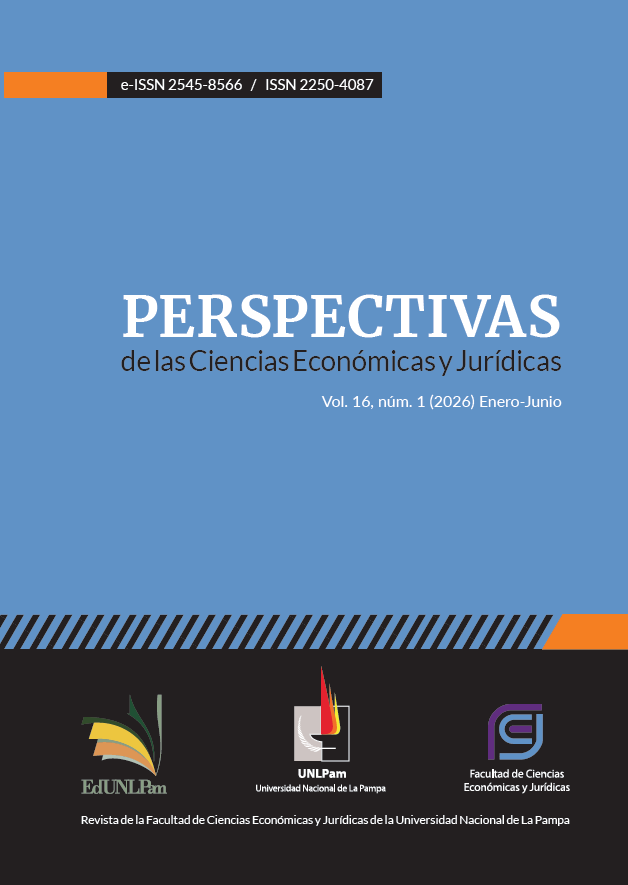
Financial education in Argentina in the period 2022-2025
DOI:
https://doi.org/10.19137/perspectivas-2026-v16n1a06Keywords:
finantial education, finantial knowledge, youthAbstract
This study analyzes financial education in Argentina and the population’s level of financial knowledge between 2022 and 2025, focusing on young people, a vulnerable group due to the limited preparation they receive in school. Also, it explores the role that financial education plays in everyday decision-making, its direct impact on both individual and collective well-being, and the consequences of its absence.
Moreover, it examines the current place of these topics within the national educational curriculum and different approaches for incorporating them into schools. The goal is to ensure that young people acquire the necessary tools to manage their money in a responsible way.
In conclusion, the Argentine population shows low levels of financial knowledge, highlighting the need to strengthen this area through concrete and effective government actions.
Downloads
References
Argentina. Ministerio de Economía. (2022). Plan Nacional de Educación Financiera. https://www.argentina.gob.ar/sites/default/files/pnef_2022_1.pdf
Banco Central de la República Argentina. (2018). Encuesta de medición de capacidades financieras en Argentina. https://www.bcra.gob.ar/pdfs/BCRAyVos/Encuesta%20de%20Medici%C3%B3n%20de%20Capacidades%20Financieras%20en%20Argentina%20-%20BCRA-CAF%20(2017).pdf
Domínguez Martínez, J.M. (2013) Educación financiera en la escuela: las
competencias según el PISA.
file:///C:/Users/vvass/Downloads/Dialnet-EducacionFinancieraEnLaEscuelaLasCompetenciasSegun-5581994.pdf
Fernández, M. (2020) La educación financiera ya es obligatoria por ley, pero todavía
no se aplica en las secundarias. Infobae.
Parada, R. (2024) ¿Por qué es importante educar a los niños, niñas y adolescentes
en temas de dinero y finanzas desde la infancia? Infobae.
Páginas web
Banco Central de la República Argentina. (s.f.). Educación financiera.
https://www.bcra.gob.ar/BCRAyVos/Educacion-Financiera.asp
BBVA. (s.f.). ¿Cuál es la diferencia entre ahorro e inversión?
BBVA. (2024). ¿Por qué es importante impartir educación financiera en las
escuelas?
BBVA. (s.f.). ¿Qué son los intereses a tasa fija?
Murgo, E. (2024). “¿Ahorro o inversión? La importancia de la educación financiera
como cambio de paradigma”. (Universidad. El sistema de medios de la UNCUYO)
Downloads
Published
Issue
Section
License
Aquellos autores/as que tengan publicaciones con esta revista, aceptan los términos siguientes:- Los autores/as conservarán sus derechos de autor y garantizarán a la revista el derecho de primera publicación de su obra, el cuál estará simultáneamente sujeto a la Licencia de reconocimiento de Creative Commons que permite a terceros compartir la obra siempre que se indique su autor y su primera publicación esta revista.
- Los autores/as podrán adoptar otros acuerdos de licencia no exclusiva de distribución de la versión de la obra publicada (p. ej.: depositarla en un archivo telemático institucional o publicarla en un volumen monográfico) siempre que se indique la publicación inicial en esta revista.
- Se permite y recomienda a los autores/as difundir su obra a través de Internet (p. ej.: en archivos telemáticos institucionales o en su página web) antes y durante el proceso de envío, lo cual puede producir intercambios interesantes y aumentar las citas de la obra publicada. (Véase El efecto del acceso abierto).






.png)



5.jpg)