Valoración retrospectiva del bienestar animal en caprinos portadores de cachemira por determinación de cortisol en fibra
Retrospective assessment of animal welfare in cashmere-wearing goats by determining fiber cortisol
DOI:
https://doi.org/10.19137/cienvet.v27.9310Palabras clave:
Cabras, Fibra animal, Esquila, Estrés, BiomarcadorResumen
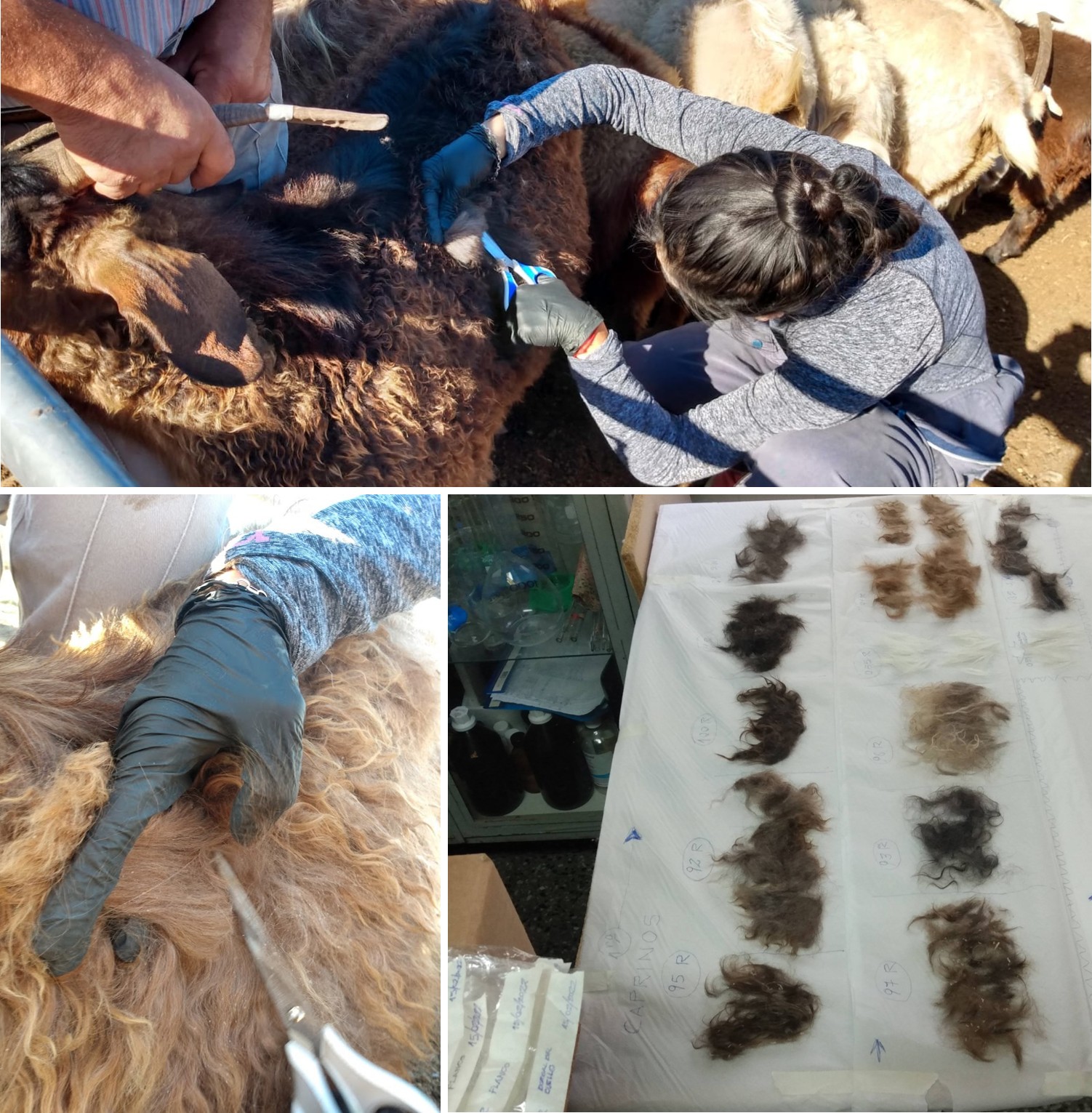
El cortisol capilar tiene utilidad como biomarcador para evaluar el estrés, la fibra puede acumularlo por incorporación desde la sangre a células del folículo piloso y por producción local. En caprinos con vellón doble capa, la fibra gruesa crece en verano-otoño y se desprende en primavera parcial y desfasadamente; y la fibra fina crece hasta abril-mayo, se desprende en junio-septiembre, mudando visiblemente en primavera. Su obtención por peinado es repetitiva, difícil de optimizar, y objetada desde el bienestar animal. La esquila incluye el vellón completo, exponiendo al animal al ambiente. El objetivo del estudio fue evaluar la utilidad del dosaje de cortisol en fibra como indicador retrospectivo del estrés animal, y comparar los niveles obtenidos de la media poblacional post-esquila con los de manejo no invasivo. Cabras criollas en condiciones semi-extensivas en La Pampa, se esquilaron a mediados de noviembre, se muestrearon por tricotomía en febrero del año siguiente, y en un ciclo posterior en mayo. El cortisol en fibra se determinó por un método automatizado comparando base y punta de la fibra, y con la media poblacional post-esquila. Resultó que los niveles de cortisol son significativamente (p < 0,05) más bajos en la base de la fibra comparados con la media post-esquila, mientras que con la punta no difieren. Esto sugiere que la etapa subsiguiente a la esquila fue de mayor estrés a una etapa posterior de menor carga fisiológica. Esta diferencia permite justificar el uso de métodos alternativos de recolección de fibra no invasivos promoviendo el bienestar animal
Referencias
Möstl E, Palme R. Hormones as indicators of stress. Domest Anim Endocrinol. 2002; 23: 67-64. Disponible en https://doi.org/10.1016/S0739-7240(02)00146-7
Heimbürge S, Kanitz E, Otten W. The use of hair cortisol for the assessment of stress in animals. Gen Comp Endocrinol. 2019; 270:10-7. Disponible en https://doi.org/10.1016/j.ygcen.2018.09.016
Rubenstein DR, Alcock J. Animal Behaviour, 11th Ed. Oxford: Oxford University Press. 2018; p. 548.
Wiepkema PR, Koolhaas JM. Estrés y bienestar animal. Bienestar Animal (South Mimms, Inglaterra). 1993; 2 (3):195-218. Disponible en https://www.ingentaconnect.com/contentone/ufaw/aw/1993/00000002/00000003/art00002
Burnard C, Ralph C, Hynd P, Hocking Edwards J, Tilbrook A. Cortisol capilar y su valor potencial como medida fisiológica de la respuesta al estrés en animales humanos y no humanos. Animal Production Science. 2017; 57: 401-414. Disponible en https://doi.org/10.1071/AN15622
Gow R, Thomson S, Rieder M, Van Uum S, Koren G. An assessment of cortisol analysis in hair and its clinical applications. Forensic Sci. Int. 2010; 196:32-37
Ghassemi Nejad J, Lohakare JD, Son JK, Kwon EG, West JW, Sung KI. Wool cortisol is a better indicator of stress than blood cortisol in ewes exposed to heat stress and water restriction. Animal. 2014; 8 (1):128-132.
Iglesias S, Jacobsen D, Gonzalez D, Azzara S, Repetto EM, Jamardo J, Gómez SG, Mesch V, Berg G, Fabre B. Hair cortisol: A new tool for evaluating stress in programs of stress management. Life Sci. 2015; 15 (141):188-192. Disponible en https://doi.org/10.1016/j.lfs.2015.10.006.
Castillo M. Estudio de la biología del crecimiento de la fibra de las cabras criollas portadoras de cachemira y de métodos innovadores (naturales) para su obtención. Tesis Doctoral. Córdoba: Universidad Católica de Córdoba. 2025; 140 pp.
Castillo M, Gómez MB, Cerutti DA, Palermo PV, Prieto A, Hick MVH, Castillo MF, Frank EN. Desarrollo de un modelo que explica el efecto de la mimosina sobre el folículo piloso de cabras productoras de cachemira a partir de imágenes histológicas de piel y fibra. VETEC Revista Académica de Investigación, Docencia y Extensión de las Ciencias Veterinarias. Edición Especial: I Jornadas de Histología y Embriología Veterinaria. Facultad de Ciencias Veterinarias de la Universidad Nacional de La Pampa. 2023; 4 (3): 45-46. Disponible en https://cerac.unlpam.edu.ar/index.php/Vetec/article/view/8037/8888
Chapman RE, Downes AM, Wilson PA. Migration and Keratinization of Cells in Wool Follicles. Australian Journal of Biological Sciences. 1980; 33: 587-603.
Ryder ML. The blood supply to the wool follicle. Proc. Of the Int. Wool Textile research conference, Australia. 1995; 1956.p. F-63
Endo N, Yamane H, Rahayu LP, Tanaka T. Effect of repeated adrenocorticotropic hormone administration on reproductive function and hair cortisol concentration during the estrous cycle in goats. Gen Comp Endocrinol. 2018; 259: 207-12. Disponible en https://doi.org/ 10.1016/j.ygcen.2017.11.027
Ito N, Ito T, Kromminga A, Bettermann A, Takigawa M, Kees F, Straub RH, Paus R. Human hair follicles display a functional equivalent of thehypothalamic–pituitary–adrenal axis and synthesize cortisol. FASEB J. 2005; 19: 1332-1334.
Slominski A, Wortsman J. Neuroendocrinology of the skin. Endocr Rev. 2000; 21: 457-487.
Slominski A, Wortsman J, Tuckey RC, Paus R. Expresión diferencial del homólogo del eje HPA en la piel. Endocrinología molecular y celular. 2007; 265 (266): 143-149.
Skobowiat C, Dowdy JC, Sayre RM, Tuckey RC, Slominski A. Cutaneous hypothalamic-pituitary-adrenal axis homolog: regulation by ultraviolet radiation. Am J Physiol Endocrinol Metab. 2011; 301 (3): 84-93. Disponible en https://doi.org/10.1152/ajpendo.00217.2011
Odeon MM, González E, Bruno-Galarraga M, Castillo D, Fernandez J, Cancino K, Giovannini N, Villagra S, Villar L. Niveles de cortisol en fibra de Mohair: una evaluación retrospectiva de estrés en cabras Angora. Revista Argentina de Producción Animal. 2022; 42 (1): 61-73.
Agradi S, Munga A, Barbato O, Palme R, Tarhan D, Bilgiç B, Dokuzeylül B, Ercan AM, Or ME, Brecchia G, Curone G, Draghi S, Vigo D, Marongiu ML, González-Cabrera M, Menchetti L. Goat hair as a bioindicator of environmental contaminants and adrenal activation during vertical transhumance. Front Vet Sci. 2023; 9 (10):1274081. Disponible en https://doi.org/10.3389/fvets.2023.1274081
Nixon AJ, Gurnseyb MP, Betteridgec K, Mitchellc RJ, Welchc RAS. Seasonal hair follicle activity and fibre growth in some New Zealand Cashmere-bearing goats (Capra hircus). Zoological Society of London. 2009; 224 (4):589-98. Disponible en https://doi.org/10.1111/j.1469-7998.1991.tb03787.x
Castillo, M, Gómez, MB, Cerutti DA, Palermo PV, Castillo MF, Prieto A, Hick MVH, Frank EN. Estudio del ciclo biológico de la fibra de cabras criollas portadoras de cachemira autóctonas de Patagonia Norte, Argentina. Ciencias Veterinarias. 2023; 25 (2):150-159. Disponible en https://doi.org/10.19137/cienvet202325204
Organización Mundial de Sanidad Animal (OIE). Bienestar Animal. 2020. Disponible en https://www.oie.int/es/bienestar-animal/el-bienestar-animal-de-un-vistazo/ (consultado: Sep. 15-2020).
Publicado
Número
Sección
Licencia
Derechos de autor 2025 Dante Alberto Cerutti, Pedro Vicente Palermo, María Flavia Castillo, Alejandro Prieto, Eduardo Narciso Frank, Melina Castillo

Esta obra está bajo una licencia internacional Creative Commons Atribución-NoComercial-CompartirIgual 4.0.
Al momento de enviar sus contribuciones, los colaboradores deberán declarar , de manera fehaciente, que poseen el permiso del archivo o repositorio donde se obtuvieron los documentos que se anexan al trabajo, cualquiera sea su formato (manuscritos inéditos, imágenes, archivos audiovisuales, etc.), permiso que los autoriza a publicarlos y reproducirlos, liberando a la revista y sus editores de toda responsabilidad o reclamo de terceros , los autores deben adherir a la licencia Creative Commons denominada “Atribución - No Comercial CC BY-NC-SA”, mediante la cual el autor permite copiar, reproducir, distribuir, comunicar públicamente la obra y generar obras derivadas, siempre y cuando se cite y reconozca al autor original. No se permite, sin embargo, utilizar la obra con fines comerciales.
Cómo citar





.jpg)