Oficina de projeto de dissertação: ensinando redação acadêmica desde uma abordagem de produção autêntica
DOI:
https://doi.org/10.19137/praxiseducativa-2026-300105Palavras-chave:
escritura, enseñanza, alfabetización academica, proyecto de tesis, investigaciónResumo
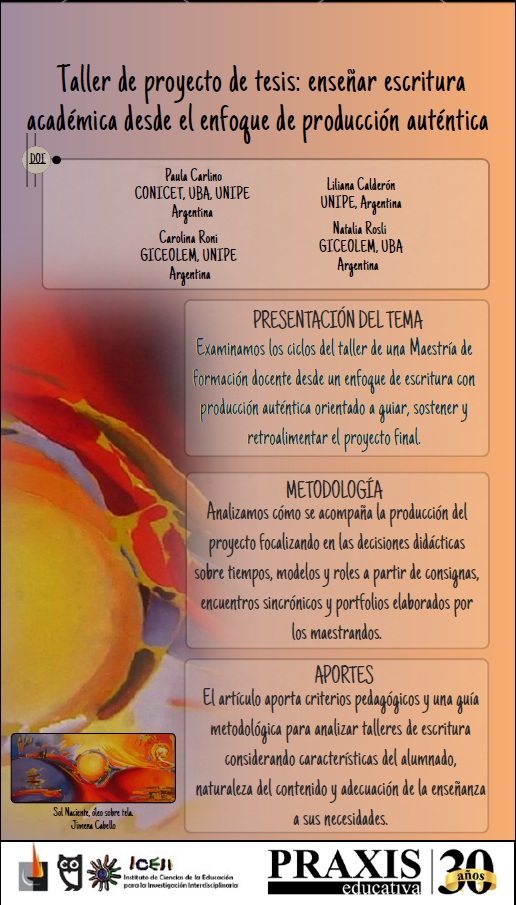
Para resolver o problema do desfasamento entre o que se ensina e o que se aprende a respeito da escrita académica, desenvolvemos a “abordagem de ensino baseada na produção autêntica”, materializada num atelier de projeto de tese de mestrado com a duração de 18 meses. O atelier foi concebido e reformulado ao longo de 10 anos de funcionamento para preservar a natureza das práticas de literacia que procura ensinar, tendo em conta as necessidades educativas dos alunos. A nossa análise detalha o modo como o ensino é configurado para ajudar os participantes a produzirem os seus projectos de tese e a construírem os conhecimentos necessários para os produzirem, impulsionados pela necessidade de resolverem os problemas implicados. Examinamos as decisões didáticas relativas aos tempos, aos ciclos de trabalho, às tarefas, às orientações, às instruções, à utilização de modelos escritos e de material bibliográfico e aos papéis dos alunos e dos professores.
Downloads
Referências
Alvarez, G. y Difabio de Anglat, H. (2023). Fundamentos de una iniciativa pedagógica en línea orientada a la revisión y reescritura de capítulos de tesis de posgrado. En G. Alvarez (Coord.), Enseñanza de la escritura de la tesis de posgrado en entornos presenciales y virtuales (pp. 47-86). Universidad Nacional de General Sarmiento.
Bazerman, C. y Russell, D. (Eds.). (2003). Writing Selves/Writing Societies: Research from Activity Perspectives. The WAC Clearinghouse; Mind, Culture, and Activity. https://doi.org/10.37514/PER-B.2003.2317
Carlino, P. (2009). Exploración de géneros, diario de tesis y revisión entre pares: Análisis de un ciclo de investigación-acción en talleres de tesis de posgrado. En E. Arnoux de Narvaja (Ed.), Escritura y producción de conocimiento en carreras de posgrado. Santiago Arcos. https://www.aacademica.org/paula.carlino/182
Calderón, L. (2018). Escribir libros de ciencias: los profesores como autores. Eje Desarrollo profesional docente: modalidades y experiencias exitosas. VIII encuentro internacional de la Red Kipus. Profesión docente: Valoración, formación inicial y permanente. San José, Costa Rica https://redkipuscr.ucr.ac.cr/memoria/
Calderón, L. (2024). Escritura en Ciencias: lecciones aprendidas para la enseñanza de las ciencias y la escritura en la formación de docentes. Séminaire adressé aux étudiants de Master et doctorat des universités partenaires. Prefalc: Programme regional france, Amérique latine, Caräibe. https://www.fmsh.fr/appels/programme-prefalc
Carlino, P. (2012). Helping Doctoral Students of Education to Face Writing and Emotional Challenges in Identity Transition. En M. Castello y C. Donahue, University writing: Selves and Texts in Academic Societies. Emerald Group Publishing. https://www.aacademica.org/paula.carlino/99
Carlino, P. (2013). Alfabetización académica diez años después. Revista Mexicana de Investigación Educativa, XVII (57), 355-381. https://www.aacademica.org/paula.carlino/103
Carlino, P. (2015). Revisión entre pares: una práctica social que los posgrados deberían enseñar. Espaço Pedagógico, 22(1), 9-29. https://www.aacademica.org/paula.carlino/219
Carlino, P. (2023). New Cognitive Practices in a Master's Thesis Proposal Writing Seminar. En P. Rogers, D. Russell, Pa. Carlino y J. Marine (Eds.), Writing as a human activity: Implications and applications of the work of Charles Bazerman. Fort Collins: Colorado State University Open Press y The WAC Clearinghouse. https://www.aacademica.org/paula.carlino/304
Carlino, P. y Cordero, G. (2023). Enseñar con escritura y enseñar a escribir: enfoque entrelazado mediante colaboración interdisciplinar. Lengua y Sociedad. Revista de Lingüística Teórica y Aplicada, 22(2), 35-64. https://www.aacademica.org/paula.carlino/306
Cassany, D. (1988). Describir el escribir. En Cómo se aprende a escribir. Paidós.
Cavallini, A. y Alvarez, G. (2024). Panorama de estudios latinoamericanos sobre retroalimentación escrita en formación de posgrado. Praxis educativa, 28(2), 1-18. https://dx.doi.org/10.19137/praxiseducativa-2024-280217
Chevallard, I. (1998). La transposición didáctica. Del saber sabio al saber enseñado. Aique Grupo editor.
Chois Lenis, P. M., Guerrero Jiménez, H. I. y Brambila Limón, R. (2020). Una mirada analítica a la enseñanza de la escritura en posgrado: revisión de prácticas documentadas en Latinoamérica. Íkala, Revista de Lenguaje y Cultura, 25(2), 535-556. https://doi.org/10.17533/udea.ikala.v25n02a09
Chois. P. y Jaramilllo, L. (2016). La investigación sobre la escritura en posgrado: estado del arte. Lenguaje, 44(2), 227-259.
Espino Datsira, S. (2015). La enseñanza de estrategias de escritura y comunicación de textos científicos y académicos a estudiantes de posgrado. Revista mexicana de investigación educativa, 20(66), 959-976.
Fernández Fastuca, L. y Guevara, J. (2017). Los talleres de tesis como aproximación a una comunidad de práctica. Cuadernos de Investigación Educativa, 8(1). https://repositorio.uca.edu.ar/handle/123456789/8742
Giraldo-Giraldo, C. (2020). Dificultades de la escritura y desaprovechamiento de su potencial epistémico en estudiantes de posgrado. Revista Colombiana de Educación, (80), 173-192. https://doi.org/10.17227/rce.num80-9633
Guerrero, H. I. y Chois Lenis, P. M. (2019). Prácticas de escritura en posgrado: el caso de una maestría en educación. Lenguaje, 47(1), 120-146. https://doi.org/10.25100/lenguaje.v47i1.6094
Guerrero, R. y Mostacero, R. (2014). Logros y alcances de escribir el trabajo de grado en un grupo de escritura. EDUCERE, 18(61), 527-534.
Hernández Morales, J., Morales, P. A., Pérez Arenas, D. y Condés Infante, J. F. (2022). Procesos y momentos de la investigación en los posgrados en educación. Praxis educativa, 26(2), 254-276. https://dx.doi.org/https://doi.org/10.19137/praxiseducativa-2022-260213
Lerner, D. (2001). Leer y escribir en la escuela: Lo real, lo posible y lo necesario. Fondo de Cultura Económica.
Martín Torres, G. G. (2012). La escritura de tesis de posgrado en el área de investigación educativa. El acompañamiento, una pieza clave. CPU-e, Revista de Investigación Educativa, (15), 69-86.
Pastré, P. (2008). Aprendizaje y actividad. En A. Pereyra y L. Calderón, Didáctica profesional y trabajo docente. Aportes teóricos para su análisis en la formación (pp. 205-237). UNIPE Editorial Universitaria.
Pozzo, M. I., Camargo Angelucci, T. y Cardoso, A. L. (2021). Formación de profesores universitarios en posgrados interdisciplinarios. Dificultades en la escritura del plan de tesis. Revista Digital de Investigación en Docencia Universitaria, 15(2), e1238. https://doi.org/10.19083/10.19083/ridu.2021.1238
Pozzo, M. I. y Rosso, F. (2023). Enseñanza de la escritura académica en entornos virtuales: desafíos de la pandemia en el posgrado. Folios, (58), 56-74. https://doi.org/10.17227/folios.58-16014.
Rossi Peralta, M. (2023). Dificultades sociodiscursivas para la escritura académica en estudiantes universitarios de pregrado y posgrado. Lengua y Sociedad, 22(2), 335-356. https://dx.doi.org/10.15381/lengsoc.v22i2.23883
Russell, D. R. (1995). Activity theory and its implications for writing instruction. En J. Petraglia (Ed.), Reconceiving writing, rethinking writing instruction (pp. 51-77). Laurence Erlbaum.
Smith, F. (1983). Reading like a writer. Language Arts, 60(5), 558-567.
Villabona Osorio, L. (2018). Situaciones que facilitan o dificultan la escritura de tesis de posgrado. Perspectivas Metodológicas, 22(2), 49-74.
Publicado
Edição
Seção
Licença
Copyright (c) 2026 Natalia Rosli

Este trabalho está licenciado sob uma licença Creative Commons Attribution-NonCommercial-ShareAlike 4.0 International License.
Aviso de direitos autorais
Comitê Editorial Revista Práxis Educativa:
Declaro que sou o autor do artigo intitulado (nome do artigo), que o mesmo é original e de minha autoria e que não foi publicado anteriormente em qualquer outro formato ou meio. Declaro saber que a revista não me cobrará nenhum tipo de taxa em hipótese alguma, nem receberei qualquer tipo de remuneração monetária.
Caso seja aceito para publicação na Práxis Educacional, autorizo a referida revista a publicá-lo digitalmente e a divulgá-lo em suas redes sociais.
Se o trabalho for publicado, aderi à licença Creative Commons denominada "Atribuição - Compartilhamento Não Comercial pela mesma Licença CC BY-NC-SA", por meio da qual é permitido copiar, reproduzir, distribuir, comunicar publicamente o trabalho e gerar trabalhos derivados , desde que o autor original seja citado e reconhecido. Esta licença está em uso desde setembro de 2018. Em 2016 foi aderido ao CC BY NC ND 4.0; e nos anos de 2017 e 2018 (janeiro-agosto) CC BY NC 4.0.
Esta licença CC BY-NC-SA Share Alike não permite, entretanto, o uso comercial da obra. Como autor, a revista poderá estabelecer acordos adicionais para a distribuição não exclusiva da versão do trabalho publicado na revista, permite-me autoarquivar os artigos publicados, na sua versão post-print, em repositórios institucionais, temáticos , páginas web pessoais ou qualquer outro uso relevante. com o reconhecimento de ter sido publicado pela primeira vez nesta revista.
SA Práxis Educacional adere à DORA (Declaração sobre Avaliação de Pesquisa) assinada em São Francisco, Califórnia, em 16 de dezembro de 2012, e à Declaração do México (Declaração Conjunta LATINDEX - REDALYC - CLACSO - IBICT).









_(1)2.png)


3.png)








_(2).png)






2.jpg)