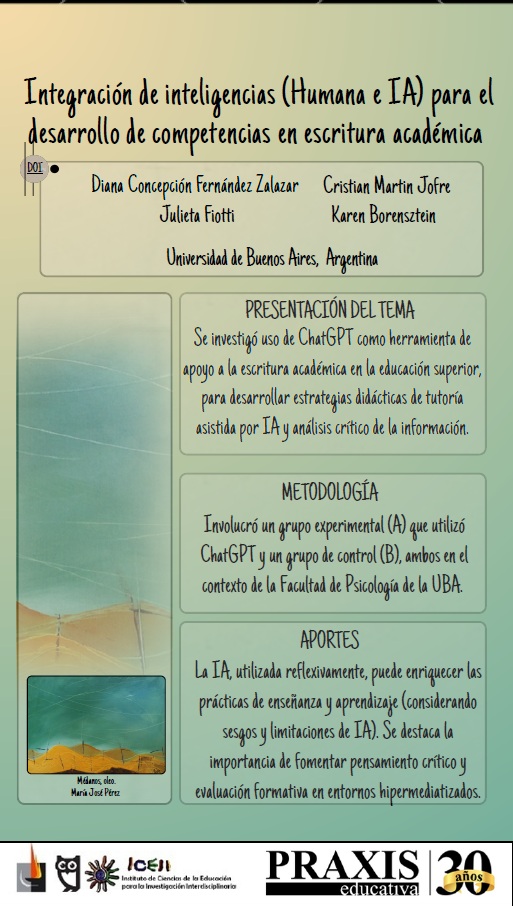
Integração de inteligências (humana e IA) para o desenvolvimento de habilidades de redação acadêmica.
DOI:
https://doi.org/10.19137/praxiseducativa-2026-300112Palavras-chave:
ChatGPT, ensino superior, inteligência artificial, redação acadêmica.Resumo
Este estudo exploratório investigou o uso do ChatGPT como uma ferramenta de apoio à redação acadêmica no ensino superior, com o objetivo de desenvolver estratégias didáticas para a tutoria assistida por IA e promover a análise crítica das informações. A metodologia envolveu um grupo experimental (A) usando o ChatGPT e um grupo de controle (B), ambos no contexto da Faculdade de Psicologia da UBA. Os resultados indicaram que o grupo experimental apresentou um bom desempenho nas produções escritas, evidenciando um desenvolvimento de habilidades metacognitivas e de análise crítica. Conclui-se que a IA, utilizada de forma reflexiva, pode enriquecer as práticas de ensino e aprendizagem, embora os vieses e as limitações dos algoritmos, bem como dos diferentes modelos de IA, devam ser sempre considerados. Destaca-se a importância de promover o pensamento crítico e a avaliação formativa em ambientes hipermidiáticos.
Downloads
Referências
Artopoulos, A. (2023). Imaginarios de IA generativa en educación: Chatbots que enseñan, bicicletas eléctricas y el quinto Beatle. Hipertextos, 11.
Awasthi, S. (2019). Plagiarism and academic misconduct: A systematic review. DESIDOC Journal of Library &
Information Technology, 39(2).
Cardina, Y., Kristiani, K. & Sangka, B. (2022). Qualitative Survey of Academic Dishonesty on Higher
Education: Identify the Factors and Solutions. Journal of Positive School Psychology, 6(3), 8705-8719.
Chang, D. H., Lin, M. P. C., Hajian, S., & Wang, Q. Q. (2023). Educational Design Principles of Using AI
Chatbot That Supports Self-Regulated Learning in Education: Goal Setting, Feedback, and
Personalization. Sustainability, 15(17), 12921.
Colmenares E., A. M., & Piñero M., M. L. (2008). LA INVESTIGACIÓN ACCIÓN. Una herramienta
metodológica heurística para la comprensión y transformación de realidades y prácticas
socio-educativas. Laurus, 14(27), 96-114.
Deng, X., & Yu, Z. (2023). A Meta-Analysis and Systematic Review of the Effect of chatbot Technology Use in
Sustainable Education. Sustainability, 15(4), 29-40.
Fernández Zalazar, D. C., Neri, C., Ciacciulli, S. M., Jofre, C. M., & Pisani, P. (2014). Motivación hacia el
aprendizaje y usos de las Tics en estudiantes universitarios: aproximaciones desde la Escala MSLQ. In
VI Congreso Internacional de Investigación y Práctica Profesional en Psicología XXI Jornadas de
Investigación Décimo Encuentro de Investigadores en Psicología del MERCOSUR. Facultad de
Psicología-Universidad de Buenos Aires.
Fernández Zalazar, D. C., Matos, F. B., & Frangullo, Y. B. (2024). Análiticas de aprendizaje, herramientas y
estratégias de enseñanza. In XVI Congreso Internacional de Investigación y Práctica Profesional en
Psicología. XXXI Jornadas de Investigación. XX Encuentro de Investigadores en Psicología del
MERCOSUR. VI Encuentro de Investigación de Terapia Ocupacional. VI Encuentro de Musicoterapia.
Facultad de Psicología-Universidad de Buenos Aires.
Fernández Zalazar, D., Muiños, R., Fiotti, J., & Jofre, C. (2024). Construcción de un inventario de competencias
digitales en estudiantes universitarios de Psicología de la UBA. Anuario de Investigaciones.
https://www.psi.uba.ar/publicaciones/anuario/trabajos_completos/30/fernandez_zalazar.pdf
Ghayoomi, M. (2023). Applications of Chatbots in Education. In Trends, Applications, and Challenges of
Chatbot Technology (pp. 80-118). IGI Global.
Grande de Prado, M., García-Peñalvo, F. J., Corell, A., y Abella García, V. (2021). Evaluación en Educación
Superior durante la pandemia de la COVID-19. Campus virtuales, 1(10), 49-58.
Jofre, C. M. (2023). ChatGPT, Inteligencia Artificial y Universidad. Nuevas tensiones, transformaciones y
desafíos en la educación superior. Campo Universitario 4(7) Enero-Julio 2023, 1-12.
Martínez-Comesaña, M., Rigueira-Díaz, X., Larrañaga-Janeiro, A., Martínez-Torres, J., Ocarranza-Prado, I., &
Kreibel, D. (2023). Impacto de la inteligencia artificial en los métodos de evaluación en la educación
primaria y secundaria: revisión sistemática de la literatura. Revista de Psicodidáctica.
Mancilla-Pavía, M. F. (2023). Pánico artificial. El avance de la Inteligencia Artificial y el miedo al reemplazo de
la humanidad.
Sok, S., & Heng, K. (2023). ChatGPT for education and research: A review of benefits and risks. SSRN.
https://ssrn.com/abstract=4378735 or http://dx.doi.org/10.2139/ssrn.4378735
Tinoco, L. F. S., Heras, E. B., Hern, A., & Zapata, L. (2011). Validación del cuestionario de motivación y
estrategias de aprendizaje forma corta–MSLQ SF, en estudiantes universitarios de una institución
pública-Santa Marta. Psicogente, 14(25).
Zapata-Ros, M. (2018). La universidad inteligente. Revista de Educación a Distancia (RED), (57).
Publicado
Edição
Seção
Licença
Copyright (c) 2026 Diana Concepción Fernández Zalazar, Cristian Martin Jofre, Julieta Fiotti, Karen Borensztein

Este trabalho está licenciado sob uma licença Creative Commons Attribution-NonCommercial-ShareAlike 4.0 International License.
Aviso de direitos autorais
Comitê Editorial Revista Práxis Educativa:
Declaro que sou o autor do artigo intitulado (nome do artigo), que o mesmo é original e de minha autoria e que não foi publicado anteriormente em qualquer outro formato ou meio. Declaro saber que a revista não me cobrará nenhum tipo de taxa em hipótese alguma, nem receberei qualquer tipo de remuneração monetária.
Caso seja aceito para publicação na Práxis Educacional, autorizo a referida revista a publicá-lo digitalmente e a divulgá-lo em suas redes sociais.
Se o trabalho for publicado, aderi à licença Creative Commons denominada "Atribuição - Compartilhamento Não Comercial pela mesma Licença CC BY-NC-SA", por meio da qual é permitido copiar, reproduzir, distribuir, comunicar publicamente o trabalho e gerar trabalhos derivados , desde que o autor original seja citado e reconhecido. Esta licença está em uso desde setembro de 2018. Em 2016 foi aderido ao CC BY NC ND 4.0; e nos anos de 2017 e 2018 (janeiro-agosto) CC BY NC 4.0.
Esta licença CC BY-NC-SA Share Alike não permite, entretanto, o uso comercial da obra. Como autor, a revista poderá estabelecer acordos adicionais para a distribuição não exclusiva da versão do trabalho publicado na revista, permite-me autoarquivar os artigos publicados, na sua versão post-print, em repositórios institucionais, temáticos , páginas web pessoais ou qualquer outro uso relevante. com o reconhecimento de ter sido publicado pela primeira vez nesta revista.
SA Práxis Educacional adere à DORA (Declaração sobre Avaliação de Pesquisa) assinada em São Francisco, Califórnia, em 16 de dezembro de 2012, e à Declaração do México (Declaração Conjunta LATINDEX - REDALYC - CLACSO - IBICT).








_(1)2.png)

3.png)







_(2).png)






2.jpg)