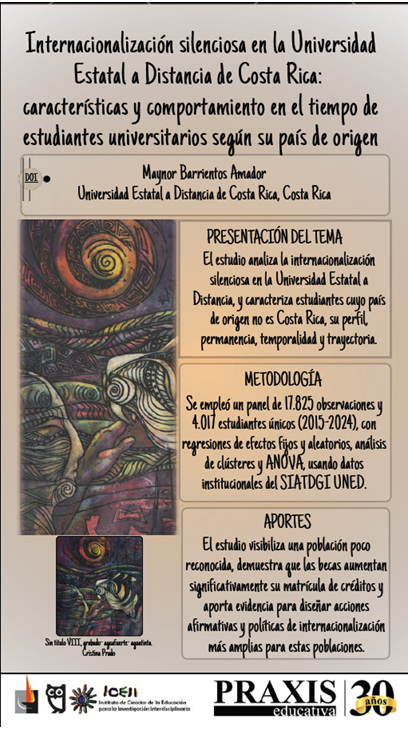
Silent Internationalization at the State Distance University of Costa Rica
Characteristics and behavior over time of university students according to their country of origin
DOI:
https://doi.org/10.19137/praxiseducativa-2026-300225Keywords:
Higher education internationalization, Distance education, international student, Migration, Internationalization for societyAbstract
This study aims to provide a detailed characterization of the student population at the Universidad Estatal a Distancia (UNED) whose country of origin is not Costa Rica, to better understand their main features, behavior over time, and permanence or temporality of this population within the institution, and the relevance of institutional support such as financial aid (scholarships). The study uses a panel data set extracted from UNED's Information System for Decision-Making Support and Institutional Management (SIATDGI), containing historical information on students, their enrollment behavior, demographic data, nationality, and detailed information on institutional support and academic performance. The sample comprises a total of 17,825 observations distributed across 4,017 unique student groups, from the first quarter of 2015 to the first quarter of 2024. To analyze the influence of financial aid on the number of credits enrolled by the selected student sample, fixed and random effects regression models were employed, along with cluster analysis to identify homogeneous groups within the student data, and ANOVA analysis to assess significant differences between the identified clusters. The results confirm a positive and significant effect of financial aid on the credit enrollment behavior of the study population. The study suggests that it is relevant for the institution to develop affirmative action policies for this population, similar to those already implemented by UNED for other groups, and the development of broader regional and global internationalization policies.
Downloads
References
Abarca, A. (2024). Retos y oportunidades de las tendencias migratorias en educación de Costa Rica. Revista Estudios en Educación, 7, 36-56.
Acock, A. C. (2008). A gentle introduction to Stata. Stata press.
Adarlo, G. M. (2020). Service-Learning as Global Citizenship Education: Acting Locally on Global Challenges and Concerns. IAFOR Journal of Education, 8(3), 7-23.
Adel, H. M., Zeinhom, G. A. y Mahrous, A. A. (2018). Effective management of an internationalization strategy: A case study on Egyptian–British universities’ partnerships. International Journal of Technology Management & Sustainable Development, 17(2), 183-202.
Alam, F., Alam, Q., Chowdhury, H. y Steiner, T. (2013). Transnational education: Benefits, threats and challenges. Procedia Engineering, 56, 870-874.
Aleixo, A. M., Leal, S. y Azeiteiro, U. M. (2018). Conceptualization of sustainable higher education institutions, roles, barriers, and challenges for sustainability: An exploratory study in Portugal. Journal of cleaner production, 172, 1664-1673.
Alfaro, F. (2019). Evaluación de la calidad del servicio de atención a estudiantes becados por beca socioeconómica del programa de becas por condición socioeconómica de la Dirección de Asuntos Estudiantiles. CIEI, UNED.
Alsharari, N. M. (2020). Internationalization market and higher education field: institutional perspectives. International Journal of Educational Management, 34(2), 315-334.
Altbach, P. G. (2004). Globalisation and the university: Myths and realities in an unequal world. Tertiary Education & Management, 10(1), 3-25.
Altbach, P. G. (2015). Perspectives on Internationalizing Higher Education. International Higher Education, (27).
Altbach, P. G. y Knight, J. (2007). The internationalization of higher education: Motivations and realities. Journal of studies in international education, 11(3-4), 290-305.
Anderson, V., Cone, T., Rafferty, R. e Inoue, N. (2022). Mobile agency and relational webs in women’s narratives of international study. Higher Education, 83(4), 911-927. https://doi.org/10.1007/s10734-021-00714-7
Araya Solís, J. y Vega Villalobos, M. (2020). Migración interna en estudiantes universitarios: un análisis desde el enfoque de transiciones [tesis de maestría no publicada]. Universidad Nacional.
Asamblea Universitaria Representativa. (2021). Lineamientos de Política Institucional 2021-2025. UNED.
Baltagi, B. H. (2021). Econometric Analysis of Panel Data. Springer.
Bamberger, A. (2022). From human capital to marginalized other: a systematic review of diaspora and internationalization in higher education. British journal of educational studies, 70(3), 363-385.
Bamberger, A., Kim, T., Morris, P. y Rizvi, F. (2021). Diaspora, Internationalization and Higher Education. British Journal of Educational Studies, 69(5), 501-511. https://doi.org/10.1080/00071005.2021.1966282
Barrientos, M. y Cascante-Gatgens, A. (2022). Efecto positivo del sistema de educación superior a distancia en las metas institucionales de inclusión educativa en tiempos de pandemia: el caso de la Universidad Estatal a Distancia de Costa Rica. En Viviendo la Inclusión. Editorial Corporación Universitaria del Meta -UNIMETA.
Bastos, L. S. y Murillo, J. H. (2022). Las migraciones en Costa Rica: desarrollo de políticas migratorias recientes para su atención. Serie de Documentos de Política Pública. PNUD América Latina y el Caribe.
Bedenlier, S., Kondakci, Y. y Zawacki-Richter, O. (2018). Two decades of research into the internationalization of higher education: Major themes in the Journal of Studies in International Education (1997-2016). Journal of studies in international education, 22(2), 108-135.
Benavides, J. R. V. y Cruz, P. A. C. (2021). Caracterización socioeconómica de jóvenes migrantes del municipio de San Miguel en El Salvador. Ciencia, Cultura y Sociedad, 6(2), 37-49.
Bennell, P. (2019). Transnational higher education in the United Kingdom: An up-date. International Journal of Educational Development, 67, 29-40.
Bilsland, C., Carter, L. y Wood, L. (2020). Beyond the degree: graduate transitions from a transnational campus in Vietnam. Higher Education, 80(6), 1103-1120.
Block, D. y Moncada-Comas, B. (2022). English-medium instruction in higher education and the ELT gaze: STEM lecturers’ self-positioning as NOT English language teachers. International Journal of Bilingual Education and Bilingualism, 25(2), 401-417.
Bochorishvili, N. (2023). Global Migration, Discrimination, and the Internationalization of Higher Education. En Handbook of Research on the Regulation of the Modern Global Migration and Economic Crisis (pp. 277-292). IGI Global.
Bornmann, L. (2020). Bibliometrics-based decision tree (BBDT) for deciding whether two universities in the Leiden ranking differ substantially in their performance. Scientometrics, 122(2), 1255-1258.
Brunner, L. R. (2017). Higher educational institutions as emerging immigrant selection actors: A history of British Columbia’s retention of international graduates, 2001-2016. Policy Reviews in Higher Education, 1(1), 22-41.
Brunner, L. R. (2022). Towards a More Just Canadian Education-migration System: International Student Mobility in Crisis. Studies in Social Justice, 16(1), 78-102.
Cai, Y. (2019). China-Europe higher education cooperation: Opportunities and challenges. Frontiers of Education in China, 14, 167-179.
Cascante, A. (2023). Informe de datos según base de datos PROCAI-VIVE. UNED.
Cerna, L. y Chou, M. H. (2023). Politics of internationalisation and the migration-higher education nexus. Globalisation, Societies and Education, 21(2), 222-235.
Chaves-González, D. y Mora, M. J. (2021). El estado de la política migratoria y de integración de Costa Rica. Iniciativa de América Latina y el Caribe, 59.
Cohodes, E. M., Kribakaran, S., Odriozola, P., Bakirci, S., McCauley, S., Hodges, H. R. y Gee, D. G. (2021). Migration‐related trauma and mental health among migrant children emigrating from Mexico and Central America to the United States: Effects on developmental neurobiology and implications for policy. Developmental psychobiology, 63(6), e22158.
Consejo Universitario de la UNED. (14 de diciembre de 2023). Reglamento general de becas de pregrado y grado y de apoyos complementarios de la Universidad Estatal a Distancia. Acuerdo sesión N° 3000-2023, Artículo IV, inciso 1.
Consejo Universitario de la UNED. (4 de noviembre de 2009). Política para la internacionalización y la cooperación. Acuerdo sesión N° 2004-2009, Artículo I, Costa Rica.
Curaj, A., Deca, L., Egron-Polak, E. y Salmi, J. (Eds). (2015). Higher education reforms in Romania: Between the bologna process and national challenges. Springer.
Dafouz, E. y Smit, U. (2016). Towards a dynamic conceptual framework for English-medium education in multilingual university settings. Applied linguistics, 37(3), 397-415.
Dakowska, D. (2017). Competitive universities? The impact of international and European trends on academic institutions in the ‘New Europe’. European Educational Research Journal, 16(5), 588-604.
Datta, J. y Miller, B. M. (2012). International students in United States’ medical schools: Does the medical community know they exist? Medical Education Online, 17(1). https://doi.org/10.3402/meo.v17i0.15748
de Aguiar Pereira, E. M. y Morosini, M. (2024). Internationalization of higher education in times of regional movements: interview with Marilia Morosini. Revista Internacional de Educação Superior, Campinas, 11, 1-11.
Dirección de Internacionalización y Cooperación. (2022). Informe de Labores Anual 2022. UNED.
Fernández, N. (2023). Informe. Programa de Atención a Estudiantes Privados de libertad. UNED.
Frezghi, T. G. y Tsegay, S. M. (2019). Internationalisation of higher education in China: A critical analysis. Social Change, 49(4), 643-658.
Ganga-Contreras, F., Calderón, A. I., San Martín, W. S. y Wandercil, M. (2021). Evolución de las universidades chilenas en los rankings académicos nacionales. Revista Venezolana de Gerencia: RVG, 26(96), 1125-1153.
Gatica, G. (4 octubre 2023). La UNED, una puerta de acceso a la educación superior para las personas extranjeras que habitan Costa Rica. Centro de Investigación en Cultura y Desarrollo. https://cicde.uned.ac.cr/blog/129-blog-ggl-acceso-educacion-superior-personas-extranjeras-costa-rica
Graham, N. y Pottie-Sherman, Y. (2022). Higher education, international student mobility, and regional innovation in non-core regions: International student start-ups on “the rock”. Canadian Geographer, 66(2), 234-247. https://doi.org/10.1111/cag.12730
Guillerme, G. (2023). International student mobility at a Glance 2023 Global Analysis. Top International Managers in Engineering. https://timeassociation.org/publications-3/
Guimarães, F. F., Finardi, K. R., El Kadri, M. S. y Taquini, R. (2020). The mission statements of the federal universities and the projection of internationalization in Brazil. System, 94, 102331.
Hausman, J. A. (1978). Specification tests in econometrics. Econometrica: Journal of the econometric society, 1251-1271.
Haussen, T. y Uebelmesser, S. (2018). Job changes and interregional migration of graduates. Regional Studies, 52(10), 1346-1359.
Horta, H. (2009). Global and national prominent universities: internationalization, competitiveness and the role of the State. Higher Education, 58(3), 387-405.
International Organization for Migration. (2019). Costa Rica Perfil de Gobernanza sobre Migración. https://costarica.iom.int/sites/g/files/tmzbdl1016/files/documents/Perfil%20de%20Gobernanza%20Migratoria%20Final%20CR.pdf.
International Organization for Migration. (2022). Costa Rica Strategic Plan 2022-2026. https://costarica.iom.int/sites/g/files/tmzbdl1016/files/documents/2024-02/eng-strategy-full-jan-2024.pdf.
International Organization for Migration. (2024). World Migration Report 2024. https://publications.iom.int/books/world-migration-report-2024.
Iorio, J. y Pereira, S. (2018). Social class inequalities and international student mobility: The case of Brazilian students in the Portuguese higher education system. Belgeo, 3.
Jacobs, E. (2022). The homogenizing and diversifying effects of migration policy in the internationalization of higher education. Higher Education, 83(2), 339-355.
Kaufman, L. y Rousseeuw, P. J. (2009). Finding groups in data: an introduction to cluster analysis. John Wiley & Sons.
Kehm, B. M. y Teichler, U. (2007). Research on internationalisation in higher education. Journal of studies in international education, 11(3-4), 260-273.
Kirkegaard, A. M. Ø. y Nat-George, S. M. L. W. (2016). Fleeing through the globalised education system: The role of violence and conflict in international student migration. Globalisation, Societies and Education, 14(3), 390-402.
Kirloskar, P. y Inamdar, N. (2021). Shifting International Student Mobility Directions and Factors Influencing Students’ Higher Education Destination Choices. Journal of Higher Education Policy and Leadership Studies, 2(3), 160-178.
Knight, J. (2004). Internationalization remodeled: Definition, approaches, and rationales. Journal of studies in international education, 8(1), 5-31.
Knight, J. (2010). Higher education crossing borders. A Framework and Overview of New Development and Issues. In R. Sakamoto y D. Chapman (Eds), Cross-border partnerships in higher education: Strategies and issues, (pp. 16-41). Routledge.
Knight, J. (2016). Transnational education remodeled: Toward a common TNE framework and definitions. Journal of Studies in International Education, 20(1), 34-47.
Kostrykina, S. (2021). Overcoming the White Knight Complex: Social License and Internationalization for Society. Journal of Studies in International Education, 20.
Kumpoh, A. Z. A., Sulaiman, E. A. y Le Ha, P. (2021). Insights into Bruneian students’ transformative mobility experiences from their community outreach activities in Vietnam. Research in Comparative and International Education, 16(3), 228-251.
Leask, B. y de Gayardon, A. (2021). Reimagining Internationalization for Society. Journal of Studies in International Education, 25(4), 323-329.
Lenton, P. (2015). Determining student satisfaction: An economic analysis of the National Student Survey. Economics of Education Review, 47, 118-127.
Lipura, S. J. y Collins, F. L. (2020). Towards an integrative understanding of contemporary educational mobilities: A critical agenda for international student mobilities research. Globalisation, Societies and Education, 18(3), 343-359.
Luque Martínez, T., Faraoni, N. y Doña Toledo, L. (2018). Meta-ranking de universidades. Posicionamiento de las universidades españolas. Revista española de Documentación Científica, 41(1), 198.
Luthra, R. y Platt, L. (2016). Elite or middling? International students and migrant diversification. Ethnicities, 16(2), 316-344.
Marantz‐Gal, A. y Leask, B. (2020). Internationalizing the curriculum: The power of agency and authenticity. New directions for higher education, 2020(192), 39-50.
Maxwell, C., Deppe, U., Krüger, H. H. y Helsper, W. (Eds.). (2017). Elite education and internationalisation: From the early years to higher education. Springer.
Minor, R. (2023). How tuition fees affected student enrollment at higher education institutions: the aftermath of a German quasi-experiment. Journal for Labour Market Research, 57(1), 28.
Mittelmeier, J., Gunter, A., Raghuram, P. y Rienties, B. (2022). Migration intentions of international distance education students studying from a South African institution: unpacking potential brain drain. Globalisation, Societies and Education, 20(4), 523-541.
Mok, K. H., Zhang, Y. y Bao, W. (2022). Brain drain or brain gain: a growing trend of Chinese international students returning home for development. En Higher education, innovation and entrepreneurship from comparative perspectives: Reengineering China through the greater bay economy and development (pp. 245-267). Springer Nature Singapore.
Moshtari, M. y Safarpour, A. (2024). Challenges and strategies for the internationalization of higher education in low-income East African countries. Higher Education, 87(1), 89-109.
Nuñez, R. y Osorio-Caballero, M. I. (2021). Remittances, migration, and poverty. A study for Mexico and Central America. Investigación económica, 80(318), 98-125.
O’Connor, S. (2018). Problematising strategic internationalisation: Tensions and conflicts between international student recruitment and integration policy in Ireland. Globalisation, Societies and Education, 16(3), 339-352.
Oleksiyenko, A. V., Chan, S. J., Kim, S. K., Lo, W. Y. W. y Manning, K. D. (2021). World class universities and international student mobility: Repositioning strategies in the Asian Tigers. Research in Comparative and International Education, 16(3), 295-317.
Ploner, J. (2017). Resilience, Moorings and International Student Mobilities – Exploring Biographical Narratives of Social Science Students in the UK. Mobilities, 12(3), 425-444.
Qiang, Z. (2003). Internationalization of Higher Education: Towards a Conceptual Framework. Policy Futures in Education, 1(2).
Restaino, M., Vitale, M. P. y Primerano, I. (2020). Analysing International Student Mobility Flows in Higher Education: A Comparative Study on European Countries. Social Indicators Research, 149(3), 947-965.
Rodríguez, A. y Barrientos, M. (Eds.). (2024). Análisis de Políticas Públicas para la Internacionalización de la Educación Superior en América Central. AMPEI, CSUCA e INILAT.
Rojas, R. (2015). Informe de Investigación: Elementos contextuales de los centros universitarios para la asignación de becas en los cursos de inglés del centro de idiomas de la UNED. CIEI, UNED.
Sakhiyya, Z. (2022). Cosmopolitanism or cosmopolitics? The roles of university elites in the internationalisation of Indonesian higher education. Globalisation, Societies and Education, 1-13.
Sandoval, C., Soto Loaísiga, A. y González, D. (2020). Migración, desplazamiento y educación en Costa Rica: inclusión y educación de nicaragüenses en Costa Rica. UNESCO.
Sequeira, H. K. y MacGregor, J. F. (2004). Analyzing cluster membership using ANOVA. Journal of Quality Technology, 36(4), 381-396.
Siekierski, P., Lima, M. C. y Borini, F. M. (2018). International mobility of academics: Brain drain and brain gain. European Management Review, 15(3), 329-339.
Sin, C., Antonowicz, D. y Wiers-Jenssen, J. (2021). Attracting international students to semi-peripheral countries: A comparative study of Norway, Poland and Portugal. Higher Education Policy, 34(1), 297-320.
Smith, W. C. (2019). One indicator to rule them all: How SDG 4.1. 1 dominates the conversation and what it means for the most marginalized. Annual Review of Comparative and International Education 2018, 37, 27-34.
Solano, T. (2024). Anuario Estadístico 2023. Centro de Investigación y Evaluación Institucional.
Stein, S. (2018). National exceptionalism in the ‘EduCanada’ brand: Unpacking the ethics of internationalization marketing in Canada. Discourse, 39(3), 461-477.
Stock, J. H. y Watson, M. W. (2020). Introduction to econometrics. Pearson.
Strenger, N., Frerich, S. y Petermann, M. (2016). Higher Education Institutions as Key Actors in the Global Competition for Engineering Talent–Germany in International Comparison. Engineering Education 4.0: Excellent Teaching and Learning in Engineering Sciences, 619-626.
Studer, P. y Smit, U. (2021). English-medium education in internationalised universities: sketching a way forward: introduction to the special issue. European Journal of Language Policy, 13(2), 129-140.
Tandberg, D. A., Hillman, N. y Barakat, M. (2014). State higher education performance funding for community colleges: Diverse effects and policy implications. Teachers College Record, 116(12), 1-31.
Ten Have, N. J., Jimenez, K. J., Attilus, J., Livaudais, M. B. y Mengistu, B. S. (2023). COVID-19 and protracted displacement: a scoping review of migration policies in Mexico and Central America. Journal of International Migration and Integration, 24(4), 1835-1863.
UNED. (2023). Informe de Labores. Centro de Planificación y Programación Institucional.
Zhang, Y., O’Shea, M. y Mou, L. (2021). International Students’ Motivations and Decisions to do a PhD in Canada: Proposing a Three-Layer Push-Pull Framework. Canadian Journal of Higher Education, 51(2), 61-73.
Zurita, G., Merigo, J. M., Lobos-Ossandon, V. y Mulet-Forteza, C. (2020). Bibliometrics in computer science: An institution ranking. Journal of Intelligent & Fuzzy Systems, 38(5), 5441-5453.
Zuzevičiūtė, V., Pranevičienė, B., Simanavičienė, Ž. y Vasiliauskienė, V. (2017). Internationalization of higher education: Lithuanian experience in Bologna Process and Beyond. Montenegrin journal of economics. Podgorica: Economic Laboratory Transition Research Podgorica-Elit, 13(1).
Downloads
Published
Issue
Section
License
Copyright (c) 2026 Maynor Barrientos Amador

This work is licensed under a Creative Commons Attribution-NonCommercial-ShareAlike 4.0 International License.
Copyright Notice
Editorial Committee Educational Praxis Magazine:
I hereby declare that I am the author of the article titled (article name), that it is original and my own and that it was not previously published in any other format or medium. I declare to know that the magazine will not charge me any type of fee under any circumstances, nor will I receive any type of monetary compensation If it were accepted for publication in Educational Praxis, I authorize the aforementioned magazine to publish it digitally and to advertise it on its social networks.
If the work is published, I adhere to the Creative Commons license called "Attribution - Non-Commercial Share Alike CC BY-NC-SA", through which it is allowed to copy, reproduce, distribute, publicly communicate the work and generate derivative works, as long as when the original author is cited and acknowledged. This license has been used since September 2018. In 2016 CC BY NC ND 4.0 was adhered to; and in the years 2017 and 2018 (January-August) CC BY NC 4.0.
This CC BY-NC-SA Share Alike license does not, however, permit commercial use of the work. As an author, the journal may establish additional agreements for the non-exclusive distribution of the version of the work published in the journal, it allows me to self-archive the published articles, in their post-print version, in institutional, thematic repositories, personal web pages or any other relevant use. with the recognition of having been first published in this journal.
Educational Praxis adheres to DORA (Declaration on Research Assessment) signed in San Francisco, California, on December 16, 2012, and to the Declaration of Mexico (Joint Declaration LATINDEX - REDALYC - CLACSO - IBICT).










_(1)2.png)


3.png)








_(2).png)






2.jpg)