Teoria curricular itinerante: a teoria do povo contra o ethos epistemicida do campo
DOI:
https://doi.org/10.19137/praxiseducativa-2026-300120Palavras-chave:
teoría crítica, curriculum epistemicida, eugenesia, teoría curricular itineranteResumo
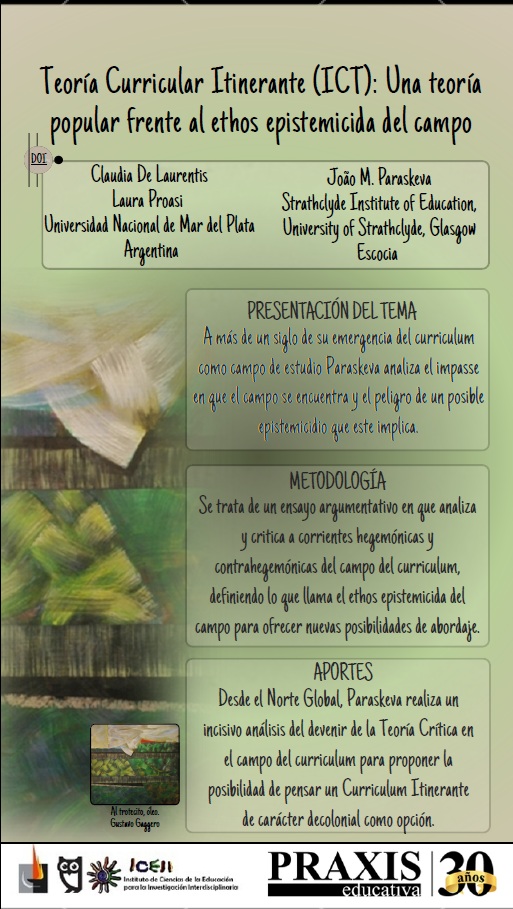
O campo dos estudos curriculares sofre de um evidente impasse teórico. Esse impasse tem sido atribuído, em parte, à onda de triunfalismo neoliberal que massacrou a educação no hemisfério com políticas e práticas que reduzem a pedagogia a uma práxis instrumentalista diretamente associada aos desejos e necessidades sedentos do mercado. No entanto, outra parte substancial desse impasse — pouco explorada em nossas esferas acadêmicas — está relacionada ao aparente fracasso de muitas abordagens críticas e pós-críticas. A combinação desses dois eixos completamente antagônicos contribuiu para a natureza epistemicida do currículo. O cerne deste artigo é um apelo aos acadêmicos da área para que combatam esse impasse, desterritorializando suas abordagens e se comprometendo com uma postura itinerante para abordar a diversidade ilimitada de tradições epistemológicas, desinstalando a natureza eugênica de nosso campo — sua teoria e desenvolvimento. O artigo também explora alguns obstáculos significativos que os impulsos contra-hegemônicos enfrentam no campo. Nesse sentido, o artigo revela os desafios envolvidos na construção de uma plataforma crítico-hegemônica. Propomos um elogio ao comprometimento coletivo com uma teoria do currículo itinerante como uma teoria popular em direção à justiça social e cognitiva.
Downloads
Referências
Adams, F. y Horton, M. (1975). Unearthing seeds of fire: The idea of highlander. John F. Blair Publisher.
Addams, J. (2023). Trade unions and public duty. En J. M. Paraskeva (Ed.), The curriculum: A new comprehensive reader (pp. 417-426). Peter Lang.
Al-l-Ahmad, J. (1984). Occidentosis: A plague from the West. Mizan Press.
Ambedkar, B. (2016). Annihilation of caste. En A. Roy (Ed.), Annihilation of caste. B. R. Ambedkar. Verso.
Amin, S. (2008). The world we wish to see. Revolutionary objectives in the twenty-first century. Monthly Review Press.
Apple, M. (2002). Power, meaning, and identity. Peter Lang.
Apple, M. W. (1979). Ideology and curriculum. Routledge and Kegan Paul.
Apple, M. W. (2000). Official knowledge. Routledge.
Apple, M. W. (2013). Knowledge, power, and education. The selected works of Michael W. Apple. Routledge.
Austin, J. L. (1962). How to do things with words. Oxford University.
Baker, B. (2009). The new curriculum history. Sense Publishers.
Ball, S. (2012). Global education INC: New policy networks and neoliberal imaginary. Routledge.
Bauman, Z. (2005). Identity. Polity Press.
Beane, J. (1997). Curriculum integration: Designing the core of democratic education. Teachers College Press.
Bell, B., Gaventa, J. y Peters, J. (1990). Myles Horton and Paulo Freire, we make the road by walking: Conversations on education and social change. Temple University Press.
Bernstein, B. (1977). Class, codes and control. Routledge and Kegan Paul.
Beyer, L. y Liston, D. (1996). Curriculum in conflict: Social visions, educational agendas and progressive school reform. Teachers College.
Bode, B. (2023). Why educational objectives? En J. M. Paraskeva (Ed.), The curriculum: A new comprehensive reader (pp. 495-500). Peter Lang.
Bond, H. M. (2023). The curriculum and the Negro child. En J. M. Paraskeva (Ed.), The curriculum: A new comprehensive reader (pp. 459-468). Peter Lang.
Bourdieu, P. (2001). Language and symbolic power. Harvard University Press.
Césaire, A. (2000). Discourse on colonialism. Monthly Review Press.
Collins, P. H. (2000). Black feminist thought: Knowledge, consciousness, and the politics of empowerment. Routledge.
Collins, P. H. (2019). Intersectionality as critical social theory. Duke University Press.
Counts, G. (2023). Dare progressive education to be progressive? En J. M. Paraskeva (Ed.), The curriculum: A new comprehensive reader (pp. 509-516). Peter Lang.
Couto, M. (2008). Terra Sonambula. Leya.
Cremin, L. (1964). The transformation of the school. Progressivism in American education, 1876–1957. Vintage Books.
Darder, A. (2016). Ruthlessness and the forging of Liberatory epistemologies: An arduous journey. En J. M. Paraskeva (Ed.), Curriculum epistemicides (pp. ix-ixv). Routledge.
Darder, A. (2022). The generation of the utopia: Foreword. En J. M. Paraskeva (Ed.), Curriculum and the generation of utopia (pp. xv–xix). Routledge.
Deleuze, G. (1994). What is philosophy? Columbia University Press.
Deleuze, G. y Guattari, F. (1984). A thousand plateaus. Capitalism and schizophrenia. University of Minnesota Press.
Dewey, J. (1916). Democracy and education. MacMillan.
Du Preez, P., Le Grange, L. y Simmonds, S. (2022). Re/thinking curriculum inquiry in the posthuman condition: A critical posthumanist stance. Education as Change, 26, 1-20.
DuBois, W. E. (2023). Does the negro need separate schools? En J. M. Paraskeva (Ed.), The curriculum: A new comprehensive reader (pp. 447-454). Peter Lang.
Dussel, E. (2013). Ethics of liberation: In the age of globalization and exclusion. Duke University Press.
Eagleton, T. (2003). After theory. Basic Books.
Ellsworth, E. (1989). Why doesn't this feel empowering? Working through the repressive myths of critical pedagogy. Harvard Educational Review, 59(3), 297-324.
Escobar, A. (2013). Words and knowledges otherwise. En W. Mignolo y A. Escobar (Eds.), Globalization and the decolonial turn (pp. 33-36). Routledge.
Fanon, F. (2001). Wretched of the earth. Penguin Books.
Gil, J. (1998). Metamorphoses of the body. University of Minnesota Press.
Gil, J. (2009). Em busca da identidade. O desnorte. Relógio D'Água.
Giroux, H. (1981). Ideology, culture and the process of schooling. Temple University Press.
Giroux, H. (2004). The terror of neoliberalism: Authoritarianism and the eclipse of democracy. Paradigm.
Gore, J. (1993). The struggle for pedagogies: Critical and feminist discourses as regimes of truth. Routledge.
Gramsci, A. (1999). Antonio Gramsci: Selections from the prison notebooks. International Publishers.
Greene, M. (1973). Teacher as a stranger. Wadsworth Publishing Company, INC.
Grosfoguel, R. (2018). Decolonizing Western universalisms: Decolonial Pluri-versalism from Aime Cesaire to the Zapatistas. En J. M. Paraskeva (Ed.), Towards a just curriculum theory: The epistemicide (pp. 131-148). Routledge.
Habermas, J. (1981). Modernity versus postmodernity. New German Critique, 22, 3-14.
Harding, S. (2008). Sciences from bellow. Feminisms, postcolonialities and modernities. Duke University Press.
Harding, V. (1981). There is a river. The black struggle for freedom in America. Harcourt Brace Jovanovich Publishers
Harvey, D. (2005). A brief history of neoliberalism. Oxford University Press.
Henry, P. (2000). Caliban reason. Introducing Afro-Caribbean philosophy. Routledge.
Holt, J. (1970). What should I do on Monday? Dutton.
Huebner, D. (1976). The moribund curriculum field: It's wake and our work. Curriculum Inquiry, 6(2), 153-167.
Huebner, D. (2002). Huebner, D. A Foreword-Second edition: Theory not as a schema for “acting,” but for “looking”. En J. M. Paraskeva (Ed.), Conflicts in curriculum theory (pp. v-x). Palgrave.
Huebner, D. y Paraskeva, J. M. (2022). A curriculum afterword: The dialogue Dwayne Huebner and João M. Paraskeva. En J. M. Paraskeva (Ed.), Conflicts in curriculum theory (pp. 215-262). Palgrave.
Jal, M. (2023). Epistemological untouchability: The deafening silence of Indian academics. En J. M. Paraskeva (Ed.), Critical perspectives on the denial of caste in educational debate towards a non-derivative curriculum reason (pp. 188-239). Routledge.
Jupp, J. (2017). Decolonizing and de-canonizing curriculum studies: An engaged discussion organized around João M. Paraskeva's Recent Books. Journal of the American Association for the Advancement of Curriculum Studies, 12(1), 1-25.
Jupp, J. (Ed.). (2023). Itinerant curriculum theory: Decolonial praxes, theories, and histories. Peter Lang.
Jupp, J., Delgado, M., Calderón, F., Berumen, F. y Hesse, C. (2024). Decolonial-Hispanophone curriculum: A preliminary sketch and invitation to a South-South dialogue. En J. M. Paraskeva (Ed.), Itinerant curriculum theory (pp. 37-54). Bloomsbury.
Karatani, K. (2003). Transcritique. On Kant and Marx. MIT.
Kellner, D. (1989). Critical theory, marxism and modernity. The John Hopkins University Press.
Kirkwood, G. y Kirkwood, C. (2011). Living adult education. Freire in Scotland. Sense.
Kliebard, H. (1995). The struggle for the American curriculum. Routledge.
Krug, E. (1969). The shaping of the American high school, 1880-1920. The University of Wisconsin Press.
Lakoff, G. (2004). Don't think of an elephant. Chelsea Green Publishing.
Le Grange, L. (2018). Decolonising, Africanising, indigenising and internationalizing of curriculum studies: Opportunities to re)imagine the field. Journal of Education, 74, 5-18.
Lipman, P. (2011). The new political economy of urban education. Routledge.
Liston, D. (1988). Capitalist schools: Explanation and ethics in radical studies of schooling. Routledge.
Liston, D. y Zeichner, K. (1987). Critical pedagogy and teacher education. Journal of Education, 169, 117-137.
Lorde, A. (2007). Sister outsider. Crossing Press.
Lugones, M. (2016). The coloniality of gender. En W. Harcourt (Ed.), The Palgrave handbook of gender and development (pp. 1-18). Palgrave Macmillan.
MacDonald, J. (1975). The quality of everyday life in school. En J. Macdonald y E. Zaret (Eds.), Schools in search of meaning (pp. 78-94).
Maldonado-Torres, N. (2018). Against coloniality: On the meaning and significance of the decolonial turn. En J. M. Paraskeva (Ed.), Towards a just curriculum theory. The epistemicide (pp. 149-164). Routledge.
Mbembe, A. (2017). The critique of the black reason. Duke University Press.
McLaren, P. (1986). Life in schools. Routledge.
Mignolo, W. (2012). The darker side of western modernity. Global futures, decolonial options. Duke University Press.
Mignolo, W. (2018). The invention of the human and the three pillars of the coloniality matrix of power. En C. Walsh y W. Mignolo (Eds.), On decoloniality: Concepts, analytics, praxis (pp. 153-176). Duke University Press.
Nkrumah, K. (1964). Consciencism. Monthly Review Press.
Oliveira, V. A. (2011). Actionable postcolonial theory in education. Palgrave.
Oliveira, V. M. (2021). Hospicing modernity. Penguin.
Paraskeva, J. M. (2011). Conflicts in curriculum theory. En Challenging hegemonic epistemologies. Palgrave.
Paraskeva, J. M. (2013). School rituals as a counter-hegemonic performance. Policy Futures in Education, 11(4), 484-493.
Paraskeva, J. M. (2015). Opening up curriculum canon to democratize democracy. En J. M. Paraskeva y S. Steinberg (Eds.), Decanonizing the field (pp. 3-38). Peter Lang.
Paraskeva, J. M. (2016). Curriculum epistemicides. Routledge.
Paraskeva, J. M. (2018). Towards a just curriculum theory. The epistemicide. Routledge.
Paraskeva, J. M. (2021a). Curriculum and the generation of utopia. Routledge.
Paraskeva, J. M. (2021b). Did COVID-19 exist before the scientists? Towards curriculum theory now. Educational Philosophy and Theory, 55(1), 1-13.
Paraskeva, J. M. (2022a). Conflicts in curriculum theory. Challenging hegemonic epistemologies. Palgrave.
Paraskeva, J. M. (2022b). The generation of the utopia: Itinerant curriculum theory towards a ‘futurable future’. Discourses: Studies in the Cultural Politics of Education, 43, 1-19.
Paraskeva, J. M. (2022c). The original sin. A critique of the curriculum reason: Towards a ‘non-derivative’ critical curriculum eason. En J. M. Paraskeva (Ed.), The curriculum: A new comprehensive reader (pp. 1-62). Peter Lang.
Paraskeva, J. M. (2023a). Critical perspectives on the denial of caste in educational debate. Routledge.
Paraskeva, J. M. (2023b). The original sin: A critique of the curriculum reason: Towards a ‘non-derivative’ critical curriculum reason. En J. M. Paraskeva (Ed.), Curriculum: A new comprehensive reader (pp. 1-60). Peter Lang.
Paraskeva, J. M. (Ed.). (2024). Itinerant curriculum theory. A declaration of epistemological independence. Bloomsbury Critical Education.
Paraskeva, J. M. y Huebner, D. (2023). Dialectic materialism: An alternative way of thinking and doing education alternatively. Journal of Curriculum Studies, 55, 1-20.
Pessoa, F. (2006). Textos filosóficos (Vol. II). Nova Ática.
Pinar, W. (2004). What Is Curriculum Theory? Lawrence Erlbaum.
Pinar, W. (Ed.). (1974). Heightened consciousness, cultural revolution and curriculum theory. Proceedings of the Rochester conference. McCutchan Publishing Corporation.
Popkewitz, T. (1976). Myths of social science in curriculum. The Educational Forum, 40(3), 317-328.
Priestley, M. y Biesta, G. (2018). Introduction. En M. Priestley y G. Biesta (Eds.), Reinventing the curriculum (pp. 1-12). Bloomsbury.
Priestley, M. y Philipou, S. (2018). Editorial: Curriculum making as social practice, complex webs of enactment. The Curriculum Journal, 29, 151-158.
Quijano, A. (1991). Colonialidad y modernidad/racionalidad. Perú Indígena, 29(1), 11-21.
Reckwitz, A. y Rosa, H. (2023). Late modernity in crisis. Polity.
Rugg, H. (2023). Social reconstructionism through education. En J. M. Paraskeva (Ed.), The curriculum: A new comprehensive reader (pp. 501-508). Peter Lang.
Santos, B. S. (1995). Towards a new common sense. Routledge.
Santos, B. S. (1999). Porque é tão difícil construir uma teoria crítica? Revista Crítica de Ciencias Sociais, 54, 197-215.
Santos, B. S. (2007). Beyond abyssal thinking. From global lines to ecologies of knowledges. Review, 30(1), 45-89.
Santos, B. S. (2009). If god were a human rights activist: Human rights and the challenge of political theologies. Is humanity enough? The Secular Theology of Human Rights. Law, Social Justice and Global Development, 1, 1-42.
Santos, B. S. (2014). Epistemologies from the South. Paradigm Publishers.
Santos, B. S. (2018). The end of the cognitive empire. Duke University Press.
Saramago, J. (1999). Folhas políticas. Caminho.
Saramago, J. (2009). Death with interruptions. Houghton & Mifflin Harcourt Publishing
Schubert, W. (2017). Growing curriculum studies: Contributions of João M. Paraskeva. Journal for the American Association for the Advancement of Curriculum Studies, 12(1), 1-20.
Schubert, W., Lopez Schubert, A. L., Thomas, T. y Caroll, W. (1980). Curriculum books: The first eighty years. University Press of America.
Selden, S. (1999). Inheriting shame. The story of eugenics and racism in America. Teachers College Press.
Smith, L. (1999). Decolonizing methodologies. Zed Books.
Spencer, H. (1860a). Education: Intellectual, moral and physical. D. Appleton and Company.
Taliaferro-Baszile, D. (2010). In Ellisonian eyes, what is curriculum theory? En E. Malewski (Ed.), Curriculum studies handbook: The nest momentum (pp. 483-495). Routledge.
Teltumbde, A. (2010). The persistence of caste. The Khairlanji murders and India's hidden apartheid. Zed Books.
Teltumbde, A. (2018). Republic of caste. Thinking equality in the time of neoliberal Hindutva. Navayana.
Thernborn, G. (2010). From Marxism to post-Marxism? Verso.
Tyack, D. (1974). The one best system. A history of American urban education. Harvard University Press.
Vergès, F. (2019). Un féminism décolonial. La Frabrique Éditions.
Walsh, C. (2012). ‘Other’ knowledges, ‘other’ critiques reflections on the politics and practices of philosophy and decoloniality in the other America. Transmodernity. Journal of Peripheral Cultural Production of the Luso-Hispanic World, 1(3), 11-27.
Washington, B. T. (2023). The American Negro and his economic value. En J. M. Paraskeva (Ed.), The curriculum: A new comprehensive reader (pp. 427-436). Peter Lang.
Watkins, W. (1993). Black curriculum orientations. A preliminary inquiry. Harvard Educational Review, 63(3), 321-338.
Wexler, P. (1976). The sociology of education: Beyond inequality. The Bobbs-Merrill Company, INC.
Wexler, P. (1987). Social analysis of culture: After the new sociology. Routledge & Kegan and Paul.
Wraga, W. (2018). The historical U.S. curriculum field's sense of the past. Curriculum History, 19-28.
Yandell, J. (2013). ‘Whose knowledge counts?’ (Institute of education) [Online]. http:// resea rch. ioe. ac. uk/ portal/servi ces/ downl oadRe gister/ 53167 21/ JY_ knowl edge1 31107. Docx
Young, M. F. D. (1971). Knowledge and control. MacMillan.
Young, M. F. D. y Whitty, G. (1977). Society, state, and schooling. The Falmer Press.
Zhao, W. (2019). China's education, Curriculum knowledge and cultural inscriptions. Dancing with the wind. Routledge.
Žižek, S. (2004). The parallax view. New Left Review, 25, 121-1.
Publicado
Edição
Seção
Licença
Copyright (c) 2026 Claudia De Laurentis; laura proasi

Este trabalho está licenciado sob uma licença Creative Commons Attribution-NonCommercial-ShareAlike 4.0 International License.
Aviso de direitos autorais
Comitê Editorial Revista Práxis Educativa:
Declaro que sou o autor do artigo intitulado (nome do artigo), que o mesmo é original e de minha autoria e que não foi publicado anteriormente em qualquer outro formato ou meio. Declaro saber que a revista não me cobrará nenhum tipo de taxa em hipótese alguma, nem receberei qualquer tipo de remuneração monetária.
Caso seja aceito para publicação na Práxis Educacional, autorizo a referida revista a publicá-lo digitalmente e a divulgá-lo em suas redes sociais.
Se o trabalho for publicado, aderi à licença Creative Commons denominada "Atribuição - Compartilhamento Não Comercial pela mesma Licença CC BY-NC-SA", por meio da qual é permitido copiar, reproduzir, distribuir, comunicar publicamente o trabalho e gerar trabalhos derivados , desde que o autor original seja citado e reconhecido. Esta licença está em uso desde setembro de 2018. Em 2016 foi aderido ao CC BY NC ND 4.0; e nos anos de 2017 e 2018 (janeiro-agosto) CC BY NC 4.0.
Esta licença CC BY-NC-SA Share Alike não permite, entretanto, o uso comercial da obra. Como autor, a revista poderá estabelecer acordos adicionais para a distribuição não exclusiva da versão do trabalho publicado na revista, permite-me autoarquivar os artigos publicados, na sua versão post-print, em repositórios institucionais, temáticos , páginas web pessoais ou qualquer outro uso relevante. com o reconhecimento de ter sido publicado pela primeira vez nesta revista.
SA Práxis Educacional adere à DORA (Declaração sobre Avaliação de Pesquisa) assinada em São Francisco, Califórnia, em 16 de dezembro de 2012, e à Declaração do México (Declaração Conjunta LATINDEX - REDALYC - CLACSO - IBICT).









_(1)2.png)


3.png)








_(2).png)






2.jpg)