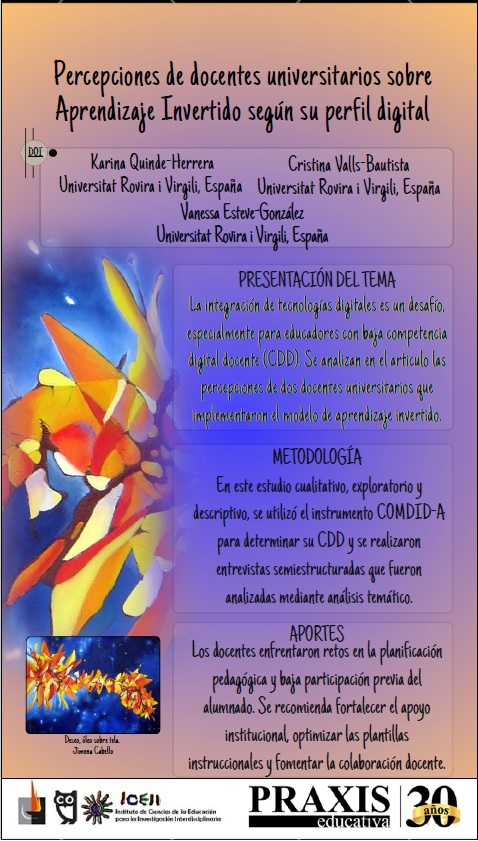
University teachers’ perceptions of Flipped Learning according to their digital profile
DOI:
https://doi.org/10.19137/praxiseducativa-2026-300113Keywords:
Flipped learning, digital teaching competence, higher education, pedagogical innovation, instructional designAbstract
The integration of digital technologies into education is a major global challenge, particularly for educators with low levels of digital teaching competence (DTC). To address this, the Flipped Learning (FL) model encourages the use of digital tools and promotes active learning. This qualitative, exploratory, and descriptive study analyzes the perceptions of university professors who have implemented FL. The COMDID-A instrument was used to assess their DTC, and semi-structured interviews were conducted and analyzed through thematic analysis. Although a high level of DTC is helpful, it is not indispensable. Professors used a variety of digital tools but faced challenges such as pedagogical planning and low initial student participation. It is recommended to strengthen institutional support, refine instructional templates, and foster faculty collaboration.
Downloads
References
Akçayır, G., & Akçayır, M. (2018). The flipped classroom: A review of its advantages and challenges. Computers and Education, 126(July), 334–345. https://doi.org/10.1016/j.compedu.2018.07.021
Braun, V., & Clarke, V. (2006). Using thematic analysis in psychology. Qualitative Research in Psychology, 3(2), 77–101. https://doi.org/10.1191/1478088706qp063oa
Bygstad, B., Øvrelid, E., Ludvigsen, S., & Dæhlen, M. (2022). From dual digitalization to digital learning space: Exploring the digital transformation of higher education. Computers and Education, 182(February). https://doi.org/10.1016/j.compedu.2022.104463
Cabero-Almenara, J., Barroso-Osuna, J., Llorente-Cejudo Antonio, C. (2022). Validación del marco europeo de competencia digital docente mediante ecuaciones estructurales. Revista Mexicana de Investigación Educativa RMIE, 27(92), 185–208. http://creativecommons.org/licenses/by-nc-nd/4.0/
Cheng, S. C., Hwang, G. J., & Lai, C. L. (2022). Critical research advancements of flipped learning: a review of the top 100 highly cited papers. Interactive Learning Environments, 30(9), 1751–1767. https://doi.org/10.1080/10494820.2020.1765395
Guba, E. G. & Lincoln, Y. S. (1994). Competing paradigms in qualitative research. In N. K. Denzin & Y. S. Lincoln (Eds.), Handbook of qualitative research, (pp. 105–117). Sage.
Hew, K. F., & Lo, C. K. (2018). Flipped classroom improves student learning in health professions education: A meta-analysis. BMC Medical Education, 18(1), 1–12. https://doi.org/10.1186/s12909-018-1144-z
Ismatovna, B. S. (2022). Implementation of Flipped Learning Classroom in Academic Context of Higher Education. International Journal on Integrated Education, 5(2), 123–126. https://journals.researchparks.org/index.php/IJIE/article/view/2731
Jain, J., Luaran, J., & Panayachi, S. (2023). Challenges and Issues of Flipping Humanities Lessons: Investigating Teachers’ Experiences in a Malaysian International School. Asia-Pacific Journal of Futures in Education and Society. https://doi.org/10.58946/apjfes-2.1.p2
Khan, Md. S. H., & Abdou, B. (2020). Flipped Classroom: How Institutions of Higher Education (HEIs) of Bangladesh Could Move Forward During Covid-19 Pandemic. SSRN Electronic Journal, April, 1–14. https://doi.org/10.2139/ssrn.3615400
Kong, S. C., Man-Yin Cheung, W., & Zhang, G. (2021). Evaluation of an artificial intelligence literacy course for university students with diverse study backgrounds. Computers and Education: Artificial Intelligence, 2. https://doi.org/10.1016/j.caeai.2021.100026
Lázaro-Cantabrana, J. L., Gisbert-Cervera, M., & Silva-Quiroz, J. E. (2018). Una rúbrica para evaluar la competencia digital del profesor universitario en el contexto latinoamericano. EDUTEC. Revista Electrónica de Tecnología Educativa, 63, 1–14.
Lo, C. K., & Hew, K. F. (2022). Design principles for fully online flipped learning in health professions education: a systematic review of research during the COVID-19 pandemic, Chung Kw. BMC Medical Education, 22(1), 1–14. https://doi.org/10.1186/s12909-022-03782-0
López, J., Pozo, S., & Alonso, S. (2019). Profundización del profesorado en flipped learning según el nivel de competencia digital. Revista Interuniversitaria de Formación del Profesorado. Continuación De La Antigua Revista De Escuelas Normales, 33(3). https://doi.org/10.47553/rifop.v33i3.73283
Martínez, M. (2012) Comportamiento Humano. Nuevos Métodos de Investigación. Trillas.
Ng, D. T. K., Leung, J. K. L., Chu, S. K. W., & Qiao, M. S. (2021). Conceptualizing AI literacy: An exploratory review. Computers and Education: Artificial Intelligence, 2. https://doi.org/10.1016/j.caeai.2021.100041
Ng, D. T. K., Leung, J. K. L., Su, J., Ng, R. C. W., & Chu, S. K. W. (2023). Teachers’ AI digital competencies and twenty-first century skills in the post-pandemic world. Educational Technology Research and Development, 71(1), 137–161. https://doi.org/10.1007/s11423-023-10203-6
O’Flaherty, J., & Phillips, C. (2015). The use of flipped classrooms in higher education: A scoping review. The Internet and Higher Education, 25, 85–95. https://doi.org/10.1016/j.iheduc.2015.02.002
Pozo, S., López, J., Moreno, A. & Hinojo-Lucena, F. (2020). Flipped learning y competencia digital: Una conexión docente necesaria para su desarrollo en la educación actual. Revista Electrónica Interuniversitaria de Formación del Profesorado, 23(2), 127-141. https://doi.org/10.6018/reifop.422971
Quinde-Herrera, K., Esteve-González, V., & Valls-Bautista, C. (2023b). Diseño y validación de un prototipo instruccional para aplicar el modelo flipped learning en educación superior. UTE Teaching & Technology (Universitas Tarraconensis), 1, 30–48. https://doi.org/https://doi.org/10.17345/ute.2022.2.3208
Quinde-Herrera, K., Pinos-Vélez, V., Esteve-González, V., & Valls-Bautista, C. (2023a). Aprendizaje invertido en Educación Superior: Una revisión de alcance de la implementación| Flipped Learning in Higher Education: A Scoping Review of Implementation. Edutec, 84, 18–34. https://doi.org/https://doi.org/10.21556/edutec.2023.84.2785
Tomczyk, Ł. (2020). Skills in the area of digital safety as a key component of digital literacy among teachers. Education and Information Technologies, 25(1), 471–486. https://doi.org/10.1007/s10639-019-09980-6
Yang, J. (2015). Adaptive Exploration on Universities Implementing the Flipped Classroom Teaching.
Yin, R K. (2009), Case Study Research. London: Sage.
Published
Issue
Section
License
Copyright (c) 2026 Karina Quinde-Herrera, Cristina Valls-Bautista, Vanessa Esteve-González

This work is licensed under a Creative Commons Attribution-NonCommercial-ShareAlike 4.0 International License.
Copyright Notice
Editorial Committee Educational Praxis Magazine:
I hereby declare that I am the author of the article titled (article name), that it is original and my own and that it was not previously published in any other format or medium. I declare to know that the magazine will not charge me any type of fee under any circumstances, nor will I receive any type of monetary compensation If it were accepted for publication in Educational Praxis, I authorize the aforementioned magazine to publish it digitally and to advertise it on its social networks.
If the work is published, I adhere to the Creative Commons license called "Attribution - Non-Commercial Share Alike CC BY-NC-SA", through which it is allowed to copy, reproduce, distribute, publicly communicate the work and generate derivative works, as long as when the original author is cited and acknowledged. This license has been used since September 2018. In 2016 CC BY NC ND 4.0 was adhered to; and in the years 2017 and 2018 (January-August) CC BY NC 4.0.
This CC BY-NC-SA Share Alike license does not, however, permit commercial use of the work. As an author, the journal may establish additional agreements for the non-exclusive distribution of the version of the work published in the journal, it allows me to self-archive the published articles, in their post-print version, in institutional, thematic repositories, personal web pages or any other relevant use. with the recognition of having been first published in this journal.
Educational Praxis adheres to DORA (Declaration on Research Assessment) signed in San Francisco, California, on December 16, 2012, and to the Declaration of Mexico (Joint Declaration LATINDEX - REDALYC - CLACSO - IBICT).










_(1)2.png)


3.png)








_(2).png)






2.jpg)