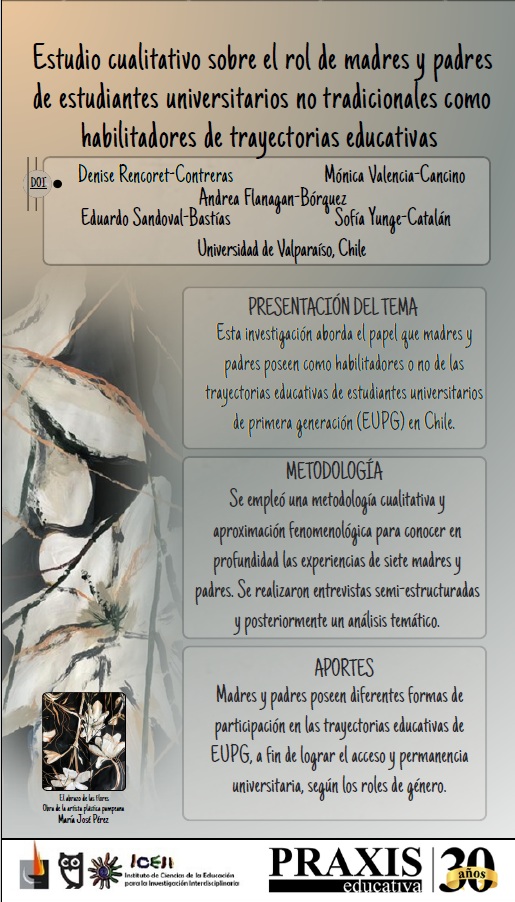
Estudio cualitativo sobre el rol de madres y padres de estudiantes universitarios no tradicionales como habilitadores de trayectorias educativas
DOI:
https://doi.org/10.19137/praxiseducativa-2026-300104Keywords:
Higher education, Universitary student, Family role, Gender role, Educational policyAbstract
This study aimed to explore the role of mothers and fathers as facilitators in the educational trajectories of first-generation university students (FGUs) in Chile. Using qualitative methodology and a phenomenological approach, seven FGUs mothers and fathers were interviewed. The analysis highlights that one of the most relevant aspects is the different forms of participation according to gender roles. Mothers tend to play a socio-affective role, which includes providing emotional support and constant care. Furthermore, during the school years, they have a greater presence in school activities and participate in them.
Downloads
References
Altbach, P. (2016). Global perspectives on higher education. John Hopkins University Press.
Álvarez, N. (2016). La moral, los roles, los estereotipos femeninos y la violencia simbólica. Revista Humanidades, 6(1), 1-32. https://doi.org/10.15517/h.v6i1.24964
Bourdieu, P. (2016). The forms of capital. En A. R. Sadovnik y R. Coughlan (eds.), Sociology of education: A critical reader (3ed, pp. 83-95).Routledge,
Bracchi, C. (2016). Descifrando el oficio de ser estudiantes universitarios: entre la desigualdad, la fragmentación y las trayectorias educativas diversificadas. Trayectorias Universitarias, 2(3), 3-14.
Braun, V., y Clarke, V. (2014). What can “thematic analysis” offer health and well-being researchers? International Journal of Qualitative Studies on Health and Well-being, 9, 26152. ht tps://doi.org /10.3402 /qhw.v9.26152
Canales, A. y De los Ríos, D. (2009). Retención de estudiantes vulnerables en la educación universitaria. Calidad en la Educación, 30, 50-83.
Castillo, J. y Cabezas, G. (2010). Caracterización de jóvenes de primera generación en educación superior. Nuevas trayectorias hacia la equidad educativa. Calidad en la Educación. 32, 44-76. doi: 10.31619/caledu.n32.151
Creswell, J. y Poth, C. (2023). Qualitative inquiry y research design: Choosing among five approaches. SAGE
Espinoza, O. (2017). Neoliberalismo y educación superior en Chile: una mirada crítica al rol desempeñado por el Banco Mundial y los "Chicago Boys". Laplage em Revista, 3(3), 93-114.
Fei, Y., Liang, Y., Li, Y., Zhao, J., Wang, X., Zhu, H., y Chen, X. (2023). A bibliometric analysis of research on first-generation college students from 2002 to 2022. Frontiers in Psychology, 15, Article 1214216. https://doi.org/10.3389/fpsyg.2023.1214216
Flanagan-Bórquez, A. (2017). Experiencias de estudiantes de primera generación en universidades chilenas: Realidades y desafíos. Revista de la Educación Superior, 46(183), 87-104. https://doi.org/10.1016/j.resu.2017.06.003
Flanagan-Bórquez, A., Rojas-MurphyTagle, A., Guzmán-Valenzuela, C. y Varas-Aguilera, P.. (2023). Análisis crítico del estado de la investigación sobre estudiantes de primera generación en Latinoamérica. Revista Mexicana deIinvestigación Educativa, 28(97), 363-390.
Flanagan-Bórquez, A., y Soriano-Soriano, G. (2024). Family and higher education: developing a comprehensive framework of parents’ support and expectations of first-generation students. Frontiers in Educaction, 9. https://doi.org/10.3389/feduc.2024.1416191
Fuster, T., Carmiol, A., Salazar, M., y Rosabal-Coto, M. (2024). Involucramiento parental en retrospectiva: apoyos académicos percibidos por estudiantes de educación superior a través de su historia educativa. Revista Actualidades Investigativas en Educación, 24(3), 1-32. https://doi.org/10.15517/aie.v24i3.59305
Garriga, S. (2024). Expectativas en torno a la universidad y elección de la carrera. Un análisis sobre casos atípicos de graduados/as y estudiantes en fase de finalización que son primera generación universitaria. Praxis Educativa, 58(1), 1-20. https://dx.doi.org/10.19137/praxiseducativa-2024-280208
Ghiardo Soto, F., y Dávila León, Ó. (2020). Educación superior y estructura social en Chile: aproximaciones desde tres grupos generacionales. Última década, 28(53), 40-77. http://dx.doi.org/10.4067/S0718-22362020000100040.
Giovine, M. (2023).Habitus desgarrados en las escuelas secundarias de elite. Inter-ação, 48(2), 430-445. https://doi.org/10.5216/ia.v48i2.76285
Gofen, A. (2009). Family Capital: How First‐Generation Higher Education Students Break the Intergenerational Cycle. Family Relations, 58(1), 104-120. https://doi.org/10.1111/j.1741-3729.2008.00538.x
Gómez-Urrutia, V., Jiménez-Figueroa, A., y Barreto Colichi, R. (2021). Proyectos familiares y laborales en jóvenes: la demanda por igualdad de género. Revista Latinoamericana de Ciencias Sociales, Niñez y Juventud, 19(1), 1-21. https://dx.doi.org/10.11600/rlcsnj.19.1.4618
Grodsky, E., y Rieglecrumb, C. (2010). Those who choose and those who don’t: Social background and college orientation. The Annals of the American Academy of Political and Social Science, 627, 14–35.
Guba, E. G. (1989). Criterios de credibilidad en la investigación naturalista. La Enseñanza: Su Teoría y Su Práctica, 148-165. https://dialnet.unirioja.es/servlet/articulo?codigo=6220913
Guerrero-Valenzuela, M., Rivero González, G., Salvo Contreras, A., Varas Aguilera, P., Vera Ponce, D., y Flanagan-Bórquez, A. (2022). Estudio exploratorio sobre las experiencias de estudiantes universitarios de primera generación y su valoración de Programas de Acción Afirmativa. Praxis Educativa (Arg), 26(2), . https://doi.org/10.19137/praxiseducativa-2022-260208
Guzmán-Concha, C. (2022). La política estudiantil: apuntes para una agenda de investigación. Esboços, 29(51), 430-448. https://doi.org/10.5007/2175-7976.2022.e85774
Guzmán-Valenzuela, C., Darwin, S., Flanagan, A., Aguilera-Muñoz, A. y Geldres, A. (2022). (Un)Limited choice: analysing the strategic choices of first-in-generation students in neoliberal higher education. British Journal of Sociology of Education, DOI: 10.1080/01425692.2022.2080045
Guzmán-Valenzuela, C., Flanagan-Bórquez, A., Darwin, S., Rojas-Murphy-Tagle, A. F. y Aguilera-Muñoz, A. (2023). Capital aspiracional académico-familiar: experiencias de estudiantes universitarios chilenos de primera generación. Magis, Revista Internacional de Investigación en Educación, 16, 1-27. https://doi.org/10.11144/Javeriana.m16.caaf
Harper, C. E., Zhu, H., y Kiyama, J. M. (2019). Parents and families of first-generation university students experience their own university transition. The Journal of Higher Education. https://doi.org/10.1080/00221546.2019.1647583
Jarpa, C., y Rodriguez, C. (2017). Segmentación y exclusión en Chile: El caso de los Jóvenes Primera Generación en Educación Superior. Revista Latinoamericana de Ciencias Sociales, Niñez y Juventud, 15(1), 327-343. http://doi.org/10.11600/1692715x.1512028032016.
Jiménez-Moya, G., Carvacho, H., y Álvarez, B. (2020). Azul y rosado: la (aún presente) trampa de los estereotipos de género. Midevidencias 23, 1-9.
Jiménez V. (2020). Triangulación metodológica cualitativa y cuantitativa. Revista sobre estudios e investigaciones del saber académico, 14(14), 76-81.
Jones, E. J., y Schreier, H. M. C. (2022). First-generation college students have greater systemic inflammation than continuing-generation college students following the initial college transition: a brief report. Ann. Behavior. Med. 57, 86-92. doi: 10.1093/ abm/kaac008
Koenig, A., y Eagly, A. (2019). Typical Roles and Intergroup Relations Shape Stereotypes: How Understanding Social Structure Clarifies the Origins of Stereotype Content. Social Psychology Quarterly, 82(2), 205-230. https://doi. org/10.1177/0190272519850766
Levinson, B. (2011). Symbolic domination and the reproduction of inequality. En B. A. U. Levinson, J. P. K. Gross, C. Hanks, J. Heimer Dadds, K. D. Kumasi, J. Link y D. Metro-Roland (eds.), Beyond critique. Exploring critical social theories and education, (113-138). Routledge.
Leyton, D., Vásquez, A., y Fuenzalida, V. (2012). La experiencia de estudiantes de contextos vulnerables en diferentes Instituciones de Educación Superior Universitaria (IESU): Resultados de investigación. Calidad en la educación, (37), 61-97. https://dx.doi.org/10.4067/S0718-45652012000200003
Linne, J. (2018). El Deseo de Ser Primera Generación Universitaria. Ingreso y Graduación en Jóvenes de Sectores Populares. Revista Latinoamericana de Educación Inclusiva, 12(1), 129-147. https://dx.doi.org/10.4067/S0718-73782018000100129
Madolell Orellana, R., Gallardo Vigil, M.A y Alemany Arrebola, I. (2020). Los estereotipos de género y las actitudes sexistas de los estudiantes universitarios en un contexto multicultural. Profesorado. Revista de Currículum y Formación de Profesorado, 24(1), 284-303. DOI: 10.30827/profesorado.v24i1.8148
Mcdossi, O., Wright, A. L., McDaniel, A., y Roscigno, V. J. (2022). First-generation inequality and college integration. Social Science Research, 105, 102698. https://doi.org/10.1016/j.ssresearch.2022.102698
Montalvo, J. (2020). El trabajo desde la perspectiva de género. Revista de la Facultad de Derecho, 1-19. https://doi.org/10.22187/rfd2020n49a6
Nascimento L, Souza T, Dos Santos C, Montenegro J. Cordeiro R, Da Silva L (2018) Theoretical saturation in qualitative research: an experience report in interview with schoolchildren. Rev. Bras. Enferm. 71, 228-233. https://doi.org/10.1590/0034-7167-2016-0616
Nichols, L., y Islas, A. (2016). Pushing and Pulling Emerging Adults Through College: College Generational Status and the Influence of Parents and Others in the First Year. Journal of Adolescent Research, 31, 59-95. https://doi.org/10.1177/0743558415586255.
Nyimbili , F., y Nyimbili , L. (2024). Types of Purposive Sampling Techniques with Their Examples and Application in Qualitative Research Studies. British Journal of Multidisciplinary and Advanced Studies, 5(1), 90–99. https://doi.org/10.37745/bjmas.2022.0419
Ortiz, R., Ortiz, C., León, H., y Ramos, R. (2023). Estudiantes de Primera Generación (EPG): sus condiciones, en el marco de las acciones afirmativas: Condiciones y acciones afirmativas. Runae, 110-133.
O'Shea, S., May, J., Stone, C., y Delahunty, J. (2024). First-in-family students, university experience and family life. Motivations, transitions and participation: Springer Nature.
Pataro, R. (2019). Democratização da universidade pública e estudantes de primeira geração na unespar. Revista Contemporânea de Educação, 14, (29), 71-95.
Reátegui, L. (2023). La elección universitaria de jóvenes que son primera generación de universitarios en Lima-Perú. Revista Peruana de Investigación Educativa, 15(19), 121-144. https://doi.org/10.34236/rpie.v15i19.484
Segovia, F. y Flanagan-Bórquez, A. (2019). Desafíos de ser un estudiante indígena de primera generación en la universidad chilena de hoy. Revista Mexicana de Investigación Educativa, 24(82), 745-764.
Stuber, J. M. (2012). Inside the college gates: How class and culture matter in higher education. Lexington Books. https://doi.org/10.1353/csd.2013.0013
Suarez-Cretton, X., y Castro-Méndez, N. (2022). Perfiles de gratitud, necesidades psicológicas y su relación con la resiliencia en estudiantes no tradicionales. Estudios sobre Educación. https://doi.org/10.15581/004.43.006
Tonon, G. (2012). Reflexiones latinoamericanas sobre investigación cualitativa. Revista Latinoamericana De Ciencias Sociales, Niñez y Juventud, 8(1).
Valdéz, X. (2007). La vida en común: Familia y vida privada en Chile y el medio rural en la segunda mitad del siglo XX. Santiago: LOM.
Webb, A. (2018). Getting there and staying in: first-generation indigenous students’ educational pathways into Chilean higher education. International Journal of Qualitative Studies in Education, 32(5), 529-546. https://doi.org/ 10.1080/09518398.2018.1488009
Wright, B. (2019). Supportive campuses and first-generations-student learning outcomes. Information Discovery and Delivery, 47(2), 84-95. https://doi.org/10.1108/IDD-09-2018-0042.
Yosso, T. (2005). Whose culture has capital? A critical race theory discussion of community cultural wealth. Race Ethnicity and Education, 8(1), 69 -91. https://doi.org /10.1080/1361332052000341006
Zambrano-Mendoza, G., y Vigueras-Moreno, J. (2020). Rol familiar en el proceso de enseñanza-aprendizaje. Domus Científica, 6(3), 448-473.http://dx.doi.org/10.23857/dc.v6i3.1293
Zhao, Y., Wang, Z., y Zengyuan, R. (2023). Research on the influence of family capital on academic achievement of first-generation college students in China. Frontiers in Psychology. 14:1174345. doi: 10.3389/fpsyg.2023.1174345
Published
Issue
Section
License
Copyright (c) 2026 Denise Rencoret-Contreras, Eduardo Sandoval-Bastías, Mónica Valencia-Cancino, Sofía Yunge-Catalán, Andrea Flanagan-Bórquez

This work is licensed under a Creative Commons Attribution-NonCommercial-ShareAlike 4.0 International License.
Copyright Notice
Editorial Committee Educational Praxis Magazine:
I hereby declare that I am the author of the article titled (article name), that it is original and my own and that it was not previously published in any other format or medium. I declare to know that the magazine will not charge me any type of fee under any circumstances, nor will I receive any type of monetary compensation If it were accepted for publication in Educational Praxis, I authorize the aforementioned magazine to publish it digitally and to advertise it on its social networks.
If the work is published, I adhere to the Creative Commons license called "Attribution - Non-Commercial Share Alike CC BY-NC-SA", through which it is allowed to copy, reproduce, distribute, publicly communicate the work and generate derivative works, as long as when the original author is cited and acknowledged. This license has been used since September 2018. In 2016 CC BY NC ND 4.0 was adhered to; and in the years 2017 and 2018 (January-August) CC BY NC 4.0.
This CC BY-NC-SA Share Alike license does not, however, permit commercial use of the work. As an author, the journal may establish additional agreements for the non-exclusive distribution of the version of the work published in the journal, it allows me to self-archive the published articles, in their post-print version, in institutional, thematic repositories, personal web pages or any other relevant use. with the recognition of having been first published in this journal.
Educational Praxis adheres to DORA (Declaration on Research Assessment) signed in San Francisco, California, on December 16, 2012, and to the Declaration of Mexico (Joint Declaration LATINDEX - REDALYC - CLACSO - IBICT).










_(1)2.png)


3.png)








_(2).png)






2.jpg)