Curación de contenidos y praxis pedagógica : un modelo de formación para el profesorado universitario
DOI:
https://doi.org/10.19137/praxiseducativa-2026-300216Keywords:
Digital skills, Teaching practice, Educational models, Training, Teaching materialsAbstract
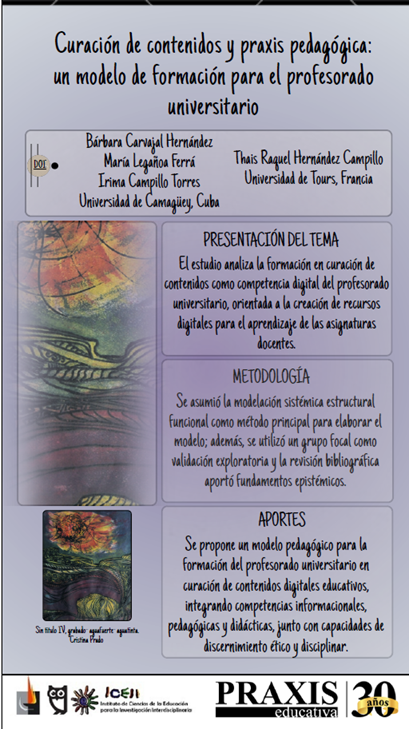
The research addresses the need to develop digital competencies in university professors to adopt more active and engaging pedagogies. In this regard, the study focuses on creating a pedagogical model that facilitates training in content curation. To develop the model, a systemic, structural, and functional approach was used in defining its subsystems and components, complemented by a literature review that established the epistemic foundations of the proposal. The model integrates three subsystems that promote training in content curation, the use of digital tools, and didactics. Moreover, the interaction between the components reveals new theoretical relationships and a higher-level integrative quality that demonstrates the teacher's comprehensive training. It is concluded that this model can strengthen didactic performance and support continuous training in the current educational context.
Downloads
References
Aguilar-Peña, J. D., Rus-Casas, C., Eliche-Quesada, D., Muñoz-Rodríguez, F. J. y La Rubia, M. D. (2022). Content Curation in E-Learning: A Case of Study with Spanish Engineering Students. Applied Sciences, 12(6), 1-19. https://doi.org/10.3390/app12063188
Bassani, P.S. y Magnus, E.B. (2020). Percursos de autoria em/na rede: o processo de curadoria de conteúdo digital na perspectiva dos ambientes pessoais de aprendizagem. RE@D - Revista de Educação a Distância e eLearning, 3(1), 78-99. https://doi.org/10.34627/vol3iss1pp78-99
Castells, M. (2005). La era de la información: economía, sociedad y cultura. Alianza Editorial.
Chagas, A.M. y Linhares, R.N. (2020). The Digital Content Curation, as a Device in the Education-Research in Cyberculture. Journal of Distance Education and eLearning, 3(1), 100-114. https://doi.org/10.34627/vol3iss1pp100-114
Chao, T.C., Cragin, M.H. y Palmer, C.L. (2015). Data Practices and Curation Vocabulary (DPCVocab): An empirically derived framework of scientifc data practices and curatorial processes. Journal of the Association for Information Science & Technology, 66(3), 616-633. https://doi.org/10.1002/asi.231
Chiappe, A. (2016). Tendencias sobre contenidos educativos digitales en América Latina. UNESCO OEI, 1-26, https://unesdoc.unesco.org/ark:/48223/pf0000245673
Colunga S. (2022). Pautas para la delimitación y empleo de los resultados científicos en la investigación educativa. Humanidades médicas, 22(2), 207-233. https://www.medigraphic.com/cgi-bin/new/resumen.cgi?IDARTICULO=113435
de Godoi, K.A., Costa, A.P. (2023). Study on contexts and stages of digital content curation models: Guidelines for use in qualitative analysis software. The Qualitative Report, 28(10), 2980-2994. https://doi.org/10.46743/2160-3715/2023.6684
de la Peña, G., Velázquez, R.M. (2018). Algunas reflexiones sobre la teoría general de sistemas y el enfoque sistémico en las investigaciones científicas. Revista Cubana de Educación Superior, 3(2), 31-44. http://scielo.sld.cu/scielo.php?pid=S0257-43142018000200003&script=sci_arttext&tlng=en
Deschaine, M. y Sharma, S.A. (2015). The five Cs of digital curation: Supporting twenty-first-century teaching and learning. InSight: A Journal of Scholarly Teaching, 10, 19-24. https://eric.ed.gov/?id=EJ1074044
Elias, T. (2021). Exploring Curation as a Path Towards Decolonizing Education. The Open/Technology in Education. Society, and Scholarship Association Journal, 1(2), 1-19. https://doi.org/10.18357/otessaj.2021.1.2.15
Forkosh-Baruch, A. y Gadot, R. (2021). Social Curation Experience: Towards Authentic Learning in Preservice Teacher Training. Technology, Knowledge and Learning, 26(1), 105-122. https://doi.org/10.1007/s10758-020-09449-3
Freire, P. y Shor, I. (2014). Miedo y Osadía. La cotidianidad del docente que se arriesga a practicar una pedagogía transformadora. Siglo Veintiuno
Fullan, M. (2002). El significado del cambio educativo: un cuarto de siglo de aprendizaje. Profesorado. Revista de Currículum y Formación de Profesorado, (6)1, 1-14. https://revistaseug.ugr.es/index.php/profesorado/article/view/19173
García-Martínez, J.A., Rosa-Napal, F.C., Romero-Tabeayo, I., López-Calvo, S. y Fuentes-Abeledo, E.J. (2020). Digital Tools and Personal Learning Environments: An Analysis in Higher Education. Sustainability, 12(19), 1-11. https://doi.org/10.3390/su12198180
Garibaldi, D. y Borges, L.M. (2022). Curadoria de conteúdo na EAD: gestão da qualidade para o desenvolvimento de um modelo de referencia. Revista Brasileira de Educação em Ciência da Informação, 9, 1-34 https://doi.org/10.24208/rebecin.v9.300
Gadot, R. y Tsybulsky, D. (2023). Digital curation as a pedagogical approach to promote critical thinking. Journal of Science Education and Technology, 32(6), 814-823. https://doi.org/10.1007/s10956-022-10016-x
Guallar, J. y Leiva-Aguilera, J. (2013). El content curator: guía básica para el nuevo profesional de internet. UOC.
Autoría et al. (2022) Esta información fue eliminada para no vulnerar el proceso de revisión a ciegas
Huang, F. y Teo, T. (2021). Examining the role of technology-related policy and constructivist teaching belief on English teachers’ technology acceptance: A study in Chinese universities. British Journal of Educational Technology, 52(1), 441-460, https://doi.org/10.1111/bjet.13027
Juárez, D., Torres, C. A. y Herrera, L.E. (2017). Las posibilidades educativas de la curación de contenidos: una revisión de literatura. Apertura, 9(2), 116-131. doi:10.18381/Ap.v9n2.1046, ,
Lewis, D. (1996). Dying for information?: An Investigation Into the Effects of Information Overload in the UK and Worldwide. Reuters Business Information
Liesa-Orús, M., Latorre-Cosculluela, C., Vázquez-Toledo, S. y Sierra-Sánchez, V. (2020). The Technological Challenge Facing Higher Education Professors: Perceptions of ICT Tools for Developing 21st Century Skills. Sustainability, 12(13), 1-14. https://doi.org/10.3390/su12135339
Lingo, E. L. (2023). Digital Curation and Creative Brokering: Managing information overload in open organizing. Organization Studies, 44(1), 105-133. https://doi.org/10.1177/01708406221099697
Marimon-Martí, M., Cabero, J., Castañeda, L., Coll, C., de Oliveira, J. M. y Rodríguez-Triana, M. J. (2022). Construir el conocimiento en la era digital: retos y reflexiones. Revista de Educación a Distancia, 22(69), 1-32. https://doi.org/10.6018/red.505661
Marín, V., Moreno, J. y Negre, F. (2012). Modelos educativos para la gestión de la información en educación superior: una experiencia de curación de contenidos como estrategia metodológica en el aula universitaria. Edutec, Revista Electrónica de Tecnología Educativa, (42), 1-22. https://doi.org/10.21556/edutec.2012.42.1
Meneses-Chagas, A. y Nunes-Linhares, R. (2020). A curadoria de conteúdos digitais, como dispositivo na pesquisa-formação na cibercultura. RE@D-Revista de Educação a Distância e Elearning, 3(1), 100-114. https://doi.org/10.34627/vol3iss1pp100-114
Meneses-Chagas, A., Nunes-Linhares, R. y Fontes-Mota, M. (2019). A curadoria de conteúdo digital enquanto proposta metodológica e multirreferencial. Revista Ibérica de Sistemas e Tecnologias de Informação, (33), 32-47. doi: 10.17013/risti.33. 32–47
Mihailidis, P. y Fromm, M. E. (2014). Scaffolding curation: Developing digital competencies in media literacy education. En M. Stocchetti (Ed), Media and education in the digital age (pp 91-105). Peter Lang GmbH
Negre, F., Marín, V. I. y Pérez, A. (2013). Estrategias para la adquisición de la competencia informacional en la formación inicial de profesorado de primaria. Revista Electrónica Interuniversitaria de Formación del Profesorado, 16(2), 1-12.
Rantasaari, J. (2021). Doctoral Students' Educational Needs in ResearchData Management: Perceived Importance and Current Competencies. International Journal of Digital Curation, 16(1), 1-36. http://dx.doi.org/10.2218/ijdc.v16i1.684
Stasi, M. L. (2022). La exposición a la diversidad de contenidos en las redes sociales: entre la regulación o la desagregación en la curación de contenidos. Teoría & Derecho. Revista de Pensamiento jurídico, (32), 130-165. https://doi.org/10.36151/TD.2022.041
Tamayo-Roca, C., Roca-Revilla, M. y Nápoles-Quiñones, G. (2017). La modelación científica: algunas consideraciones teórico-metodológicas. Santiago, (142), 79-90. https://santiago.uo.edu.cu/index.php/stgo/article/view/2123
Tobón, S. (2013). Formación integral y competencias. Pensamiento complejo, currículo, didáctica y evaluación. ECOE
Tsybulsky, D. (2020). Digital curation for promoting personalized learning: A study of secondary-school science students’ learning experiences. Journal of Research on Technology in Education, 52(3), 429-440. https://doi.org/10.1080/15391523.2020.1728447
Vega, B., Salazar, A.J. y Panchi, V.P. (2022). Propuesta de modelo para curación eficaz de contenidos en enseñanza mixta y no escolarizada de la UAEMéx. Revista Mexicana De Bachillerato a Distancia, 14(27), 1-7. https://doi.org/10.22201/cuaieed.20074751e.2022.27.82007
Zhao, C. y Zhao L. (2021). Digital Nativity, Computer Self-Efficacy, and Technology Adoption: A Study Among University Faculties in China. Frontiers in Psychology, 12, 1-7. https://doi.org/10.3389/fpsyg.2021.746292
Downloads
Published
Issue
Section
License
Copyright (c) 2026 Thais Raquel Hernández Campillo, Bárbara Carvajal Hernández, María Legañoa Ferrá, Irima Campillo Torres

This work is licensed under a Creative Commons Attribution-NonCommercial-ShareAlike 4.0 International License.
Copyright Notice
Editorial Committee Educational Praxis Magazine:
I hereby declare that I am the author of the article titled (article name), that it is original and my own and that it was not previously published in any other format or medium. I declare to know that the magazine will not charge me any type of fee under any circumstances, nor will I receive any type of monetary compensation If it were accepted for publication in Educational Praxis, I authorize the aforementioned magazine to publish it digitally and to advertise it on its social networks.
If the work is published, I adhere to the Creative Commons license called "Attribution - Non-Commercial Share Alike CC BY-NC-SA", through which it is allowed to copy, reproduce, distribute, publicly communicate the work and generate derivative works, as long as when the original author is cited and acknowledged. This license has been used since September 2018. In 2016 CC BY NC ND 4.0 was adhered to; and in the years 2017 and 2018 (January-August) CC BY NC 4.0.
This CC BY-NC-SA Share Alike license does not, however, permit commercial use of the work. As an author, the journal may establish additional agreements for the non-exclusive distribution of the version of the work published in the journal, it allows me to self-archive the published articles, in their post-print version, in institutional, thematic repositories, personal web pages or any other relevant use. with the recognition of having been first published in this journal.
Educational Praxis adheres to DORA (Declaration on Research Assessment) signed in San Francisco, California, on December 16, 2012, and to the Declaration of Mexico (Joint Declaration LATINDEX - REDALYC - CLACSO - IBICT).









_(1)2.png)


3.png)








_(2).png)






2.jpg)