Design and Validation of the Inventory for Soft Skills in Secondary Education Students: IHBE
DOI:
https://doi.org/10.19137/praxiseducativa-2026-300114Keywords:
classroom diagnoses, secondary schools, soft skills, inventory, educational projectsAbstract
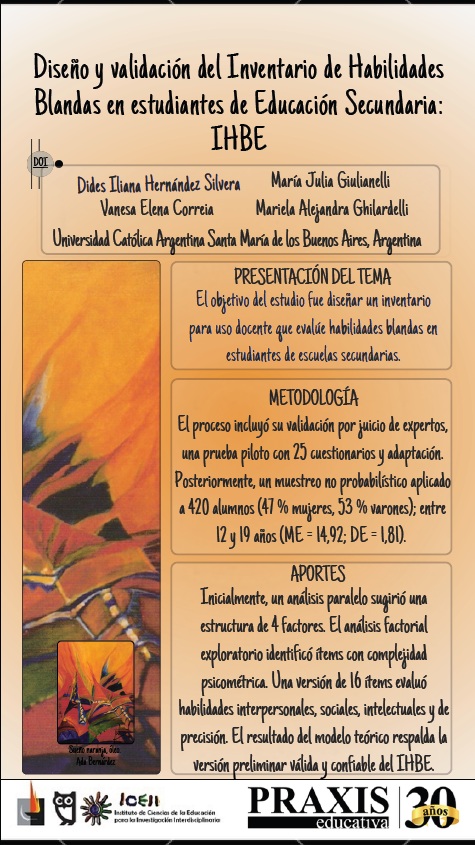
The objective of this study was to design an inventory for teacher use to assess soft skills in secondary school
students. The process included validation by expert judgment, a pilot test with 25 questionnaires, and adaptation.
Subsequently, a non-probability sample was applied to 420 students (47% female, 53% male) between the ages
of 12 and 19 (ME = 14.92; SD = 1.81). Initially, a parallel analysis suggested a four-factor structure of the IHBE.
Exploratory factor analysis identified items with psychometric complexity, so 16 items were retained. The
16-item version measures four factors: interpersonal, social, intellectual, and accuracy skills. Semi-confirmatory
factor analysis yielded goodness-of-fit indices (GFI = .98, AGFI = .96, RMSA = .000) with a 95% confidence
interval. The IHBE showed high internal consistency (α = .97, .95, .85, and .90 for each factor; 97 for the total
instrument). The results of the theoretical model support the validity and reliability of the preliminary version of
the IHBE.
Downloads
References
Apaza, S. Á., y Vera, H. M. B. (2022). Relación de habilidades blandas y rendimiento académico en estudiantes de la Institución Educativa Juan Velasco Alvarado N° 40399 del Centro Poblado de Chalhuanca, Yanque, Caylloma–Arequipa 2019. Disciplinares, 1(1), 57-68. https://doi.org/10.1177/1052562913489029
Araya-Fernández, E., y Garita-González, G. (2020). Habilidades blandas: elementos para una visión holística en la formación de profesionales en informática. Trilogía Ciencia Tecnología Sociedad, 12(23), Instituto Tecnológico Metropolitano. https://doi.org/10.22430/21457778.1614
Araya-Fernández, E. y Garita -González, G. (2019). Propuesta para el fortalecimiento de habilidades blandas y complementarias, y su impacto en el currículo TIC desde una perspectiva laboral, profesional y de gestión académica. Calidad en Educación Superior, 10(2), 112-141. https://doi.org/10.22458/caes.v10i2.1907
Baque Villanueva, L. K., Viteri Intriago, D. A., y Izquierdo Morán, A. M. (2022). Las habilidades interpersonales en la eficiencia de las empresas ecuatorianas. Revista Estudios del Desarrollo Social: Cuba y América Latina, 10(1). http://scielo.sld.cu/scielo.php?pid=S2308-01322022000100018&script=sci_arttext
Brenlla, M. E., Seivane, M. S., Fernández da Lama, R. G., y Germano, G. (2023). Pasos Fundamentales Para Realizar Adaptaciones de Pruebas Psicológicas. Revista De Psicología, 19(38), 121–148. https://doi.org/10.46553/RPSI.19.38.2023
Bucheli, M. G. V., y Mata, S. C. (2023). Habilidades blandas y la web 2.0 en la educación secundaria. Emerging Trends in Education, 5(10), 58-67. https://doi.org/10.19136/etie.a5n10.5078
Grez-Cook, F. G. (2018). Veo, pienso y me pregunto. El uso de rutinas de pensamiento para promover el pensamiento crítico en las clases de historia a nivel escolar. Praxis pedagógica, 18(22), 65-84. https://doi.org/10.26620/uniminuto.praxis.18.22.2018.65-84
Cuenca, A., Álvarez, M., Ontaneda, L., Ontaneda, E., y Ontaneda, S. (2021). La Taxonomía de Bloom para la era digital: actividades digitales docentes en octavo, noveno y décimo grado de Educación General Básica (EGB) en la Habilidad de «Comprender». Espacios, 42(11), 11-25.https://doi.org/10.48082/espacios-a21v42n11p02
Dalporto, H., y Lepe, M. (2022). Implementing Soft-Skills Programs in a Postsecondary Setting: Lessons from the New World of Work. MDRC. https://eric.ed.gov/?id=ED624673
De Prada-Creo, E., Mareque, M., y Portela-Pino, I. (2020). The acquisition of teamwork skills in university students through extra-curricular activities. Educ.Training 63, 165–181. https://doi.org/10.1108/ET-07-2020-0185
DeVellis, R. F. (2017). Scale development: Theory and application (4th ed.). Thousand Oaks, CA: SAGE Publications.
Feraco, T., Resnati, D., Fregonese, D., Spoto, A., y Meneghetti, C. (2022). Soft skills and extracurricular activities sustain motivation and self-regulated learning at school. The Journal of Experimental Education, 90(3), 550-569. https://doi.org/10.1080/00220973.2021.1873090
Feraco, T., y Meneghetti, C. (2022) Sport Practice, Fluid Reasoning, and Soft Skills in 10- to 18-Year-Olds. Frontiers in Human Neuroscience 16. https://doi.org/10.3389/fnhum.2022.857412
Ferrando, P. J., y Lorenzo-Seva, U. (2017). Program FACTOR at 10: Origins, development and future directions. Psicothema, 29(2), 236-240. https://doi.org/10.7334/psicothema2016.304
Ferrando, P. J., y Lorenzo-Seva, U. (2014). El análisis factorial exploratorio de los ítems: algunas consideraciones adicionales. Anales de Psicología/Annals of Psychology, 30(3), 1170–1175. https://doi.org/10.6018/analesps.30.3.199991
Ferroni, M. (2021). Habilidades relacionadas con la comprensión lectora en lectores iniciales que crecen en contextos de pobreza. CES Psicología, 14(3), 1-18. https://www.aacademica.org/000-007/371
Hair, J. F., Black, W. C., Babin, B. J., y Anderson, R. E. (2019). Multivariate data analysis (8th ed.). Pearson Prentice Hall.
Keeney, S., McKenna, H. A., y Hasson, F. (2011). The Delphi technique in nursing and health research. John Wiley & Sons.
Khasanzyanova, A. (2017). How volunteering helps students to develop soft skills. Int Rev Educ 63, 363–379. https://doi.org/10.1007/s11159-017-9645-2
Mair, P., Hatzinger, R., y Maier, M. J. (2015). Extending the range of factor rotation in factor analysis for ordinal variables. Psychological Methods, 20(3), 378–399.
Nunnally, J. C., y Bernstein, I. H. (1994). Psychometric Theory (3rd ed.). McGraw-Hill.
López, M. L. L. (2021). Las habilidades blandas y su influencia en la construcción del aprendizaje significativo. Ciencia Latina Revista Científica Multidisciplinar, 5(6), 10828-10837. https://doi.org/10.37811/cl_rcm.v5i6.1129
Quispe, R. I. (2018). Habilidades blandas y su relación con el clima organizacional de los docentes en la institución educativa Politécnico Rafael Loayza Guevara, Arequipa, http://repositorio.unsa.edu.pe/handle/UNSA/8512
Ramírez-Calixto, C. Y., Arteaga Rolando, M. A., & Luna Álvarez, H. E. (2020). La percepción visual y las habilidades lingüísticas en el proceso lector. Conrado, 16(72), 178-181.(PDF) Visual perception and linguistic abilities in the reading process (researchgate.net)
Sá, M. J., y Serpa, S. (2022). Higher Education as a Promoter of Soft Skills in a Sustainable Society 5.0. Journal of Curriculum and Teaching, 11(4), 1-12. https://eric.ed.gov/?id=EJ1360312
Swartz, R. (2018). Pensar para aprender. Cómo transformar el aprendizaje en el aula con el TBL, Bilblioteca Innovación. Editorial SM (Madrid).
Timmerman, M. E., y Lorenzo-Seva, U. (2011). Dimensionality assessment of ordered polytomous items with parallel analysis. Psychological Methods, 16(2), 209-220. https://doi.org/10.1037/a0023353
Published
Issue
Section
License
Copyright (c) 2026 Dides Iliana Hernández Silvera, María Julia Giulianelli, Vanesa Elena Correia, Mariela Alejandra Ghilardelli

This work is licensed under a Creative Commons Attribution-NonCommercial-ShareAlike 4.0 International License.
Copyright Notice
Editorial Committee Educational Praxis Magazine:
I hereby declare that I am the author of the article titled (article name), that it is original and my own and that it was not previously published in any other format or medium. I declare to know that the magazine will not charge me any type of fee under any circumstances, nor will I receive any type of monetary compensation If it were accepted for publication in Educational Praxis, I authorize the aforementioned magazine to publish it digitally and to advertise it on its social networks.
If the work is published, I adhere to the Creative Commons license called "Attribution - Non-Commercial Share Alike CC BY-NC-SA", through which it is allowed to copy, reproduce, distribute, publicly communicate the work and generate derivative works, as long as when the original author is cited and acknowledged. This license has been used since September 2018. In 2016 CC BY NC ND 4.0 was adhered to; and in the years 2017 and 2018 (January-August) CC BY NC 4.0.
This CC BY-NC-SA Share Alike license does not, however, permit commercial use of the work. As an author, the journal may establish additional agreements for the non-exclusive distribution of the version of the work published in the journal, it allows me to self-archive the published articles, in their post-print version, in institutional, thematic repositories, personal web pages or any other relevant use. with the recognition of having been first published in this journal.
Educational Praxis adheres to DORA (Declaration on Research Assessment) signed in San Francisco, California, on December 16, 2012, and to the Declaration of Mexico (Joint Declaration LATINDEX - REDALYC - CLACSO - IBICT).








_(1)2.png)

3.png)








_(2).png)





2.jpg)