Association between behavioral reactivity and phenotypic performance traits in Nellore cattle under commercial production
Association between behavioral reactivity and phenotypic performance traits in Nellore cattle under commercial production
DOI:
https://doi.org/10.19137/cienvet.v28.9948Keywords:
Bos indicus, Animal behavior, Body growth, Cattle temperamentAbstract
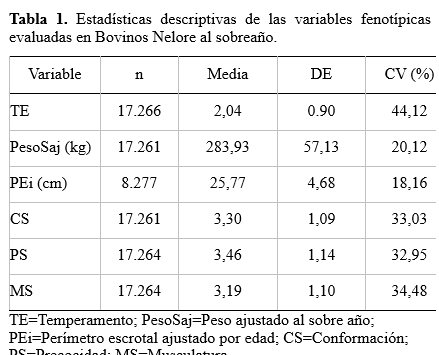
The objective of this study was to evaluate the association between behavioral reactivity and phenotypic traits related to growth and productive performance in Nellore cattle raised under commercial production conditions in Paraguay. Historical records from the Genetic Improvement Program of the Paraguayan Nellore Breeders Association (APCN), including animals born between 2006 and 2020, were used. After data editing and quality control procedures, 17,261 records were analyzed for yearling weight adjusted for age (PesoSaj), 8,277 for scrotal circumference adjusted for age (PEi), and 17,260 records for temperament and visual appraisal traits. Behavioral reactivity was evaluated using an ordinal scale ranging from 1 to 5 during animal handling. Statistical analyses were performed using General Linear Models (GLM) through the GLM procedure of SAS® software. Temperament significantly affected all evaluated traits (P < 0.0001). Negative associations were observed between behavioral reactivity and PesoSaj, PEi, and visual appraisal traits related to conformation, precocity, and muscling. The results suggest that animals with lower behavioral reactivity during handling tend to exhibit better phenotypic indicators of growth and productive performance under tropical production conditions. Due to the observational nature of the study, the observed associations should be interpreted as adjusted phenotypic relationships rather than direct causal or genetic associations. These findings provide relevant information regarding the relationship between behavior and productive performance in Nellore cattle raised under commercial tropical production systems.
References
1. Burrow HM. Measurements of temperament and their relationships with performance traits of beef cattle. Animal Breeding Abstracts,1997; 65(7), 477–495.
2.Burrow HM, Dillon RD Relationships between temperament and growth in a feedlot and commercial carcass traits of Bos indicus crossbreds. Australian Journal of Experimental Agriculture, 1997; 37(4), 407–411. https://doi.org/10.1071/EA96148
3. LeDoux JE Emotion circuits in the brain. Annual Review of Neuroscience, 2000; 23, 155–184. https://doi.org/10.1146/annurev.neuro.23.1.155
4.Koolhaas JM, de Boer SF, Coppens CM, Buwalda B. Neuroendocrinology of coping styles: Towards understanding the biology of individual variation. Frontiers in Neuroendocrinology, 2010; 31(3), 307–321. https://doi.org/10.1016/j.yfrne.2010.04.001
5. Moberg GP, Mench JA , (Eds.). Biological response to stress: Implications for animal welfare. In G. P. Moberg & J. A. Mench (Eds.), The Biology of Animal Stress: Basic Principles and Implications for Animal Welfare 2000; (pp. 1–21). CABI Publishing.
6.Curley KO, et al. Functional characteristics of the bovine hypothalamic–pituitary–adrenal axis vary with temperament. Hormones and Behavior, 2008; 53(1), 20–27. https://doi.org/10.1016/j.yhbeh.2007.08.005
7. Voisinet BD, Grandin T, O’Connor SF, Tatum JD, Deesing MJ,. Bos indicus-cross feedlot cattle with excitable temperaments have tougher meat and a higher incidence of borderline dark cutters. Meat Science,(1997a) 46(4), 367–377. https://doi.org/10.1016/S0309-1740(97)00031-0.
8. Voisinet BD, Grandin T, Tatum JD, O’Connor SF, Struthers JJ (1997b). Feedlot cattle with calm temperaments have higher average daily gains than cattle with excitable temperaments. Journal of Animal Science, (1997b) 75(4), 892–896. https://doi.org/10.2527/1997.754892x
9. Cafe LM, Robinson DL, Ferguson DM, McIntyre BL, Geesink GA, Greenwood PL. Cattle temperament: Persistence of assessments and associations with productivity, efficiency, carcass and meat quality traits. Journal of Animal Science;2011 89(5), 1452–1465. https://doi.org/10.2527/jas.2010-3304.
10. Hoppe S, Brandt HR, Konig S, Erhardt G, Gauly M. Temperament traits of beef calves measured under field conditions and their relationships to performance. Journal of Animal Science,2010; 88(6), 1982–1989. https://doi.org/10.2527/jas.2008-1557
11. Kadel MJ, Johnston DJ, Burrow HM, Graser HU, Ferguson DM. Genetics of flight time and other measures of temperament and their value as selection criteria for improving meat quality traits in tropically adapted breeds of beef cattle. Australian Journal of Agricultural Research, 2006; 57,1029-1035. https://doi.org/10.1071/AR05082
12. Sant’Anna AC, Paranhos da Costa MJR, Baldi F, Rueda PM, Albuquerque LG,Genetic associations between flight speed and growth traits in Nellore cattle. Journal of Animal Science,2012; 90, 3427–3432. https://doi.org/10.2527/jas.2011-5044
13.Haskell MJ, Simm G, Turner SP, . Genetic selection for temperament traits in dairy and beef cattle. Frontiers in Genetics, 2014; 5, 368. https://doi.org/10.3389/fgene.2014.00368
14.Koury Filho W. (2005). Escores visuais e suas relações com características de crescimento em bovinos de corte (Tese de Doutorado em Zootecnia – Produção Animal). Faculdade de Ciências Agrárias e Veterinárias, Universidade Estadual Paulista "Júlio de Mesquita Filho" (UNESP), Jaboticabal, SP, Brasil
15.Faria CU, Magnabosco CU, Albuquerque LG, Bezerra LAF, Lobo RB. Avaliação genética de características de escores visuais de bovinos da raça Nelore da desmama até a maturidade. Revista Brasileira de Zootecnia, 2009; 38(7), 1191–1200. https://doi.org/10.1590/S1516-35982009000700005
16. Forni S, Federici JF, Albuquerque LG, Alencar MM . Genetic trends in Nellore cattle selected for visual scores of conformations, precocity and musculature at weaning. Revista Brasileira de Zootecnia, 2007; 36(3), 572–577. https://doi.org/10.1590/S1516-35982007000300008
17. Faria CU et al. Utilização de escores visuais de características morfológicas de bovinos Nelore como ferramenta para o melhoramento genético animal2007, (Documentos 177). Planaltina, DF: Embrapa Cerrados.
18. Da Silveira DD, et al.. Genetic analysis of growth, visual scores, height, and carcass traits in Nelore cattle. Animal Science Journal, 2021; 92(1), e13611. https://doi.org/10.1111/asj.1361
19.Cooke RF Bill E. Kunkle Interdisciplinary Beef Symposium: Temperament and acclimation to human handling influence growth, health, and reproductive responses in Bos taurus and Bos indicus cattle. Journal of Animal Science, 2014; 92(12), 5325–5333. https://doi.org/10.2527/jas.2014-8017
20. Valente TS, Sant’Anna A, Baldi F, Albuquerque LG, Paranhos da Costa MJR Genetic association between temperament and sexual precocity indicator traits in Nellore cattle. Journal of Applied Genetics, 2015; 56(3), 349–354. https://doi.org/10.1007/s13353-014-0259-0
21. Freitas AP, et al. Genetic parameters for behavioral and growth traits of Nellore cattle. Journal of Animal Science, 2023; 101, skad280.
Published
Issue
Section
License
Copyright (c) 2026 Diego Avilio Ocampos Olmedo, Claudio Fabian Tobal, Jose Carlos Ortiz Bordas

This work is licensed under a Creative Commons Attribution-NonCommercial-ShareAlike 4.0 International License.
Al momento de enviar sus contribuciones, los colaboradores deberán declarar , de manera fehaciente, que poseen el permiso del archivo o repositorio donde se obtuvieron los documentos que se anexan al trabajo, cualquiera sea su formato (manuscritos inéditos, imágenes, archivos audiovisuales, etc.), permiso que los autoriza a publicarlos y reproducirlos, liberando a la revista y sus editores de toda responsabilidad o reclamo de terceros , los autores deben adherir a la licencia Creative Commons denominada “Atribución - No Comercial CC BY-NC-SA”, mediante la cual el autor permite copiar, reproducir, distribuir, comunicar públicamente la obra y generar obras derivadas, siempre y cuando se cite y reconozca al autor original. No se permite, sin embargo, utilizar la obra con fines comerciales.
How to Cite