Differential spectral doppler pattern for the right ventricular outflow tract
DOI:
https://doi.org/10.19137//cienvet202224107Keywords:
echocardiography, doppler, pulmonary artery, spectral tracingAbstract
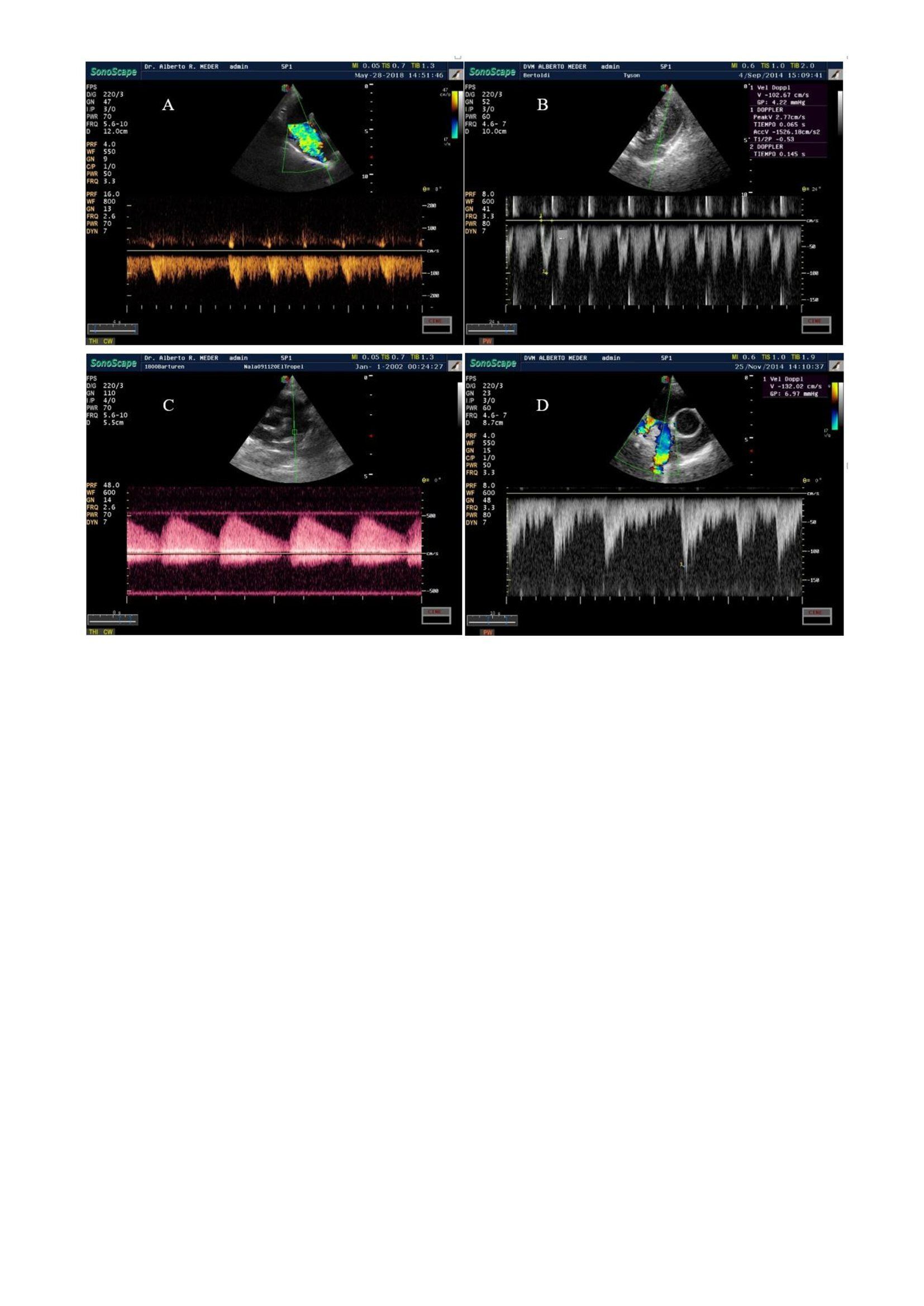
Spectral doppler scanning of the right ventricular outflow tract (RVOT) provides hemodynamic information for the differential diagnosis of heart disease. The flow profile provides data of speed, time, direction and anatomical or functional determination of different changes. The objective of this present work is to analyze the spectral doppler pattern of the right ventricular outflow tract to contribute to the differential diagnosis of heart disease and hemodynamic disorders in pets. The normal ejection spectral trace shows a symmetrical profile, a rounded tip, and tip velocity less than 1.81 m / s (Type I). Pulmonary hypertension, as a consequence of the increased pulmonary vascular resistance, may present a dagger profile, asymmetric, and top speed that is reached within the first third of the spectral trace (Type II). The presence of a gap in the final third of the deceleration curve (flying W), defines the profile as Type III. In stenotic processes top and integral speed time, exceed the normal range and allow to classify the severity of the process. Fixed pulmonary stenosis presents a symmetrical and high-speed profile (> 1.81 m / s). In dynamic obstructions the spectral profile is inverted, reaching the maximum speed at the end of the acceleration curve. When ductus arteriosus is persistent, the flow profile is continuous. Systodiastolic, positive and negative flows, are observed throughout the entire trace. The findings of the spectral doppler scan, by means of the analysis of the flow profile of the right ventricular outflow tract, allow to differentiate pathological processes present, as well as determinate its severity, collaborating in a quick way in the doppler differential diagnosis.
Downloads
Published
Issue
Section
License
Al momento de enviar sus contribuciones, los colaboradores deberán declarar , de manera fehaciente, que poseen el permiso del archivo o repositorio donde se obtuvieron los documentos que se anexan al trabajo, cualquiera sea su formato (manuscritos inéditos, imágenes, archivos audiovisuales, etc.), permiso que los autoriza a publicarlos y reproducirlos, liberando a la revista y sus editores de toda responsabilidad o reclamo de terceros , los autores deben adherir a la licencia Creative Commons denominada “Atribución - No Comercial CC BY-NC-SA”, mediante la cual el autor permite copiar, reproducir, distribuir, comunicar públicamente la obra y generar obras derivadas, siempre y cuando se cite y reconozca al autor original. No se permite, sin embargo, utilizar la obra con fines comerciales.
How to Cite





.jpg)