Education in MERCOSUR: Historical Evolution and Projections of Educational Integration
DOI:
https://doi.org/10.19137/praxiseducativa-2026-300322Keywords:
MERCOSUR, regional integration, internacional education, regional identity, SDG 4 – Quality EducationAbstract
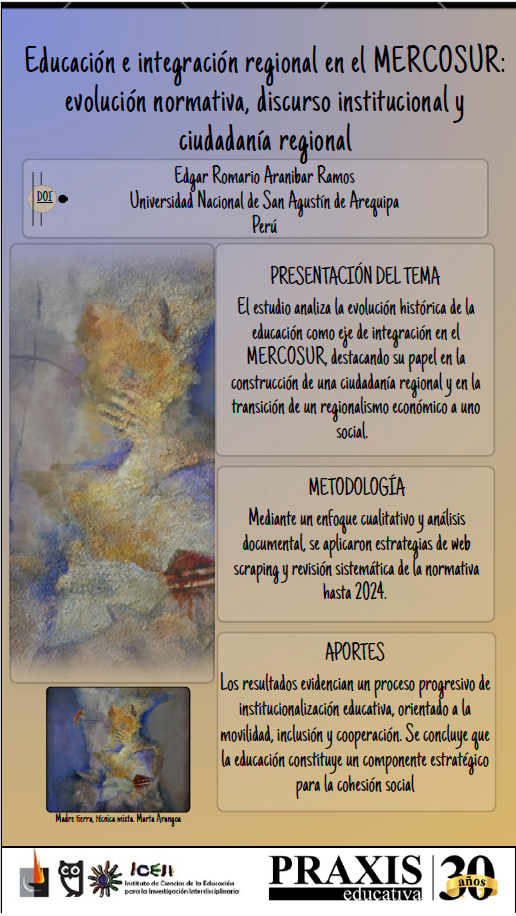
This study analyses the historical evolution of education as a core axis of integration within MERCOSUR, highlighting its role in building a regional citizenship and facilitating the transition from an economic to a social regionalism. Addressing the limited research connecting educational discourse and regional regulations, this paper examines the bloc’s decisions, resolutions, and recommendations alongside institutional press sources. Using a qualitative approach and documentary analysis, web scraping and systematic review techniques were applied to materials published up to 2024. Findings reveal a progressive institutionalisation of education focused on mobility, inclusion, and cooperation. The study concludes that education has become a strategic component for regional cohesion and sustainable integration in South America.
References
Bendixen, C., & Jacobsen, J. C. (2020). Accreditation of higher education in Denmark and European Union: From system to substance? Quality in Higher Education, 26(1), 66–79. https://doi.org/10.1080/13538322.2020.1729310
Bouzas, R. (2005). Mercosur: instituciones de gobierno regional, asimetrías e integración profunda. http://dx.doi.org/10.18235/0011154
Bouzas, R. (2017). El regionalismo en América Latina y el Caribe:¿ qué hay de nuevo?. Estudios Internacionales (Santiago), 49(SPE), 65-88. http://dx.doi.org/10.5354/0719-3769.2017.47533
Chen, Q., & Zhou, J. (2025). Assessing the role of regional educational integration policies in fostering university-industry-research innovation: Evidence from China. PLoS One, 20(7), Article e0325717. https://doi.org/10.1371/journal.pone.0325717
De la Mora, L. M. (2023). The perpetual pursuit of integration in Latin America and the Caribbean. CEPAL Review, 2023(141), 103-119. https://hdl.handle.net/11362/69198
Dri, W. I. de O., & Silva, L. L. da. (2019). Formação continuada de professores e regionalização educativa: Uma análise das políticas do setor educacional do MERCOSUL. Acta Scientiarum. Education, 41(1), Article e44930. https://doi.org/10.4025/actascieduc.v41i1.44930
Dogucu, M., & Çetinkaya-Rundel, M. (2021). Web scraping in the statistics and data science curriculum: Challenges and opportunities. Journal of Statistics and Data Science Education, 29(sup1), S112-S122. https://doi.org/10.1080/10691898.2020.1787116
Klatt, G., & Milana, M. (2020). Governing education policy: The European Union and Australia. Australian and New Zealand Journal of European Studies, 12(1), 1–18. https://doi.org/10.30722/anzjes.vol12.iss1.15076
Luscombe, A., Dick, K., & Walby, K. (2022). Algorithmic thinking in the public interest: navigating technical, legal, and ethical hurdles to web scraping in the social sciences. Quality & Quantity, 56(3), 1023-1044. https://doi.org/10.1007/s11135-021-01164-0
González, G. H., García-González, J. D., Gómez-Medina, J. S., & Corbella, V. I. (2023). Regionalization of Latin America based on asymmetries in the absorptive capacity of countries. The Journal of Economic Asymmetries, 27, e00291. https://doi.org/10.1016/j.jeca.2023.e00291.
Granato, L. (2016). Mercosul, Assimetrias E Integração Produtiva: discussão e balanço 25 anos após a criação do bloco. Caderno CRH, 29, 381-394. https://doi.org/10.1590/S0103-49792016000200012.
Morche, B. (2012). Inclusión y exclusión en el sistema educativo: la expansión de la educación superior en Brasil, India y China. Revista MAD, (27), 44–52. https://doi.org/10.5354/0719-0527.2012.22306
Muskaj, B., Musaraj, J., & Cilento, M. (2022). European Union between the Right of Education and Social Integration. Journal of Educational and Social Research, 12(4), 78–92. https://doi.org/10.36941/jesr-2022-0098
Pereira, A. E., Bernardo, G. J., Culpi, L. A., & Pessali, H. F. (2018). A governança facilitada no Mercosul: Transferência de políticas e integração nas áreas de educação, migração e saúde. REVISTA DE ADMINISTRAÇÃO PÚBLICA, 52(2), 285–302. https://doi.org/10.1590/0034-761220170063
Pereira, M., D’Inverno, G., & Camanho, A. S. (2025). Learning mobility in European higher education: How has the Union’s flagship initiative progressed? Annals of Operations Research, 351, 1589–1619. https://doi.org/10.1007/s10479-024-06195-y
Peixoto Batista, J., & Perrotta, D. (2018). El Mercosur en el nuevo escenario político regional: más allá de la coyuntura. Desafíos, 30(1), 91-134. https://doi.org/10.12804/revistas.urosario.edu.co/desafios/a.5767
Rhi-Sausi, J. L., & Oddone, N. (2013). Integración regional y cooperación transfronteriza en los nuevos escenarios de América Latina. Investigación y Desarrollo, 21(1), 260-285. http://www.scielo.org.co/pdf/indes/v21n1/v21n1a11.pdf
Rivarola Puntigliano, A. (2021). Geopolitics and regionalism: A Latin American perspective. Latin American Policy, 12(2), 221-235. https://doi.org/10.1111/lamp.12224
Silveira, Z. S. (2016). Setor educacional do MERCOSUL: Convergência e integração regional da educação superior brasileira. Avaliação: Revista da Avaliação da Educação Superior, 21(3), 901–927. https://doi.org/10.1590/S1414-40772016000300012
Slocum, N., Van Langenhove, L. (2004). The meaning of regional integration: introducing positioning theory in regional integration studies. Journal of European Integration.
Perrotta, D. V. (2014). El regionalismo de la educación superior en el MERCOSUR como vector de internacionalización: un acercamiento desde la política regional de acreditación. https://ri.conicet.gov.ar/handle/11336/35239
Verger, A., & Hermo, J. P. (2010). The governance of higher education regionalisation: comparative analysis of the Bologna Process and MERCOSUR‐Educativo. Globalisation, Societies and Education, 8(1), 105–120. https://doi.org/10.1080/14767720903574116
Viegas, E. R. dos S., & Domingues, A. T. (2024). O direito à educação no Mercosul: Ações de acolhimento de imigrantes em Dourados-MS. Práxis Educativa, 19, Article e23012. https://doi.org/10.5212/PraxEduc.v.19.23012.032
Wellings, B. (2023). Nationalism and European disintegration. Nations and Nationalism, 29(4), 1164-1178. https://doi.org/10.1111/nana.12884.
Zamorano Farías, R., & Gutiérrez, E. (2020). Política, reformas educativas y educación de calidad para todos. Revista MAD, (41), 1–11. https://doi.org/10.5354/0719-0527.2019.57580
Downloads
Published
Issue
Section
License
Copyright (c) 2026 Edgar Romario Aranibar Ramos

This work is licensed under a Creative Commons Attribution-NonCommercial-ShareAlike 4.0 International License.
Copyright Notice
Editorial Committee Educational Praxis Magazine:
I hereby declare that I am the author of the article titled (article name), that it is original and my own and that it was not previously published in any other format or medium. I declare to know that the magazine will not charge me any type of fee under any circumstances, nor will I receive any type of monetary compensation If it were accepted for publication in Educational Praxis, I authorize the aforementioned magazine to publish it digitally and to advertise it on its social networks.
If the work is published, I adhere to the Creative Commons license called "Attribution - Non-Commercial Share Alike CC BY-NC-SA", through which it is allowed to copy, reproduce, distribute, publicly communicate the work and generate derivative works, as long as when the original author is cited and acknowledged. This license has been used since September 2018. In 2016 CC BY NC ND 4.0 was adhered to; and in the years 2017 and 2018 (January-August) CC BY NC 4.0.
This CC BY-NC-SA Share Alike license does not, however, permit commercial use of the work. As an author, the journal may establish additional agreements for the non-exclusive distribution of the version of the work published in the journal, it allows me to self-archive the published articles, in their post-print version, in institutional, thematic repositories, personal web pages or any other relevant use. with the recognition of having been first published in this journal.
Educational Praxis adheres to DORA (Declaration on Research Assessment) signed in San Francisco, California, on December 16, 2012, and to the Declaration of Mexico (Joint Declaration LATINDEX - REDALYC - CLACSO - IBICT).
How to Cite










_(1)2.png)