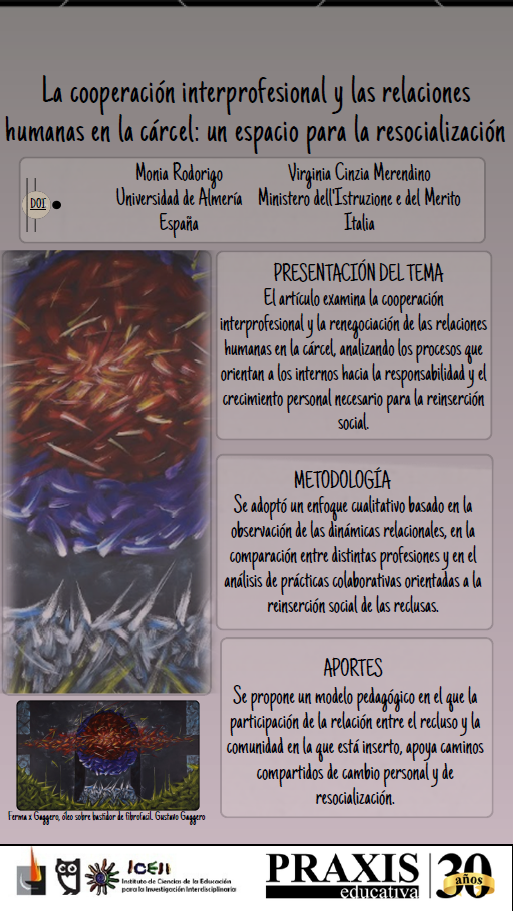
Interprofessional Cooperation and Human Relationships in Prison: A Space for Resocialization
DOI:
https://doi.org/10.19137/praxiseducativa-2026-300321Keywords:
adult education, resocialization, cooperative skills, transformationAbstract
This article addresses the complex principle of re-education from a legal-normative and socio-pedagogical perspective, exploring how each organization that concretely embodies the institution can, through the educational and learning processes of inmates, translate this principle via the cooperation of knowledge. This gives rise to knowledge as a continuous process, shaped through mediation and sharing, where it is the institutional dialectic—encompassing the school, the professional figures operating within the prison, and the inmate’s willingness—that guides the process of resocialization. The article highlights the participatory importance of a symmetrical care relationship in educational terms, both among institutions and between the inmate and the community in which they are embedded. This relationship is essential in the delicate pathways that accompany inmates in the redefinition of their personal journey and must be based, within a shared prescriptive framework, on a transformation in the way of thinking and acting of those involved in these processes. The goal is to create and develop the concept of an inclusive educational community—one that is not merely the sum of educational actions, but rather one capable of overcoming the “oppressor-oppressed” dialectic. This model aims to integrate inmates positively and constructively into society through the practical application of the skills they have acquired, by uniting shared intentions.
References
Abbott, A. (1988). The System of Professions. The University of Chicago Press.
Benelli, C. y Del Gobbo, G. (2016). Liberi di formarsi. Educazione non formale degli adulti e biblioteche in carcere. Pacini.
Buffa, P. (2014). Prigioni. Amministrare la sofferenza. Gruppo Abele Edizioni.
Burke P. J. y Stets J. E. (2009). Identity theory. Oxford University Press.
Catarci, M. (2016). La pedagogia della liberazione di Pauolo Freire. Educazione, intercultura e cambiamento sociale. Franco Angeli.
Crawley, E. M. (2004). Emotion and performance Prison officers and the presentation of self in prisons, Punishment and Society, (6)4, 411-427. https://doi.org/10.1177/1462474504046121.
Clemmer, D. (1997). La comunità carceraria. Carcere e società liberale (a cura di Santoro E.). Giappichelli.
Fernández-Sierra, J. y Fernandez-Larragueta, S. (2013). Investigar las transiciones educativo-culturales: Estudios de caso, multicaso. En J. Fernández-Sierra (coord.). Transitar la cultura: niños y niñas inmigrantes en la educación obligatoria. Aljibe.
Freire, P. (1973). L’educazione come pratica della libertà. I fondamenti sperimentali della «pedagogia degli oppressi». Arnoldo Mondadori.
Freire, P. (2011). Pedagogia degli oppressi. EGA.
Glaser, B.G. y Strauss A.L. (1967). La scoperta del grounded theory. Strategie per la ricerca qualitativa. Armando.
Goffman, E. y Asylums, N. (1968). Le istituzioni totali. Einaudi.
Guba, E. (1989). La credibilidad en la investigación naturalista. En J. Gimeno Sacristán y A. Pérez-Gómez, La enseñanza: su teoría y su práctica. Akal.
Guba, E. y Lincoln, Y. (1991). Investigación naturalista y racionalista. En T. Husen y N. Posthlewaite, Enciclopedia Internacional de la Educación. MEC.
Lave, J. y Wenger, E. (1991). L’apprendimento situate. Erickson.
Liebling, A (1999). Doing research in prison: breaking the silence? Theoretical Criminology, 3(2), 147-173. http://dx.doi.org/10.1177/1362480699003002002.
Liebling, A (2011). Distinctions and distinctivenessin the work of prison officers: legitimacy and autorityrevisited, European Journal of Criminology, 8(6), 484-499. https://doi.org/10.1177/1477370811413807.
Mantegazza, R. (2006). I buchi neri dell’educazione. Elèuthera.
Mortari, L. (2015). Filosofia della cura. Cortina.
Mortari, L. (2017). Educatori e lavoro di cura. Pedagogia Oggi, Rivista SIPED, XV(2), 91-105.
Mortari, L. (2006). La pratica dell’aver cura. Mondadori.
Mortari, L. (2006). Un metodo a-metodico. La pratica della ricerca in Maria Zambrano. Liguori.
Nussbaum, M.C. (2010). Non per profitto. Perché le democrazie hanno bisogno della cultura umanistica. Il Mulino.
Patrizi, P. (1997). Psicologia e contesto penitenziario, in “Rassegna penitenziaria e criminologica”, n.1-2, Istituto Poligrafico e Zecca dello Stato.
Rodorigo, M. y Fernández-Sierra, J. (2013). Tarek en la escuela calé: un niño árabe en un centro singular (Caso 2). En J. Fernández-Sierra (coord.), Transitar la cultura: niños y niñas inmigrantes en la educación obligatoria: estudios de caso, multicaso. Aljibe (pp. 51-78).
Sen, A.K. (2000). Lo sviluppo è libertà. Perché non c’è crescita senza democrazia. Mondadori.
Stake, R. (1998). Investigación con Estudios de Caso. Morata.
Taylor, S. G. y Bogdan, R. (2002). Introduzione ai metodi di ricerca qualitativa: La ricerca del significato. Paidós.
Downloads
Published
Issue
Section
License
Copyright (c) 2026 Monia Rodorigo, Virginia Cinzia Merendino

This work is licensed under a Creative Commons Attribution-NonCommercial-ShareAlike 4.0 International License.
Copyright Notice
Editorial Committee Educational Praxis Magazine:
I hereby declare that I am the author of the article titled (article name), that it is original and my own and that it was not previously published in any other format or medium. I declare to know that the magazine will not charge me any type of fee under any circumstances, nor will I receive any type of monetary compensation If it were accepted for publication in Educational Praxis, I authorize the aforementioned magazine to publish it digitally and to advertise it on its social networks.
If the work is published, I adhere to the Creative Commons license called "Attribution - Non-Commercial Share Alike CC BY-NC-SA", through which it is allowed to copy, reproduce, distribute, publicly communicate the work and generate derivative works, as long as when the original author is cited and acknowledged. This license has been used since September 2018. In 2016 CC BY NC ND 4.0 was adhered to; and in the years 2017 and 2018 (January-August) CC BY NC 4.0.
This CC BY-NC-SA Share Alike license does not, however, permit commercial use of the work. As an author, the journal may establish additional agreements for the non-exclusive distribution of the version of the work published in the journal, it allows me to self-archive the published articles, in their post-print version, in institutional, thematic repositories, personal web pages or any other relevant use. with the recognition of having been first published in this journal.
Educational Praxis adheres to DORA (Declaration on Research Assessment) signed in San Francisco, California, on December 16, 2012, and to the Declaration of Mexico (Joint Declaration LATINDEX - REDALYC - CLACSO - IBICT).
How to Cite










_(1)2.png)