A identidade dos professores do ensino básico e superior hoje
DOI:
https://doi.org/10.19137/praxiseducativa-2026-300316Palavras-chave:
professores da educação básica, professores da educação superior e identidade docenteResumo
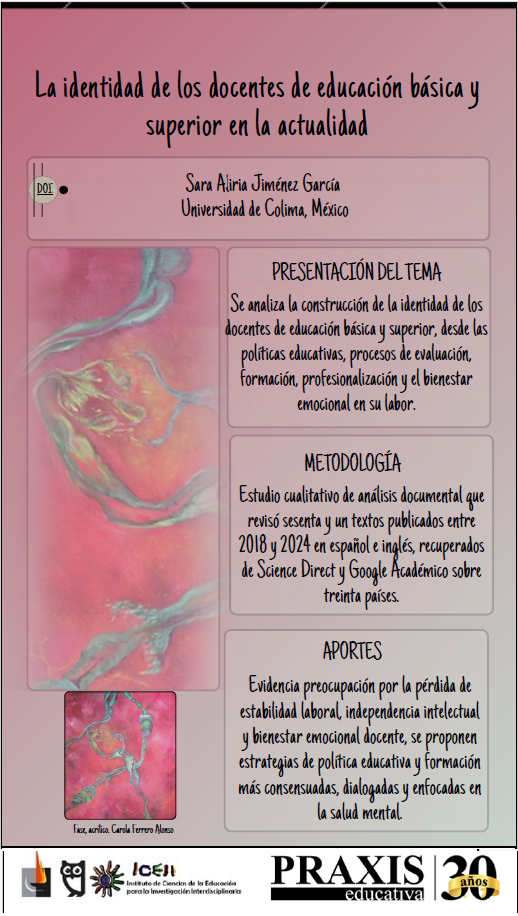
São apresentados os resultados de uma pesquisa sobre elementos que moldaram a identidade dos professores da educação básica e superior nos últimos anos. O estudo foi qualitativo, por meio de análise documental, com base em 61 textos publicados entre 2018 e 2024, nos idiomas inglês e espanhol; os documentos foram obtidos do Science Direct e do Google Scholar e referem-se a experiências em 30 países. Os resultados indicam que nos últimos anos e em ambos os níveis de ensino existe uma preocupação global com a diminuição da estabilidade laboral dos professores, da sua independência intelectual e do desconforto psicológico e profissional que o ambiente de trabalho lhes causa desde o momento em que ingressam até à sua aposentação da profissão docente. Além disso, constatou-se que faltam melhores estratégias políticas para a formação, profissionalização e avaliação consensual dos professores.
Referências
Referencias bibliográficas
Aguilar, J. (2022). Análisis conceptual de los discursos de política federal para docentes en la secundaria alta en México. Revista archivos analíticos de políticas educativas, 30(88), 1-20. https://epaa.asu.edu/index.php/epaa/article/download/7088/2854/32944.
Atuhurra, J. & Kaffenberger, M. (2022). Measuring education system coherence: Alignment of curriculum standards, examinations, and teacher instruction in Tanzania and Uganda International. International Journal of Educational Development, 92, 1-16. https://doi.org/10.1016/j.ijedudev.2022.102598.
Bleiberg J., Brunner, E., Harbatkin, E., Kraft, M. y Springer, M. (2023). Taking teacher evaluation to scale: the effect of state reforms on achievement and attainment. NBER working paper series, 1-70. DOI: 10.2139/ssrn.4386595.
Böhn, S. & Deutscher, V. (2022). Dropout from initial vocational training – A meta-synthesis of reasons from the apprentice’s point of view. Educational Research Review, 35, 1-14. https://doi.org/10.1016/j.edurev.2021.100414.
Bourdieu, P. (2003). El oficio del científico. Ciencia de la ciencia y reflexividad. España: Editorial Anagrama.
Cochran, M. y Villegas, A. (2014). Framing teacher preparation research: An overview of the field, Part 1. Journal of Teacher Education, 66(1), 7 – 20. DOI: 10.1177/0022487114549072.
CONAHCYT (2024). Programa Nacional Estratégico de Educación. México: CONAHCYT (Consejo Nacional de Humanidades, Ciencia y Tecnología) y Gobierno de México. https://conahcyt.mx/pronaces/pronaces-educacion/.
Daza, V., Björk, G. & Lund, A. (2021). Partnerships as third spaces for professional practice in initial teacher education: A scoping review. Teaching and Teacher Education, 102, 1-14. https://doi.org/10.1016/j.tate.2021.103338.
Diery, A., Knogler, M. & Seidel, T. (2021). Supporting evidence-based practice through teacher education: A profile analysis of teacher educators’ perceived challenges and possible solutions. International Journal of Educational Research Open, 2, 1-11. https://doi.org/10.1016/j.ijedro.2021.100056.
Escudero, T. (2019). Evaluación del profesorado como camino directo hacia la mejora de la calidad educativa. Revista de Investigación Educativa, 37(1), 15-37. https://revistas.um.es/rie/article/view/342521/254271.
Extremera, N., Mérida, S. y Sánchez, M. (2019). La importancia de la inteligencia emocional del profesorado en la misión educativa: impacto en el aula y recomendaciones de buenas prácticas para su entrenamiento. Voces de la educación, 2, 74-97. https://www.revista.vocesdelaeducacion.com.mx/index.php/voces/article/view/213/182.
Freire, P. (1990). La naturaleza política de la educación. Cultura, poder y liberación. Paidós.
Galaz, A., Jiménez, M. y Díaz, Á. (2019). Evaluación del desempeño docente en Chile y México. Antecedentes, convergencias y consecuencias de una política global de estandarización. Perfiles educativos, 41(163), 156-176. https://perfileseducativos.unam.mx/iisue_pe/index.php/perfiles/article/view/58935/52097
Gkonou, C. & Miller, E. (2023). Relationality in language teacher emotion regulation: Regulating emotions through, with and for others. System, 115, 1-10. https://doi.org/10.1016/j.system.2023.103046.
Gómez, L. y Valdés, M. (2019). La evaluación del desempeño docente en la educación superior. Propósitos y Representaciones, 7(2), 479–515. http://dx.doi.org/10.20511/pyr2019.v7n2.255.
Guzmán, F. (2018). La experiencia de la evaluación docente en México: análisis crítico de la imposición del servicio profesional docente. Revista Iberoamericana de Evaluación Educativa, 11(1), 136-140. https://repositorio.uam.es/bitstream/handle/10486/681784/RIEE_11_1_8.pd?sequence=1
Hascher, T. & Waber, J. (2021). Teacher well-being: A systematic review of the research literature from the year 2000–2019. Educational Research Review, 34, 1-25. https://doi.org/10.1016/j.edurev.2021.100411.
Ibarra, E., Ibarra, E. y Sánchez, Y. (2024). Cansancio emocional y rendimiento académico en estudiantes universitarios durante el retorno a clases presenciales. Revista de investigación educativa de la rediech, 15(e1979), 1-16. DOI: https://doi.org/10.33010/ie_rie_rediech.v15i0.1979
Khaleel, A. & Borhandden, M. (2021). Effects of teacher licensing on educators’ professionalism: UAE case in local perception. Heliyon, 7(11), 1-9. https://doi.org/10.1016/j.heliyon.2021.e08348.
Knapp, D., Hosek, J., Mattock, M. & Asch, B. (2023). Predicting teacher retention behavior: Ex ante prediction and ex post realization of a voluntary retirement incentive offer. Economics of Education Review, 93, 1-17. https://doi.org/10.1016/j.econedurev.2022.102325.
Liu, H. & Li, X. (2023). Unravelling students’ perceived EFL teacher support. System, 115, 1-12. https://doi.org/10.1016/j.system.2023.103048.
Liu, A., Liu, N. & Wang, A. (2022). Why can't rural schools retain young teachers? An analysis of the professional development of rural school teachers in China: Taking teachers in rural western China. Social Sciences & Humanities Open, 5(1), 1-6. https://doi.org/10.1016/j.ssaho.2021.100238.
Luján, R. y Bejarano, P. (2024). Estrategias de evaluación formativa: Una revisión sistemática. Horizontes. Revista de Investigación en Ciencias de la Educación, 8(33), 1033-1046. https://doi.org/10.33996/revistahorizontes.v8i33.781
Magaji, A. y Ade, G. (2023). Trainee teachers’ classroom assessment practices: Towards evaluating trainee teachers’ learning experience in a teacher education program. Social Sciences & Humanities Open, 7(1), 1-9. https://doi.org/10.1016/j.ssaho.2023.100467.
Martínez, F. (2016). La evaluación de docentes de educación básica. Una revisión de la experiencia internacional. INEE. https://www.inee.edu.mx/wp-content/uploads/2018/12/P1C233.pdf.
Moreno, A., Rodríguez, J. & Rodríguez, I. (2018). Vista de la importancia de la emoción en el aprendizaje: propuestas para mejorar la motivación de los estudiantes. Cuaderno de pedagogía universitaria, 19(29), 3-11. https://cuaderno.pucmm.edu.do/index.php/cuadernodepedagogia/article/view/296/273.
Nordgren, K., Kristiansson, M., Liljekvist, Y. & Bergh, D. (2021). Collegial collaboration when planning and preparing lessons: A large-scale study exploring the conditions and infrastructure for teachers’ professional development. Teaching and Teacher Education, 108, 1-11. https://doi.org/10.1016/j.tate.2021.103513.
Origgi, G. (2020). Trust and reputation as filtering mechanisms of knowledge. En Fricker, M., Graham, P., Henderson, D. & Pedersen, N. (2020). The Routledge Handbook of Social Epistemology. (pp. 78-86). Routledge.
Oros, L., Vargas, N., y Chemisquy, S. (2020). Estresores docentes en tiempos de pandemia: un instrumento para su exploración. Revista Interamericana de Psicología, 54(3), 1-29. https://repositorio.uca.edu.ar/handle/123456789/11181.
Pérez, E., Serrano, R., Pontes, A. & Carpio, A. (2021). Teachers’ professional identity: validation of an assessment instrument for preservice teachers. Heliyon, 7(9), 2-11. https://doi.org/10.1016/j.heliyon.2021.e08049.
Perron, D. (2020). The epistemology of groups. En Fricker, M., Graham, P., Henderson, D. & Pedersen, N. (2020). The Routledge Handbook of Social Epistemology. (pp. 263-273). Routledge.
Pesambili, J., Sayed, Y. y Stambach, A. (2022). The World Bank’s construction of teachers and their work: A critical analysis. International Journal of Educational Development, 92, 1-8. https://doi.org/10.1016/j.ijedudev.2022.102609.
Popkewitz, T. (2022). The Non-Bricks and Non-Mortar of an intellectual culture: My Americanization Story of Graduate Education. ResearchGate, 29(3), 43-61. https://doi.org/10.1007/BF03216773.
Quinn, N. (2010). The cultural analysis of discourse. En Luttrell, Wendy. Qualitative educational research. (237-257). Routledge.
Reijula, S. & Kuorikoski, J. (2020). Modeling epistemic communities. En Fricker, M., Graham, P., Henderson, D. & Pedersen, N. (2020). The Routledge Handbook of Social Epistemology. (pp. 240-249). Routledge.
Rodrigues, D., Wilson, D., Palace, F., Mello, B., Fungaro, L., Sardela, F., Piassa, V., Fuscella, J., Mourao, A. Lepique, A., Almeida, V. & Demarzo, M. (2021). Mindfulness meditation training effects on quality of life, immune function and glutathione metabolism in service healthy female teachers: A randomized pilot clinical trial. Brain, Behavior, & Immunity – Health, 18, 1-12. https://doi.org/10.1016/j.bbih.2021.100372.
Rodriguez, V., Rojas, N. & Rabadi, A. (2021). Silent Expectations: An exploration of women pre-Kindergarten teachers’ mental health and wellness during Covid-19 and beyond. Early Childhood Research Quarterly, 60, 80-95. DOI: https://doi.org/10.1016/j.ecresq.2021.12.006.
Ruiz, L., y Danielli, J. (2024). Desempeño docente y calidad educativa universitaria: Revisión sistemática. Horizontes. Revista de investigación en ciencias de la educación, 8(32), 348–364. https://doi.org/10.33996/revistahorizontes.v8i32.728.
Saha, M. (2023). English teachers’ attitudes towards learners: Effects on the rural pedagogies in Bangladesh. Ampersand, 10. 1-9. https://doi.org/10.1016/j.amper.2022.100107
Schaap, H., Van der Want, A., Oolbekkink, H. & Meijer, P. (2021). Changes over time in the professional identity tensions of Dutch early-career teachers. Teaching and Teacher Education, 100, 1-13. https://doi.org/10.1016/j.tate.2021.103283.
Shu, C. & Barrington, Y. (2023). Sustainable positive psychology interventions enhance primary teachers’ wellbeing and beyond. A qualitative case study in England. Teaching and Teacher Education, 125, 1-12. https://doi.org/10.1016/j.tate.2023.104072.
Tainio, L. & Heinonen, P. (2021). Student-to-student hand-on-shoulder touch as an embodied response to reproach and critical teacher evaluation. Linguistics and Education, 66, 1-13. https://doi.org/10.1016/j.linged.2021.100982.
VanLone, J., Pansé, C. & Long, K. (2022). Teacher preparation and the COVID-19 disruption: Understanding the impact and implications for novice teachers. International Journal of Educational Research Open, 3, 1-8. https://doi.org/10.1016/j.ijedro.2021.100120.
Downloads
Publicado
Edição
Seção
Licença
Direitos autorais (c) 2026 Sara Aliria Jiménez García

Este trabalho está licenciado sob uma licença Creative Commons Attribution-NonCommercial-ShareAlike 4.0 International License.
Aviso de direitos autorais
Comitê Editorial Revista Práxis Educativa:
Declaro que sou o autor do artigo intitulado (nome do artigo), que o mesmo é original e de minha autoria e que não foi publicado anteriormente em qualquer outro formato ou meio. Declaro saber que a revista não me cobrará nenhum tipo de taxa em hipótese alguma, nem receberei qualquer tipo de remuneração monetária.
Caso seja aceito para publicação na Práxis Educacional, autorizo a referida revista a publicá-lo digitalmente e a divulgá-lo em suas redes sociais.
Se o trabalho for publicado, aderi à licença Creative Commons denominada "Atribuição - Compartilhamento Não Comercial pela mesma Licença CC BY-NC-SA", por meio da qual é permitido copiar, reproduzir, distribuir, comunicar publicamente o trabalho e gerar trabalhos derivados , desde que o autor original seja citado e reconhecido. Esta licença está em uso desde setembro de 2018. Em 2016 foi aderido ao CC BY NC ND 4.0; e nos anos de 2017 e 2018 (janeiro-agosto) CC BY NC 4.0.
Esta licença CC BY-NC-SA Share Alike não permite, entretanto, o uso comercial da obra. Como autor, a revista poderá estabelecer acordos adicionais para a distribuição não exclusiva da versão do trabalho publicado na revista, permite-me autoarquivar os artigos publicados, na sua versão post-print, em repositórios institucionais, temáticos , páginas web pessoais ou qualquer outro uso relevante. com o reconhecimento de ter sido publicado pela primeira vez nesta revista.
SA Práxis Educacional adere à DORA (Declaração sobre Avaliação de Pesquisa) assinada em São Francisco, Califórnia, em 16 de dezembro de 2012, e à Declaração do México (Declaração Conjunta LATINDEX - REDALYC - CLACSO - IBICT).
Como Citar










_(1)2.png)