Expanding our classrooms: metaphors, dissidence and migrants
DOI:
https://doi.org/10.19137/praxiseducativa-2026-300303Keywords:
narrative research, education, expanded classrooms, artistic, practicesAbstract
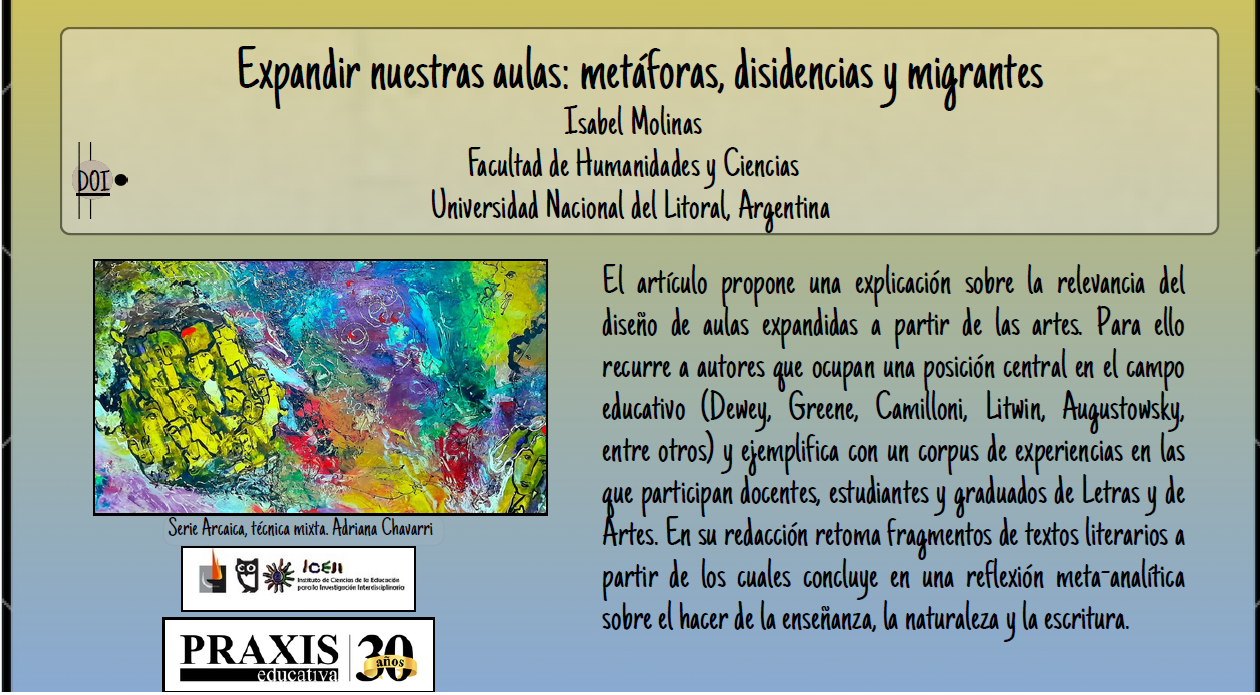
This article proposes an explanation for the relevance of designing expanded classrooms based on the arts. To this end, it draws on authors who occupy a central position in the field of education (Dewey, Greene, Camilloni, Litwin, Augustowsky, among others) and illustrates its point with a corpus of experiences involving teachers, students, and graduates of Literature and Arts. Throughout the article, it incorporates fragments of literary texts, culminating in a meta-analytical reflection on the practice of teaching, nature, and writing.
References
Augustowsky, G. (2012). El arte en la enseñanza. Paidós.
Aristóteles (2006). Poética. Colihue.
Barthes, R. (1982). Investigaciones retóricas I. Ediciones Buenos Aires.
Camilloni, A. (2013). La inclusión de la educación experiencial en el currículo universitario. En Menéndez, G. et al. (2013). Integración docencia y extensión. Otra forma de enseñar y de aprender. Universidad Nacional del Litoral.
Camilloni, A. (2016). Leer a Comenio. Su tiempo y su didáctica. Paidós.
Camilloni, A. (2021). Una enseñanza orientada al desarrollo de la creatividad. Ediciones UNL.
Carrol, L. (2002). Alicia, en el país de las maravillas. Edhasa.
Clarke, A. (2025). Presentación. En Haraway, D. y Clarke, A. (2025). Generar parentesco, no población. Debates feministas sobre natalismo. Rara Avis.
Comenius, J. A. (1986). Didáctica Magna. Akal.
Dewey, J. (1960). Experiencia y Educación. Losada.
Dewey, J. (1998). Democracia y Educación. Una introducción a la filosofía de la educación. Morata.
Dewey, J. (2008). El arte como experiencia. Paidós.
Di Giorgio, M. (2023). Y vamos a examinar los jardines. Imperfectas fordistas.
Dickinson, E. (2025). Perlas. Monada.
Eco, U. (1978). La estructura ausente. Lumen.
García Faet, B. (2024). El arte de encender las palabras. La dimensión conmovedora de la poesía. Barlin Libros.
Greene, M. (2005). Liberar la imaginación. Ensayos sobre educación, arte y cambio social. Graò.
Haraway, D. (2019). Seguir con el problema. General parentesco en el Chthuluceno. Consomi.
Jakobson, R. (1982). Lingüística y Poética. Hispamérica
Kerangal, M. y Despret, V. (2023). Prefacio. Dos investigadoras en el camino de las metamorfosis.
En Hustak, C. y Myers, N. (2023). Ímpetu evolutivo. Afectos y conversaciones entre plantas, insectos y científicos. Cactus.
Lacau, M. H. (1973). País de Silvia. Editorial Kapelusz.
Litwin, E. (2008). El oficio de enseñar. Condiciones y contextos. Paidós.
Mainero, M. y Roldán, G. (1992). Vi un árbol. Colihue.
Merian, M. S. (2023). Metamorfosis de los insectos surinameses. Buchwald.
Molinas, I. (2024). Emigrar, emerger, expandir(se). Texto para Exposición Individual Autocurada por María Eugenia Sasia, La Clandestina de Poble Nou, Barcelona.
Molinas, I. (2025). Propuesta de Práctica de Extensión de Educación Experiencial
Convocatoria Universidad Nacional del Litoral. Llegó carta: Diálogos entre Letras y Artes Visuales sobre Estéticas de las Disidencias. La mediación cultural y artística en el campo educativo. Secretaría de Extensión de la UNL.
Molinas, I. y Cimaomo, G. (2026). Llegó carta. Diálogos entre Letras y Artes Visuales sobre Estéticas de las Disidencias. En Actas del XI Congreso Nacional de Extensión Universitaria. Universidad Nacional de Rosario.
Obligado, C. (2022). Todo lo que crece. Naturaleza y escritura. Páginas de espuma.
Saer, J. (1991). El río sin orillas. Tratado imaginario. Alianza.
Sarton, M. (2020). Anhelo de raíces. Gallo nero.
Sasia, M. (1 de julio de 2026). Comunicación personal.
Sklovsky, V. (2008). “El arte como artificio”. En Todorov, Tzvetan (comp.) (2008) Teoría de la literatura de los formalistas rusos. Siglo XXI.
Vigotsky, L. (1977). Pensamiento y lenguaje. La pléyade
Downloads
Published
Issue
Section
License
Copyright (c) 2026 Isabel Molinas

This work is licensed under a Creative Commons Attribution-NonCommercial-ShareAlike 4.0 International License.
Copyright Notice
Editorial Committee Educational Praxis Magazine:
I hereby declare that I am the author of the article titled (article name), that it is original and my own and that it was not previously published in any other format or medium. I declare to know that the magazine will not charge me any type of fee under any circumstances, nor will I receive any type of monetary compensation If it were accepted for publication in Educational Praxis, I authorize the aforementioned magazine to publish it digitally and to advertise it on its social networks.
If the work is published, I adhere to the Creative Commons license called "Attribution - Non-Commercial Share Alike CC BY-NC-SA", through which it is allowed to copy, reproduce, distribute, publicly communicate the work and generate derivative works, as long as when the original author is cited and acknowledged. This license has been used since September 2018. In 2016 CC BY NC ND 4.0 was adhered to; and in the years 2017 and 2018 (January-August) CC BY NC 4.0.
This CC BY-NC-SA Share Alike license does not, however, permit commercial use of the work. As an author, the journal may establish additional agreements for the non-exclusive distribution of the version of the work published in the journal, it allows me to self-archive the published articles, in their post-print version, in institutional, thematic repositories, personal web pages or any other relevant use. with the recognition of having been first published in this journal.
Educational Praxis adheres to DORA (Declaration on Research Assessment) signed in San Francisco, California, on December 16, 2012, and to the Declaration of Mexico (Joint Declaration LATINDEX - REDALYC - CLACSO - IBICT).
How to Cite










_(1)2.png)