Teacher identity as a neurosocial construct: habitus, executive functions, and emotional processes in teachers from northern Bogotá
DOI:
https://doi.org/10.19137/praxiseducativa-2026-300315Keywords:
teacher identity, habitus, executive functions, socioemotional competencies, decolonial pedagogyAbstract
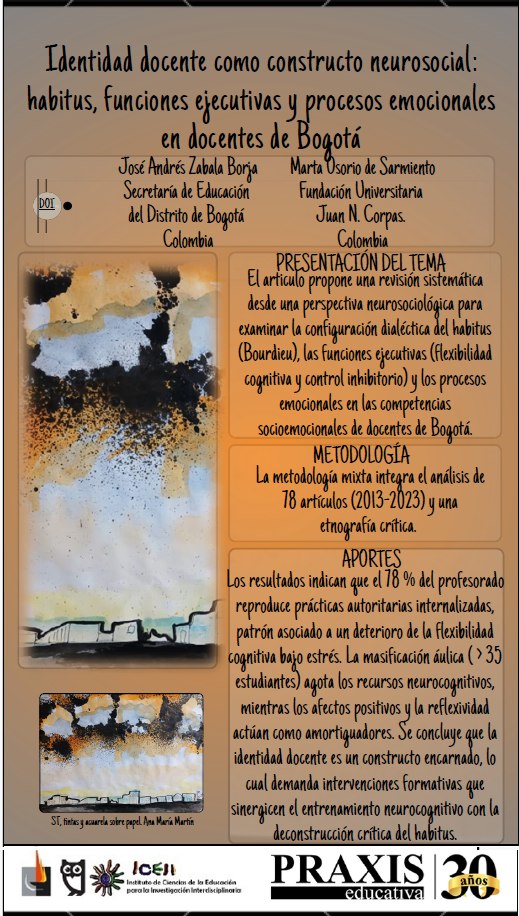
This systematic review employs a neuro-sociological framework to analyze how the dialectical interplay among habitus (Bourdieu), executive functions (cognitive flexibility, inhibitory control), and emotional processes shapes teachers' socioemotional competencies in northern Bogotá. A mixed-methods design synthesizes 78 articles (2013-2023) with critical ethnography. Findings indicate that 78% of educators replicate authoritarian practices ingrained during training, a tendency linked to diminished cognitive flexibility under duress. Structural strain from overcrowded classrooms (>35 students) depletes prefrontal cognitive resources, whereas positive affective states and reflexive practice serve as moderating forces. The study concludes that teacher identity constitutes an embodied construct, necessitating evidence-based interventions that synergistically combine targeted neurocognitive training (e.g., mindfulness) with the critical deconstruction of habitus via decolonial pedagogical approaches.
References
Argüello Parra, A. (2015). Pedagogías decoloniales y formación docente. Universidad Pedagógica Nacional.
Argüello Parra, A. (2015). Pedagogías decoloniales: Desafíos para la educación en América Latina. Universidad Andina Simón Bolívar.
Becker, E. S., Keller. M, Goetz, T., Frenzel, A., Taxer, J. (2015). Teacher emotions in the classroom. Teaching and Teacher Education, 49, 70-80. https://doi.org/10.1016/j.tate.2015.07.008
Bourdieu, P. (1972). Esquisse d’une théorie de la pratique. Droz.
Bourdieu, P. (2007). El sentido práctico. Siglo XXI.
De Barros Camargo, C. y Hernández Fernández, A. (2024). Neuropedagogy and neuroimaging of artificial intelligence and deep learning. Educational Process: International Journal, 13(3), 97-115. https://doi.org/10.22521/edupij.2024.133.6
De Barros Camargo, C., Flores Melero, C., Pinto Diaz, C. y Marín Perabá, C. (2023). Neurodidactic teacher training program for educational dropouts in vulnerable groups. Frontiers in Education, 8. https://doi.org/10.3389/feduc.2023.1134732
De Barros, C. (2022). Neuromethodology and neuroimaging for a teacher training. Texto Livre: Linguagem e Tecnologia, 15. https://doi.org/10.35699/1983-3652.2022.40454
Diamond, A. (2013). Executive functions. Annual Review of Psychology, 64, 135-168. https://doi.org/10.1146/annurev-psych-113011-143750
Diamond, A. y Lee, K. (2016). Executive functions in teacher training. Educational Psychology Review, 28(3), 575-600. https://doi.org/10.1007/s10648-015-9329-z
Diamond, A. y Lee, K. (2016). Executive functions in teacher training: Implications for classroom management. Educational Psychology Review, 28(3), 575-600. https://doi.org/10.1007/s10648-015-9329-z
Esteban, R. M., De Barros Camargo, C. y Hernández Fernández, A. (Eds.). (2023). Neuropedagogía. I Congreso Internacional de Neuropedagogía. De la neuroeducación a la neurodidáctica: metodologías docentes inclusivas, tecnologías emergentes. Editorial Dykinson.
Hamre, B. K. y Pianta, R. C. (2019). Classroom environments and developmental processes. Journal of Educational Psychology, 111(2), 215-230. https://doi.org/10.1037/edu0000321
Hamre, B. K. y Pianta, R. C. (2019). Executive functions and teacher-student interactions. Journal of Educational Psychology, 111(2), 345-360. https://doi.org/10.1037/edu0000321
Hernández Fernández, A. (2021). Relation of the ICT with neuroeducation, inclusion, pluriculturality and environmental education through a confirmatory factorial analysis study. Sustainability, 13(17). https://doi.org/10.3390/su13179626
Hernández Fernández, A. y De Barros Camargo, C. (2022). SEM model to determine the relationship between neurodidactics, inclusive education and sustainability. Sustainability, 14(19). https://doi.org/10.3390/su141912842
Jennings, P. A. y Greenberg, M. T. (2015). The prosocial classroom: Teacher social and emotional competence in relation to student outcomes. Review of Educational Research, 79(1), 491-525. https://doi.org/10.3102/0034654308325693
Lynch, K. y Crean, M. (2022). Bourdieu and teacher education: Rethinking the role of habitus in pedagogical practice. Pedagogy, Culture & Society, 30(3), 345-360. https://doi.org/10.1080/14681366.2022.2042745
Mendoza Cazares, D. C. (2022). ¿Cómo entender y promover justicia social en educación? Revista Mexicana de Investigación Educativa, 27(94), 829-853. https://doi.org/10.35366/105252
Mérida-López, S. y Extremera, N. (2020). Emotional regulation and teacher burnout: The role of social-emotional competence. Frontiers in Psychology, 11, 867. https://doi.org/10.3389/fpsyg.2020.00867
Osorio Pérez, O. y Moreno Martínez, V. (2021). Habitus académico y obstáculos en la práctica docente. Revista Latinoamericana de Estudios Educativos, 48(2), 71-96. https://doi.org/10.32870/dse.v0i24.980
Page, M. J., McKenziea, J, Bossuytb, P. , Boutronc, I., Hoffmannd, T., Mulrowe, C., Shamseerf . L., Tetzlaffg, J., Aklh, E., Brennana. S., Roger Choui, R., Glanvillej, J., Grimshawk J., Hro´bjartssonl, A., Lalum, M., Tianjing Lin, Lodero, E. , Mayo-Wilsonp, E., McDonalda, S., McGuinnessq, L., Stewartr, L., Thomass, J., Triccot, A., Welchu, W., Whitingq, P. y Moherv, D. (2021). PRISMA 2020 explanation and elaboration. BMJ, 372(160). https://doi.org/10.1136/bmj.n160
Palomares Ruiz, A. y García Toledano, E. (2021). Liderazgo y emprendimiento en docencia y educación. Editorial Síntesis.
Schönert-Reichl, K. A. y Roeser, R. W. (2021). Executive functions and reflective teaching: A pathway to professional growth. Mind, Brain, and Education, 15(3), 145-160. https://doi.org/10.1111/mbe.12245
Tarabini, A. (2015). ¿Para qué sirve la escuela? Reflexiones sociológicas sobre educación y desigualdad. Revista de la Asociación de Sociología de la Educación, 8(1), 27-39.
UNESCO. (2021). Reimagining education: Learning from COVID-19. https://unesdoc.unesco.org/ark:/48223/pf0000377860
UNESCO. (2021). Teachers and teaching in the post-COVID era. https://unesdoc.unesco.org/ark:/48223/pf0000378172
Zelazo, P. D. y Carlson, S. M. (2020). Training executive functions in pre-service teachers. Cognitive Development, 56. https://doi.org/10.1016/j.cogdev.2020.100910
Downloads
Published
Issue
Section
License
Copyright (c) 2026 José Andrés Zabala Borja, Marta Osorio de Sarmiento

This work is licensed under a Creative Commons Attribution-NonCommercial-ShareAlike 4.0 International License.
Copyright Notice
Editorial Committee Educational Praxis Magazine:
I hereby declare that I am the author of the article titled (article name), that it is original and my own and that it was not previously published in any other format or medium. I declare to know that the magazine will not charge me any type of fee under any circumstances, nor will I receive any type of monetary compensation If it were accepted for publication in Educational Praxis, I authorize the aforementioned magazine to publish it digitally and to advertise it on its social networks.
If the work is published, I adhere to the Creative Commons license called "Attribution - Non-Commercial Share Alike CC BY-NC-SA", through which it is allowed to copy, reproduce, distribute, publicly communicate the work and generate derivative works, as long as when the original author is cited and acknowledged. This license has been used since September 2018. In 2016 CC BY NC ND 4.0 was adhered to; and in the years 2017 and 2018 (January-August) CC BY NC 4.0.
This CC BY-NC-SA Share Alike license does not, however, permit commercial use of the work. As an author, the journal may establish additional agreements for the non-exclusive distribution of the version of the work published in the journal, it allows me to self-archive the published articles, in their post-print version, in institutional, thematic repositories, personal web pages or any other relevant use. with the recognition of having been first published in this journal.
Educational Praxis adheres to DORA (Declaration on Research Assessment) signed in San Francisco, California, on December 16, 2012, and to the Declaration of Mexico (Joint Declaration LATINDEX - REDALYC - CLACSO - IBICT).
How to Cite










_(1)2.png)