Artificial shade and heat stress in early-weaned calves: physiological, biochemical, and productive responses
Artificial shade and heat stress in early-weaned calves: physiological, biochemical, and productive responses
DOI:
https://doi.org/10.19137/cienvet.v28.10139Keywords:
Heat stress, ShadowAbstract
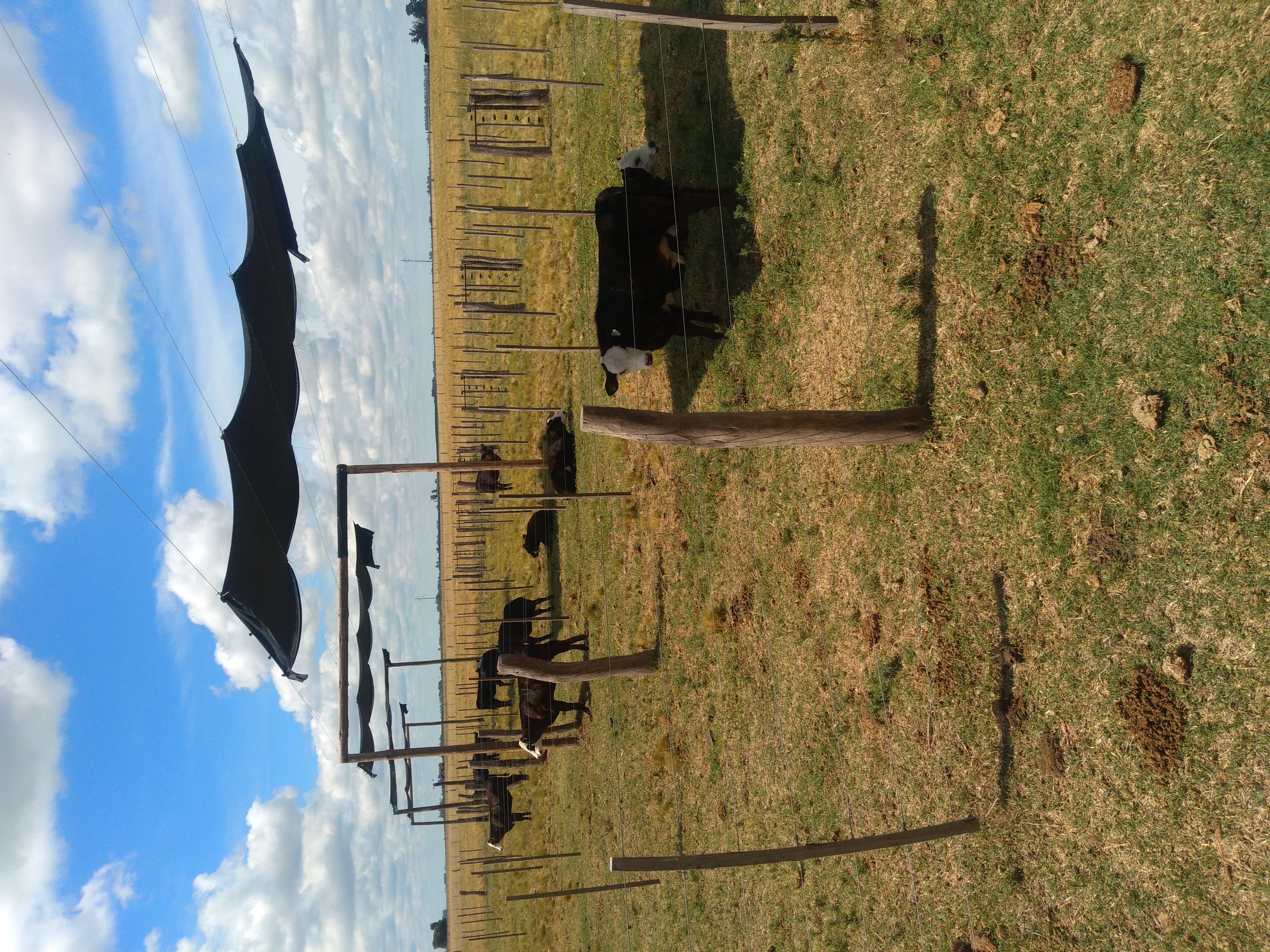
The objective of this study was to evaluate the effect of artificial shade during summer on the physiological, metabolic, and productive parameters of British-breed calves in the Pampas region. Twenty-four calves (3-4 months of age) were allocated to 12 pens for 64 days. Half of the pens were provided with artificial shade (S), whereas the remaining pens were exposed to direct sunlight (NS). Average daily gain (ADG) and feed conversion efficiency (FCE) tended to be higher in S than in NS. Respiratory rate (RR) was lower in S, whereas rectal temperature (RT) at 7:00 am tended to be 0.1 °C higher in S. At 5:00 pm, RT tended to be 0.2 °C higher on day 5 and 0.2 °C lower on day 18 in S than in NS. During the first heat wave (days 8-14 of the experiment), calves in both groups exhibited decreased serum concentrations of glucose, cholesterol and urea, and increased glutamate oxaloacetate transaminase enzyme concentration. The dry matter intake (DMI) and serum concentrations of the evaluated metabolites were not affected by shade. In conclusion, providing artificial shade to early weaned calves increased ADG and FCE and decreased RR without affecting DMI or metabolic profile evaluated, while its effects on RT were low and physiologically irrelevant.
References
1. IPCC, 2021: Summary for Policymakers. En: Climate Change 2021: The Physical Science Basis. Contribution of Working Group I to the Sixth Assessment Report of the Intergovernmental Panel on Climate Change. Masson-Delmotte V, Zhai P, Pirani A, Connors SL, Péan C, Berger S, et al., editores. Cambridge University Press, Cambridge, Reino Unido y Nueva York, NY, UU.EE, pp. 3-32. doi: 10.1017/9781009157896.001
2. Baumgard LH, Rhoads RP Jr. Effects of heat stress on post-absorptive metabolism and energetics. Annu Rev Anim Biosci. 2013; 1:311-337. DOI: 10.1146/annurev-animal-031412-103644
3. Bernabucci N. Climate change: impact on livestock and how can we adapt. Anim Front. 2019; 9(1):3-5. doi: http://10.1093/af/vfy039
4. Summer A, Lora I, Formaggioni P, Gottardo F. Impact of heat stress on milk and meat production. Anim Front. 2019; 9(1):39-46. doi: 10.1093/af/vfy039.
5. Lacetera N. Impact of climate change on animal health and welfare. Anim Front. 2019; 9(1):26-31. doi: http://10.1093/af/vfy039.
6. Cartwright, S.L.; Schmied, J.; Karrow, N.; Mallard, B.A. 2023. Impact of heat stress on dairy cattle and selection strategies for thermotolerance: a review. Front. Vet. Sci., 10:1198697. doi: http://10.3389/fvets.2023.1198697
7. Blond B, Majkić M, Spasojević J, Hristov S, Radinović M, Nikolić S, Anđušić L, Čukić A, Došenović Marinković M, Vujanović BD, Obradović N, Cincović M. Influence of heat stress on body surface temperature and blood metabolic, endocrine, and inflammatory parameters and their correlation in cows. Metabolites. 2024; 14(2): 104. doi: http://10.3390/metabo14020104.
8. Kim WS, Lee JS, Jeon SW, Peng DQ, Kim YS, Bae MH, et al. Correlation between blood, physiological and behavioral parameters in beef calves under heat stress. Asian-Australas J Anim Sci. 2018; 31(6):919-925. doi: http://10.5713/ajas.17.0545.
9. Johnson JS, Abuajamieh M, Sanz Fernandez MV, Seibert JT, Stoakes SK, Nteeba J, et al. Thermal stress alters postabsorptive metabolism during pre- and postnatal development. En: Sejian V, Gaughan J, Baumgard L, Prasad C, editores. Climate Change Impact on Livestock: Adaptation and Mitigation. Nueva Delhi: Springer India; 2015. p. 61-79.
10. Kvidera SK, Horst EA, Abuajamieh M, Mayorga EJ, Sanz Fernandez MV, Baumgard LH. Glucose requirements of an activated immune system in lactating Holstein cows. J Dairy Sci. 2017; 100(3):2360-2374. doi: http://10.3168/jds.2016-12001.
11. Edwards-Callaway LN, Cramer MC, Cadaret CN, Bigler EJ, Engle TE, Wagner JJ, Clark DL. Impacts of shade on cattle well-being in the beef supply chain. J Anim Sci. 2021; 99(2):1-21. doi: http://10.1093/jas/skaa375.
12. Collier RJ, Baumgard LH, Zimbelman RB, Xiao Y. Heat stress: physiology of acclimation and adaptation. Anim Front. 2019; 9(1):12-19. doi: http://10.1093/af/vfy031.
13. Bernabucci U, Lacetera N, Baumgard LH, Rhoads RP, Ronchi B, Nardone A. Metabolic and hormonal acclimation to heat stress in domesticated ruminants. Animal. 2010; 4(7):1167-1183. doi: http://10.1017/S175173111000090X.
14. EFSA Panel on Animal Health and Welfare (AHAW). Scientific opinion on the welfare of cattle kept for beef production and the welfare in intensive calf farming systems. EFSA J. 2012; 10(5):2669. 166 p. doi: http://10.2903/j.efsa.2012.2669.
15. Servicio Meteorológico Nacional. Estadísticas climatológicas de General Pico [Internet]. Buenos Aires: SMN; 2026 [Consultado 20 junio 2026]. Disponible en: https://www.smn.gob.ar
16. Clarke MR, Kelly AM. Some effects of shade on Hereford steers in a feedlot. Proc. Aust. Soc. Anim. Prod. 1996; 21:235-238. Disponible en línea: http://www.asap.asn.au/livestocklibrary/1996/Clarke96.PDF
17. Mader TL, Dahlquist JM, Hahn GL, Gaughan JB. Shade and wind barrier effects on summertime feedlot cattle performance. J Anim Sci. 1999; 77(8):2065-2072. doi: http://10.2527/1999.7782065x.
18. Mitlöhner FM, Morrow JL, Dailey JW, Wilson SC, Galyean ML, Miller MF, McGlone JJ. Shade and water misting effects on behavior, physiology, performance, and carcass traits of heat-stressed feedlot cattle. J Anim Sci. 2001; 79(9):2327-2335. doi: http://10.2527/2001.7992327x.
19. Mitlöhner FM, Galyean ML, McGlone JJ. Shade effects on performance, carcass traits, physiology, and behavior of heat-stressed feedlot heifers. J Anim Sci. 2002; 80(8):2043-2050. doi: http://10.2527/2002.8082043x.
20. Gaughan JB, Tait LA, Eigenberg R, Bryden WL. Effect of shade on respiration rate and rectal temperature of Angus heifers. Anim Prod Aust. 2004; 25:69-72.
21. Gaughan JB, Bonner S, Loxton I, Mader TL, Lisle A, Lawrence R. Effect of shade on body temperature and performance of feedlot steers. J Anim Sci. 2010; 88(12):4056-4067. doi: http://10.2527/jas.2010-2987.
22. Davies P, Méndez D, Pighin D. Efecto de la disponibilidad de sombra en verano sobre la ganancia de peso de novillos en engorde a corral en el noroeste bonaerense. General Villegas (Buenos Aires): Instituto Nacional de Tecnología Agropecuaria (INTA). Memoria Técnica 2011 – 2012:180-182.
23. Boyd BM, Shackelford SD, Hales KE, Brown-Brandl TM, Bremer ML, Spangler ML, Wheeler TL, King DA, Erickson GE. Effects of shade and feeding zilpaterol hydrochloride to finishing steers on performance, carcass quality, heat stress, mobility, and body temperature. J Anim Sci. 2015; 93(12):5801-5811. doi: http://10.2527/jas.2015-9613.
24. Clariget JM, Banchero G, Aznárez V, Perez E, Roig G, Luzardo S, Fernandez E, La Manna A. Mitigación del estrés calórico en novillos terminados a corral. RAPA. 2018; 38(1):1-13.
25. Mejia Turcios SE, Rotz CA, McGlone J, Rivera CR, Mitloehner FM. Effects of heat stress mitigation strategies on feedlot cattle performance, environmental, and economic outcomes in a hot climate. Animal. 2024; 18(11):101257. doi: http://10.1016/j.animal.2024.101257.
26. Sullivan ML, Cawdell-Smith AJ, Mader TL, Gaughan JB. Effect of shade area on performance and welfare of short-fed feedlot cattle. J Anim Sci. 2011; 89(9):2911-2925. doi: http://10.2527/jas.2010-3152.
27. Beede DK, Collier RJ. Potential nutritional strategies for intensively managed cattle during thermal stress. J Anim Sci. 1986; 62(2):543-554. doi: http://10.2527/jas1986.622543x.
28. Roland L, Drillich M, Klein-Jöbstl D, Iwersen M. Influence of climatic conditions on the development, performance, and health of calves. J Dairy Sci. 2016; 99(4):2438-2452. doi: http://10.3168/jds.2015-9901.
29. Thom EC. The discomfort index. Weatherwise. 1959; 12(2):57-59. doi: http://10.1080/00431672.1959.9926960.
30. R Core Team. R: A language and environment for statistical computing. Vienna: R Foundation for Statistical Computing; 2025. Disponible en: https://www.r-project.org/
31. American Humane. American Humane Certified Animal Welfare Standards for Beef Cattle [Internet]. 2017 [Consultado 23 junio 2026]. Disponible en: https://www.americanhumane.org/wp-content/uploads/2025/02/AHS-Beef-Cattle-Standards-2025.pdf
32. Certified Humane. Humane farm animal care – Welfare standards – Beef Cattle [Internet]. 2025 [Consultado 23 junio 2026]. Disponible en: https://certifiedhumane.org/wp-content/uploads/Standard_BeefCattle_Nov-2025-Edition-23.pdf
33. Hagenmaier JA, Reinhardt CD, Bartle SJ, Thomson DU. Effect of shade on animal welfare, growth performance, and carcass characteristics in large pens of beef cattle fed a beta agonist in a commercial feedlot. J Anim Sci. 2016; 94(12):5064-5076. doi: http://10.2527/jas2016-0935.
34. Brown-Brandl TM, Eigenberg RA, Nienaber JA, Hahn GL. Dynamic response indicators of heat stress in shaded and non-shaded feedlot cattle, part 1: Analyses of Indicators. Biosystems Engineering. 2005; 90(4):451-462. doi: http://10.1016/j.biosystemseng.2004.12.006.
35. Blaine KL, Nsahlai IV. The effects of shade on performance, carcass classes and behavior of heat-stresses feedlot cattle at the finisher phase. Trop Anim Health Prod. 2011; 43(3):609-615. doi: http://10.1007/s11250-010-9740-x
36. Collier RJ, Gebremedhin KG. Thermal Biology of Domestic Animals. Annu Rev Anim Biosci. 2015; 3:513-532. doi: http://10.1146/annurev-animal-022114-110659.
37. Kovács L, Kézér FL, Ruff F, Jurkovich V, Szenci O. Correction: Assessment of heat stress in 7-week old dairy calves with non-invasive physiological parameters in different thermal environments. PLoS One. 2018; 13(11):e0208528. doi: http://10.1371/journal.pone.0208528.
38. Nazifi S, Saeb M, Rowghani E, Kaveh K. The influences of thermal stress on serum biochemical parameters of Iranian fat-tailed sheep and their correlation with triiodothyronine (T3), thyroxine (T4) and cortisol concentrations. Comp Clin Pathol. 2003; 12(3):135-139. doi: http://10.1007/s00580-003-0487-x.
39. Singh SP, Hooda OK, Kundu SS, Singh S. Biochemical changes in heat exposed buffalo heifers supplemented with yeast. Trop Anim Health Prod. 2012; 44(6):1383-1387. doi: http://10.1007/s11250-012-0075-7.
40. Hooda OK, Upadhyay RC. Physiological responses, growth rate and blood metabolites under feed restriction and thermal exposure in kids. J Stress Physiol Biochem. 2014; 10(2):214-227.
41. Fang W, Wen X, Meng Q, Liu L, Xie J, Zhang H, Everaert N. Running head: Heat affects cholesterol and bile acid alterations in cholesterol and bile acids metabolism in Large White pigs during short-term heat exposure. Animals (Basel). 2020; 10(2):359. doi: http://10.3390/ani10020359.
42. Pearce SC, Gabler NK, Ross JW, Escobar J, Patience JF, Rhoads RP, Baumgard LH. The effects of heat stress and plane of nutrition on metabolism in growing pigs. J Anim Sci. 2013; 91(5):2108-2118. doi: http://10.2527/jas.2012-5738.
43. Wen X, Wu W, Fang W, Tang S, Xin H, Xie J, Zhang H. Effects of long-term heat exposure on cholesterol metabolism and immune responses in growing pigs. Livest Sci. 2019; 230:103857. doi: http://10.1016/j.livsci.2019.103857.
44. Johnson JS, Sanz Fernandez MV, Gutierrez NA, Patience JF, Ross JW, Gabler NK, Lucy MC, Safranski TJ, Rhoads RP, Baumgard LH. Effects of in utero heat stress on postnatal body composition in pigs: I. Growing phase. J Anim Sci. 2015; 93(1):71-81. doi: http://10.2527/jas2014-8354.
45. Johnson JS, Sanz Fernandez MV, Patience JF, Ross JW, Gabler NK, Lucy MC, Safranski TJ, Rhoads RP, Baumgard LH. Effects of in utero heat stress on postnatal body composition in pigs: II. Finishing phase. J Anim Sci. 2015; 93(1):82-92. doi: http://10.2527/jas2014-8355.
46. Rhoads RP, Baumgard LH, Suagee JK. Metabolic priorities during heat stress with an emphasis on skeletal muscle. J Anim Sci. 2013; 91(5):2492-2503. doi: http://10.2527/jas.2012-6120.
47. Roths M, Abeyta MA, Wilson B, Rudolph TE, Hudson MB, Rhoads RP, Baumgard LH, Selsby JT. Effects of heat stress on markers of skeletal muscle proteolysis in dairy cattle. J Dairy Sci. 2023; 106(8):5825-5834. doi: http://10.3168/jds.2022-22678.
48. O'Brien MD, Rhoads RP, Sanders SR, Duff GC, Baumgard LH. Metabolic adaptations to heat stress in growing cattle. Domest Anim Endocrinol. 2010; 38(2):86-94. doi: http://10.1016/j.domaniend.2009.08.005.
Downloads
Published
Issue
Section
License
Copyright (c) 2026 Gabriel Alberto Genero, Ignacio Azaldegui, Mateo Aristi, Gustavo Martín Lascalea, María Guillermina Bilbao, Claudio Fabián Tobal, Antonio Gerena, Mónica Alejandra Boeris, Gustavo Jaurena, Guillermo Héctor Pechin

This work is licensed under a Creative Commons Attribution-NonCommercial-ShareAlike 4.0 International License.
Al momento de enviar sus contribuciones, los colaboradores deberán declarar , de manera fehaciente, que poseen el permiso del archivo o repositorio donde se obtuvieron los documentos que se anexan al trabajo, cualquiera sea su formato (manuscritos inéditos, imágenes, archivos audiovisuales, etc.), permiso que los autoriza a publicarlos y reproducirlos, liberando a la revista y sus editores de toda responsabilidad o reclamo de terceros , los autores deben adherir a la licencia Creative Commons denominada “Atribución - No Comercial CC BY-NC-SA”, mediante la cual el autor permite copiar, reproducir, distribuir, comunicar públicamente la obra y generar obras derivadas, siempre y cuando se cite y reconozca al autor original. No se permite, sin embargo, utilizar la obra con fines comerciales.
How to Cite