
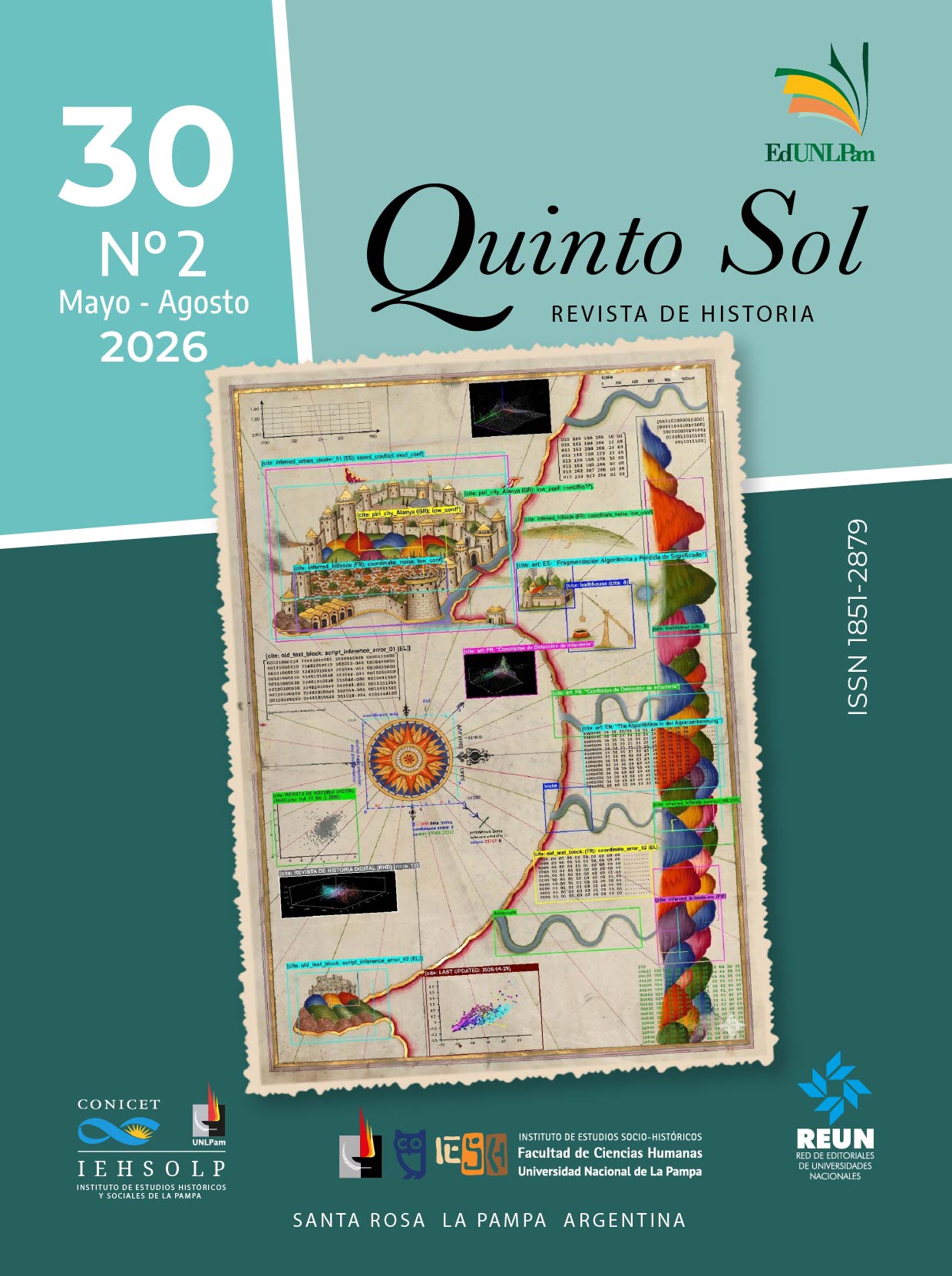
Revisualizando la historia: hacia una nueva mirada de la invasión española de los Andes (1530s)
DOI:
https://doi.org/10.19137/qs.v30i2.9730Keywords:
historia colonial, mapas, visualizaciones, cartografiaAbstract
En este artículo discutiré de qué modo se pueden responder estas preguntas: ¿cómo visualizar patrones incrustados en textos históricos?, ¿cómo mapear textos y observar narrativas? y ¿por qué hacerlo? Para ello, incorporé mapas digitales, visualización cualitativa y una lectura atenta de los textos históricos. Las visualizaciones cualitativas, humanistas y narrativas pueden complementar esfuerzos etnohistóricos para recuperar el conocimiento del pasado indígena en la época colonial. En particular, describiré los métodos que he adaptado de varias disciplinas —incluida la cartografía experimental y narrativa, la geografía literaria y la ciencia de datos— para re-imaginar la invasión española al imperio de los incas (década de 1530). Estos procedimientos permiten visibilizar los silencios de los textos y demostrar lo que escondían los autores coloniales. Por ejemplo, la importancia de los aliados andinos y la diplomacia para la conquista del Perú, también cómo escribieron narraciones de dominación desde centros de poder colonial rodeados de un vasto territorio andino fuera de su control. Asimismo, se pueden ver y mapear los itinerarios y viajes de los ejércitos, de las embajadas, los mensajeros o chaskis, y los espías nativos. El reconocimiento de esas actividades pone en el centro a los andinos en relatos dominados frecuentemente por los españoles y unas pocas élites indígenas.
References
Andrews, R. J. (2017a). Map of Firsts: An Interactive Timeline of the most Iconic Infographics. Info We Trust. https://history.infowetrust.com/
Andrews, R. J. (2017b). Interacting with History: 300 Years of Information Graphic Milestones. Info We Trust. https://infowetrust.com/project/history
Ayuntamiento de Xauxa. (1884). Carta a Su Magestad del Ayuntamiento de Xauxa, con varias notycias de gobierno e fazienda e dando las gracias por las mercedes que le a concedido. In L. Torres de Mendoza et al. (Eds.), Colección de documentos inéditos, relativos al descubrimiento, conquista y organización de las antiguas posesiones españolas de América y Oceanía (Volumen 42, pp. 114–131). Imprenta de Manuel G. Hernández.
Brown, V. (2015). Mapping a Slave Revolt: Visualizing Spatial History through the Archives of Slavery. Social Text, 33(4 (125)), 134–141. https://doi.org/10.1215/01642472-3315826
Cahill, D. (2003). The Long Conquest: Collaboration by Native Andean Elites in the Colonial System, 1513-1825. In G. Raudzens (Ed.), Technology, disease, and colonial conquests, sixteenth to eighteenth centuries: Essays reappraising the guns and germs theories (pp. 85-126). Brill.
Cairo, A. (2016). The Truthful Art: Data, Charts, and Maps for Communication. New Riders.
Cairo, A. (2020). How Charts Lie: Getting Smarter about Visual Information. W. W. Norton & Company.
Capello, E. (2020). Mapping Mountains. Brill Research Perspectives in Map History, 2(1), 1–84. https://doi.org/10.1163/25893963-12340003
Covey, A. (2020). Inca Apocalypse: The Spanish Conquest and the Transformation of the Andean World. Oxford University Press.
Cúneo-Vidal, R. (1926). História de las guerras de los últimos Incas peruanos contra el poder español. Maucci.
D’Ignazio, C. & Klein, L. F. (2020). Data feminism. MIT Press.
Drucker, J. (2020). Visualization and Interpretation: Humanistic Approaches to Display. MIT Press.
Dumett, R. (2018). El espía del inca. Lluvia.
Eltis, D. & Richardson, D. (2015). Atlas of the transatlantic slave trade. Yale University Press.
Ereira, A. (2019). The Nine Lives of John Ogilby: Britain’s Master Map Maker and His Secrets. Duckworth Books.
Espinoza Soriano, W. (1967). Los señoríos étnicos de Chachapoyas y la alianza hispano-chacha. Revista Histórica, 30, 224–333.
Espinoza Soriano, W. (1972). Los Huancas, aliados de la Conquista: Tres informaciones inéditas sobre la participación indígena en la conquista del Perú, 1558-1560-1561. Universidad Nacional del Centro del Perú.
Finley, D. & Tufte, V. (n.d.). Minard’s figurative map of Hannibal’s war. Retrieved March 9, 2023, from https://www.edwardtufte.com/tufte/minard-hannibal
Franzosi, R. (2017). A third road to the past? Historical scholarship in the age of big data. Historical Methods: A Journal of Quantitative and Interdisciplinary History, 50(4), 227-244. https://doi.org/10.1080/01615440.2017.1361879
Fuentes, M. J. (2018). Dispossessed Lives: Enslaved Women, Violence, and the Archive. University of Pennsylvania Press.
Gigliotti, S., Masurovsky, M. J. & Steiner, E. B. (2014). From the Camp to the Road: Representing the Evacuations from Auschwitz, January 1945. In A. K. Knowles, T. Cole & A. Giordano (Eds.), Geographies of the Holocaust (pp. 192-212). Indiana University Press.
Guillén Guillén, E. (1974). Versión inca de la conquista. Milla Batres.
Guillén Guillén, E. (1994). La guerra de reconquista Inka: Historia épica de como los incas lucharon en defensa de la soberanía del Perú o Tawantinsuyo entre 1536 y 1572. R. A. Ediciones.
Guillén Guillén, E. (2005). Los incas y el inicio de la guerra de reconquista. Volumen 2. Universidad Alas Peruanas.
Guilmartin Jr., J. F. (1991). The cutting edge: An analysis of the Spanish invasion and overthrow of the Inca empire. In Kenneth J. Andrien & R. Adorno (Eds.), Transatlantic encounters: Europeans and Andeans in the sixteenth century (pp. 40-69). University of California Press.
Haynes, C. (2010). Lost Illusions: The Politics of Publishing in Nineteenth-Century France. Harvard University Press.
Hemming, J. (1970). The Conquest of the Incas. Harcourt Brace Jovanovich.
Himmerich & Valencia, R. (1998). The 1536 Siege of Cuzco: An Analysis of Inca and Spanish Warfare. Colonial Latin American Historical Review, 7(4), 387–418. https://digitalrepository.unm.edu/cgi/viewcontent.cgi?article=1295&context=clahr
Humboldt, A. von. (1811). Atlas géographique et physique du royaume de la Nouvelle-Espagne. F. Schoell.
Klein, L. F. (2013). The Image of Absence: Archival Silence, Data Visualization, and James Hemings. American Literature, 85(4), 661–688. https://doi.org/10.1215/00029831-2367310
Knowles, A. K., Cole, T., & Giordano, A. (2014). Geographies of the Holocaust. Indiana University Press.
Lorandi, A. M. (2005). Spanish king of the Incas: The epic life of Pedro Bohorques. University of Pittsburgh Press.
Lupi, G. & Posavec, S. (2016). Dear data. Princeton Architectural Press.
Mainardi, P. (2017). Another World: Nineteenth-Century Illustrated Print Culture. Yale University Press. https://doi.org/10.12987/9780300223781
Mikecz, J. (2017). Mapping Conquest: A Spatial History of Indigenous Peru during the Spanish Invasion (ca. 1528-1537) [Dissertation]. University of California, Davis.
Mikecz, J. (2024a). At the Edge of the Map: The Andean World during the Spanish Invasion (1528-37) [Unpublished manuscript]. Cambridge University Press.
Mikecz, J. (2024b). Shadowy Figures: Visualizing Marginalized Historical Actors, Events, and Places (for the Spanish Invasion of the Andes and Beyond) [Unpublished manuscript]. William and Mary Quarterly.
Moretti, F. (1998). Atlas of the European novel, 1800-1900. Verso.
Murúa, M. de. (1987). Historia general del Perú. M. Ballesteros Gaibrois (Ed.), Historia 16.
Naeem, A. (2018). Black Out: Silhouettes Then and Now. Princeton University Press.
Nir, A. (2015). The “Military Miracles” in the 1536 Siege of Cuzco. In R. Adorno & I. Boserup (Eds.), Unlocking the Doors to the Worlds of Guaman Poma and His Nueva corónica (pp. 269-290). Museum Tusculanum Press.
Pearce, M. W. & Hermann, M. J. (2010). Mapping champlain’s travels: Restorative techniques for historical cartography. Cartographica: The International Journal for Geographic Information and Geovisualization, 45(1), 32-46. https://doi.org/10.3138/carto.45.1.32
Pizarro, P. (2013). Relación del descubrimiento y conquista de los reinos del Perú. Fondo de Cultura Económica. (Original published in 1571)
Prescott, W. H. (1847). Conquest of Peru. Book League of America.
Prevas, J. (2009). Hannibal Crosses the Alps: The Invasion of Italy and the Punic Wars. Da Capo Press.
Rostworowski de Diez Canseco, M. (1981). Dos Probanzas de Don Gonzalo, Curaca de Lima (1555-1559). Revista histórica, 33, 105-173.
Rostworowski de Diez Canseco, M. (1999). Historia del Tahuantinsuyu. Instituto de Estudios Peruanos.
Sancho, P. (1917). Relación de lo sucedido en la conquista del Perú. In H. Urteaga & C. A. Romero (Eds.), Las relaciones de la conquista del Perú (pp. 124-202). Imprenta y librería San Marti y Ca. (Original published in 1534)
Townsend, C. (2019). Fifth Sun: A New History of the Aztecs (Illustrated edition). Oxford University Press.
Trouillot, M. R. (1995). Silencing the past: Power and the production of history. Beacon Press.
Tufte, E. R. (2007). The visual display of quantitative information (2nd ed.). Graphics Press.
Vega, J. J. (1992). Los incas frente a España: Las guerras de la resistencia, 1531-1544. Peisa.
Vicuña Guengerich, S. (2015). Capac Women and the Politics of Marriage in Early Colonial Peru. Colonial Latin American Review, 24(2), 147-167. https://doi.org/10.1080/10609164.2015.1040275
Zimmerer, K. S. (2011). Mapping Mountains. In J. Dym & K. Offen (Eds.), Mapping Latin America: A cartographic reader (pp. 125-130). The University of Chicago Press.
Downloads
Published
Issue
Section
License
Copyright (c) 2026 Quinto Sol

This work is licensed under a Creative Commons Attribution-NonCommercial-ShareAlike 4.0 International License.
When submitting their contributions, authors must declare that they have the permission of the file or repository where the documents that are attached to the work were obtained, whatever their format (unpublished manuscripts, images, audiovisual files, etc.). Such permission authorizes their publication and reproduction, releasing the journal and its editors from any liability or claim from third parties.
Likewise, authors must adhere to the Creative Commons license called "Attribution - Non-Commercial CC BY-NC-SA", through which the author allows copying, reproducing, distributing, publicly communicating the work and generating derivative works, as long as the original author is properly quoted and acknowledged. It is not allowed, however, to use the work for commercial purposes. Authors may establish additional agreements for the non-exclusive distribution of the version of the paper published in the journal (for example, placing it in an institutional repository or publishing it in a book), with the acknowledgment of having been published first in this journal.
The publication of content in this journal does not imply any royalty or charge for taxpayers.
Quinto Sol adheres to the DORA (Declaration on Research Assessment) signed in San Francisco, California, on December 16, 2012, and to the Declaration of Mexico (Joint Declaration LATINDEX - REDALYC - CLACSO - IBICT).
How to Cite






4.png)